
Industry Insights
September 23, 2026
8 Best Production-Ready Robotics Dataset Providers for Embodied AI [2026]
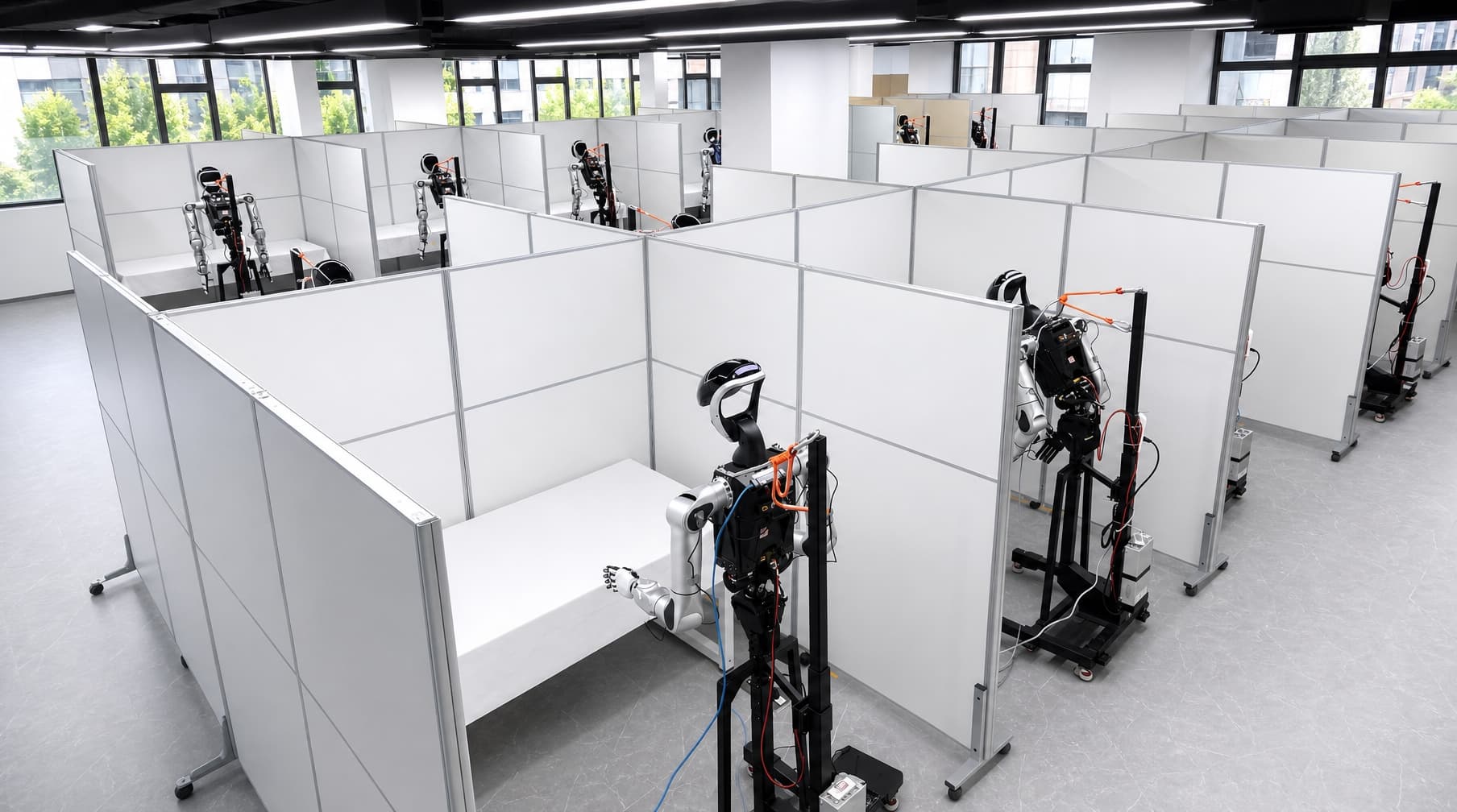
As embodied AI moves from research labs into real-world deployment, robotics teams are facing a data problem that is very different from traditional computer vision.
A robot does not simply need more images or more video. It needs data that connects perception with action: what the robot sees, how objects move, what the operator does, how the environment changes, and whether the action actually succeeds.
That is why a production-ready embodied AI dataset needs to go beyond raw video. It should be diverse, multimodal, well-structured, accurately annotated, and compatible with the training pipeline used for real robots.
For teams developing humanoids, robotic arms, autonomous systems, and other Physical AI applications, the question is no longer just where to find robotics data. The more important question is whether the dataset is ready to support production-scale model training and validation.
What Is a Production-Ready Embodied AI Dataset?
A production-ready embodied AI dataset is a robotics dataset designed to support the development, fine-tuning, evaluation, and deployment of models that interact with the physical world.
Depending on the use case, it can include:
- Egocentric and third-person video
- Robot and human demonstrations
- Teleoperation trajectories
- RGB and RGB-D imagery
- 3D point clouds and spatial data
- Robot state and proprioceptive information
- Hand and body pose
- Object and action annotations
- Multimodal sensor data
- Success, failure, and recovery sequences
- Simulation and real-world data
The critical difference is the relationship between the data modalities.
For example, a video showing a person picking up a cup is useful for visual learning. But a production training dataset may need to show the camera viewpoint, hand position, object position, temporal action sequence, and interaction outcome together.
This alignment allows models to learn not only what the world looks like, but also what actions should happen next.
Why Production Robotics Data Is Difficult to Build
Traditional AI datasets can often be collected from existing digital sources. Robotics data has a much stronger connection to the physical world.
A useful robot training episode may require a specific robot, environment, camera configuration, operator, task, and sensor setup. These elements also need to remain synchronized.
Three challenges are particularly important.
Perception and action need to be connected
Embodied AI models increasingly learn from vision-language-action data and other multimodal training signals. A dataset therefore needs more than static images.
The model needs to understand the relationship between:
observation → decision → action → outcome
This is particularly important for manipulation, navigation, tool use, and long-horizon tasks.
Real-world diversity matters
A robot trained on a narrow collection of successful demonstrations can struggle when conditions change.
Production datasets should therefore cover variations in:
- Objects and object properties
- Lighting and environments
- Human operators
- Camera viewpoints
- Task execution
- Object placement
- Successful and failed interactions
- Recovery behaviors
- Edge cases
Diversity is not simply about collecting more hours. The objective is to increase the range of situations that the model can learn to handle.
Data quality becomes a model-quality problem
Sensor synchronization, inaccurate labels, incomplete episodes, inconsistent coordinate systems, and missing metadata can all reduce the usefulness of a robotics dataset.
For multimodal embodied AI, quality assurance therefore needs to happen throughout the pipeline rather than only after collection.
What to Look for in a Production-Ready Robotics Dataset
Before choosing a dataset provider, robotics teams should evaluate several practical criteria.
Multimodal coverage
Does the provider offer only RGB video, or can it collect and process depth, pose, sensor, robot-state, and other modalities?
Robot and camera compatibility
The camera viewpoint used during training should be relevant to the robot's deployment configuration. A dataset captured from a human head-mounted camera may not directly represent what a wrist-mounted robot camera sees.
Annotation depth
Look beyond simple image labels. Depending on the application, useful annotations can include temporal action segments, object states, hand pose, keypoints, trajectories, and interaction events.
Scenario diversity
A production dataset should include different environments, objects, operators, task variations, and edge cases rather than repeatedly capturing the same successful behavior.
Data quality and synchronization
For multimodal robotics data, timestamps, coordinate systems, sensor alignment, and episode completeness need to be validated.
Scalability
A dataset provider should be able to support an initial pilot as well as larger production requirements. Collection methodology, QA processes, and delivery infrastructure all become important as volume increases.
Licensing and data governance
Commercial AI development requires clear rights to use the data. Privacy, consent, data storage, and access controls should also be considered before large-scale collection begins.
Best Production-Ready Embodied AI Dataset Providers
The market includes several different types of providers. Some focus on full-stack robotics data infrastructure, while others specialize in egocentric collection, annotation, or large-scale data programs.
Here are several providers worth evaluating based on their publicly described capabilities.
BodenAI
Key features:
- Data infrastructure for Physical AI and robotics
- Data collection, curation, annotation, and management
- Robotics and embodied AI datasets
- Custom data collection and dataset development
- Multimodal data for robot training
- Support for different robotics and Physical AI use cases
BodenAI is a data infrastructure provider focused on Physical AI, robotics, and other AI applications. Its services cover different stages of the data lifecycle, including data collection, curation, annotation, and management. For embodied AI applications, BODEN AI provides robotics datasets as well as custom data solutions for training and developing physical AI systems.
Best for: Robotics and Physical AI teams looking for datasets or custom data infrastructure for model development.
Encord
Key features:
- Teleoperation data collection
- Egocentric and first-person data
- RGB, depth, LiDAR, proprioception, and force/torque data
- Data collection in controlled and real-world environments
- Data synchronization and quality control
- Annotation and data curation workflows
Encord is an AI data platform that provides data collection, curation, annotation, and evaluation services. Its robotics data collection offering includes teleoperation and egocentric data, as well as multimodal sensor data.
Best for: Robotics teams that need multimodal data collection combined with annotation and data management.
Scale AI
Key features:
- Data collection and annotation
- Human-in-the-loop data workflows
- Computer vision and multimodal data
- Robotics and autonomous systems applications
- Large-scale data operations
- Data quality management
Scale AI provides data infrastructure and data services for AI model development. Its services include data collection, annotation, evaluation, and model-related workflows across areas such as computer vision, autonomous vehicles, and robotics.
Best for: Organizations with large-scale data collection, annotation, and AI development requirements.
Appen
Key features:
- Image and video data collection
- Multimodal data services
- Data annotation
- Human-in-the-loop workflows
- Large distributed workforce
- Support for enterprise AI projects
Appen is a data services company providing data collection, annotation, and model evaluation services. Its data operations cover areas including computer vision, speech, text, and multimodal AI. The company works with a distributed global workforce to collect and annotate data for AI development.
Best for: AI teams that require large-scale data collection and annotation across multiple data types.
MatchPoint Studio
Key features:
- Custom robotics data collection
- RGB and RGB-D data
- Human-robot interaction data
- Controlled data collection environments
- Task-specific datasets
- Custom collection programs
MatchPoint Studio provides data collection services for robotics and computer vision applications. Its services focus on collecting task-specific physical-world data in controlled environments, including RGB and RGB-D data and human-robot interaction scenarios.
Best for: Robotics teams that need custom datasets for specific tasks or environments.
iMerit
Key features:
- Data collection and annotation
- Computer vision datasets
- Human-in-the-loop workflows
- Quality assurance
- Domain-specific data services
- Support for robotics and autonomous systems
iMerit provides data services for AI and machine learning applications, including data collection, annotation, and model evaluation. Its work covers computer vision, autonomous systems, and other AI applications that require structured and labeled training data.
Best for: Organizations that need data annotation, quality assurance, and data preparation for computer vision and robotics applications.
Mecka AI
Key features:
- Egocentric video collection
- First-person human activity data
- Human demonstrations of physical tasks
- Data for humanoid robotics
- Everyday task scenarios
- Robotics-focused data collection
Mecka AI focuses on collecting egocentric data for robotics and embodied AI. Its approach uses first-person recordings of people performing physical tasks to capture how actions are performed from the human point of view.
Best for: Robotics teams looking for egocentric human activity data for humanoid and embodied AI applications.
Unidata
Key features:
- Egocentric video
- Stereo and depth data
- Hand tracking
- 6DoF pose data
- Full-body skeleton data
- Custom data collection
- Scenario-specific robotics datasets
Unidata provides egocentric and multimodal data for robotics and embodied AI. Its publicly described data collection methods combine first-person video with additional information such as depth, hand tracking, 6DoF pose, and body-skeleton data.
Best for: Robotics teams that require multimodal egocentric data for manipulation, imitation learning, and embodied AI development.
Production-Ready vs. Research-Ready: What's the Difference?
A public robotics dataset can be extremely useful without being production-ready.
Open datasets such as Open X-Embodiment, DROID, BridgeData V2, Ego4D, and other academic datasets are valuable for research, benchmarking, and early-stage model development. However, they may not match a company's specific robot, camera configuration, environment, task distribution, or commercial licensing requirements.
A production-ready dataset needs to close that gap.
For example, a robotics company developing a household humanoid may need data covering kitchen manipulation, object retrieval, drawer opening, cleaning, tool use, and recovery from failed interactions. The data also needs to reflect the robot's actual sensing configuration.
This is why many teams use a combination of public datasets and custom data collection:
public data for pretraining and benchmarking + custom data for robot-specific fine-tuning and validation
How to Build a Production-Ready Embodied AI Data Pipeline
The most effective approach is usually iterative rather than trying to build the perfect dataset in one step.
Start by identifying the tasks the robot needs to perform and the failure cases that current models cannot handle.
Then:
- Define the required modalities and sensor configuration.
- Collect representative real-world demonstrations.
- Add difficult scenarios, edge cases, and failure-recovery sequences.
- Synchronize and validate multimodal data.
- Apply task-specific annotation and curation.
- Train or fine-tune the model.
- Evaluate failures on real hardware.
- Feed those failures back into the next data-collection cycle.
This creates a closed data loop rather than a one-time dataset purchase.
Final Thoughts
The value of an embodied AI dataset is not determined by the number of videos or hours alone. For production robotics, relevance, diversity, synchronization, annotation quality, licensing, and compatibility with the target robot matter just as much as scale.
The right data provider therefore depends on the stage and requirements of the robotics program. Some teams need large-scale collection, some need specialized egocentric data, and others need an integrated infrastructure covering collection, curation, annotation, and management.
For companies moving from robotics research toward production deployment, the key question is simple:
Can the dataset help the robot learn the behaviors it actually needs to perform in the real world?
If the answer is yes, the dataset becomes more than training data. It becomes part of the infrastructure that enables embodied AI to move from controlled experiments to reliable physical-world systems.