
Industry Insights
July 30, 2026
Applications of Physical AI & Industry Use Cases
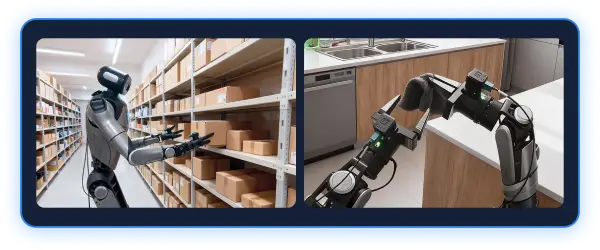
For years, artificial intelligence existed mostly in the digital realm—powering search algorithms, chatbots, and data analytics tools that operate entirely in virtual environments. Today, Physical AI is bridging digital intelligence with the tangible physical world, redefining how machines perceive, interact with, and adapt to real-world environments. As the next major wave of AI industrialization, applications of Physical AI have expanded from experimental lab prototypes to large-scale commercial deployment across manufacturing, logistics, healthcare, mobility, and public infrastructure.
Unlike traditional fixed automation that relies on pre-programmed instructions and rigid workflows, Physical AI enables robots, autonomous devices, and intelligent machines to sense environments, reason dynamically, make independent decisions, and execute adaptive actions amid unstructured, changing real-world conditions. Behind every reliable Physical AI application lies robust data infrastructure—the core foundation that powers model training, real-time iteration, and stable industrial landing.
What Is Physical AI & Why It Outperforms Traditional Automation
To better understand the value of physical AI applications, it is critical to distinguish Physical AI from conventional industrial automation and digital AI:
- Digital AI: Processes pure virtual data (text, images, audio) and outputs digital results, with no direct interaction with the physical world.
- Traditional automation: Follows fixed, pre-coded rules. It can only perform repetitive tasks in standardized scenarios and fails instantly when environments change.
- Physical AI: Integrates sensors, edge computing, robotic control, and large AI models. It learns from massive physical scene data, adapts to unstructured environments, and achieves end-to-end autonomous perception, decision-making, and execution.
The core competitiveness of Physical AI lies in its generalization capability. It no longer requires manual programming for every scenario. Instead, it iterates and optimizes continuously through real-world data, making it the key driver of flexible, intelligent industrial upgrading.
Core Applications of Physical AI Across Key Industries
In 2026, applications of physical AI have moved beyond concept verification, forming mature, revenue-generating landing scenarios in multiple high-value industries. Below are the most representative commercial use cases.
1. Smart Manufacturing & Industrial Flexibility Upgrade
Industrial scenarios are the largest and most mature application field for Physical AI. Traditional factory automation is limited by fixed production lines, struggling with frequent product updates and small-batch, customized production. Physical AI completely changes this paradigm.
AI-powered robotic arms and mobile robots realize flexible production links including intelligent material handling, precision assembly, real-time defect detection, and adaptive welding. For 3C electronics and auto parts manufacturing, Physical AI drastically simplifies production line iteration: the line changeover cycle that once took 2 hours manually can now be completed in 5 minutes via model migration and data iteration, greatly improving factory operational efficiency.
Meanwhile, AI visual inspection systems boost production quality control. Industry practices show that Physical AI-based industrial detection improves inspection efficiency and reduces human error costs. Paired with digital twin technology, it simulates material deformation and production processes in virtual space, cutting product R&D cycles.
2. Intelligent Logistics & Warehouse Autonomy
Logistics warehousing is one of the earliest large-scale landing scenarios for physical AI applications. Traditional warehouse operations rely heavily on manual sorting, handling, and inventory checking, with high labor costs and low efficiency.
Modern Physical AI-driven AMRs (Autonomous Mobile Robots) and handling robots can independently navigate complex warehouse environments, intelligently avoid obstacles (including on-site staff), and complete full-process operations such as cargo depalletizing, sorting, warehousing, and inventory counting. Leading robot solutions have realized fully unmanned whole-process warehouse operations, adapting to high-intensity work scenarios such as e-commerce peak seasons and industrial raw material turnover.
In terminal distribution, L4-level autonomous delivery vehicles powered by Physical AI have achieved normalized commercial operation in hundreds of cities, covering store replenishment, medical logistics, and community instant delivery, solving the pain points of last-mile delivery labor shortages and high costs.
3. Autonomous Mobility & Smart Transportation
Autonomous driving is the most landmark and large-scale commercial application of Physical AI. It breaks the limitations of single sensor perception and realizes multi-modal fusion perception, real-time road condition reasoning, and intelligent vehicle control.
From urban manned autonomous driving and highway trunk logistics to closed-port unmanned transportation and low-speed community distribution, Physical AI enables vehicles to adapt to complex and changing traffic scenarios, automatically avoiding obstacles, adjusting speeds, and planning optimal routes. Unlike early auxiliary driving technologies, Physical AI-based autonomous driving relies on massive real road scene data iteration, with stronger environmental adaptability and higher safety redundancy, laying the core technical foundation for future smart transportation systems.
4. Healthcare & Precision Service Scenarios
Physical AI is rapidly penetrating the healthcare industry, empowering refined medical services and reducing repetitive labor for medical staff. In hospital scenarios, AI service robots complete automatic drug delivery, ward patrol, and patient guidance, freeing up nursing resources for high-value diagnosis and care work.
In clinical diagnosis and treatment, AI-assisted surgical robots achieve micron-level precise operation through real-time perception and dynamic path adjustment, improving the accuracy and safety of minimally invasive surgery. In elderly care scenarios, humanoid Physical AI robots provide companionship, medication reminder, and daily care assistance for the elderly with cognitive impairments, making up for the shortage of elderly care labor.
Additionally, Physical AI plays a key role in pharmaceutical cleanroom manufacturing, realizing unmanned material handling and environmental monitoring in sterile spaces, effectively avoiding human contamination risks and meeting strict pharmaceutical production standards.
5. Infrastructure Inspection & Smart Public Governance
Traditional public infrastructure inspection relies on manual sampling, which is inefficient and prone to missing hidden dangers. Physical AI changes public safety management with unmanned, intelligent inspection capabilities.
AI drones and intelligent inspection robots are widely used in bridge structure detection, power grid equipment patrol, energy pipeline inspection, and urban public facility monitoring. They automatically collect physical environment data, identify structural abnormalities, equipment failures, and potential safety hazards, and form intelligent analysis reports. This full-coverage, high-frequency inspection method greatly reduces manual inspection risks and improves the refinement of urban and energy infrastructure governance.
Core Bottleneck of Physical AI Application: Data Infrastructure Gap
While applications of physical AI are booming across industries, most enterprises still face prominent bottlenecks in large-scale commercial implementation: insufficient high-quality physical scene data and imperfect data infrastructure.
Physical AI models differ fundamentally from digital large models. Their core iteration logic relies on real, diverse, high-precision physical world data—including sensor perception data, robot motion data, scene interaction data, and edge terminal real-time feedback data. At present, most enterprises lack standardized data collection, cleaning, labeling, and simulation iteration systems, resulting in insufficient model generalization, poor environmental adaptability, and high iteration costs, which restrict the large-scale landing of Physical AI scenarios.
Many Physical AI projects fail to achieve commercial replication not due to algorithm or hardware limitations, but due to the lack of a complete data closed loop: no continuous, high-quality physical data support means no stable model iteration, making it impossible to adapt to complex and changeable industrial scenarios.
Physical AI Data Infrastructure: The Underlying Engine of Industrial Landing
As a professional physical AI data infrastructure service provider, we focus on solving the core data pain points of Physical AI industrialization, building a full-link data service system covering physical scene data collection, standardized labeling, virtual simulation training, data cleaning, and edge data iteration.
Our core capabilities empower all physical AI applications in various industries:
- High-quality multi-scene data accumulation: Covering manufacturing, logistics, medical, transportation, and public inspection scenarios, we accumulate massive unstructured physical scene data to support model generalization training.
- High-precision data annotation service: Adapt to robot perception, motion control, and environment recognition tasks, providing fine-grained annotation data to improve model decision accuracy.
- Virtual simulation data iteration: Build digital twin simulation scenarios, quickly generate diverse edge case data, make up for the scarcity of extreme scene data, and shorten model iteration cycles.
- Full-link data closed-loop system: Realize real-time collection, analysis, feedback, and optimization of terminal operation data, forming a continuous self-iteration mechanism for Physical AI models.
Reliable data infrastructure is the cornerstone of Physical AI from "demo effect" to "industrial scale". We help enterprises reduce AI iteration costs, improve scenario adaptability, and accelerate the commercial replication of Physical AI applications.
Future Trends of Physical AI Applications
From 2026 onwards, applications of physical AI will present three major development trends: universal generalization, full-scene autonomy, and low-cost industrialization.
With the continuous improvement of data infrastructure and algorithm capabilities, Physical AI will break industry scenario barriers. Humanoid robots will gradually land in family services and commercial scenarios; industrial flexible robots will realize full-process unmanned production; autonomous mobility will achieve full-scene public road coverage. Ultimately, Physical AI will penetrate every link of social production and life, becoming the core underlying technology of the intelligent physical world.
Final Words
Applications of Physical AI represent the next era of AI industrial innovation, turning digital intelligence into real productivity that changes physical scenarios. Behind every autonomous robot, every intelligent production line, and every unmanned service scenario, there is indispensable support from professional physical AI data infrastructure.
If you want to accelerate the landing and iteration of your Physical AI projects and solve the pain points of insufficient scene data and slow model optimization, our professional physical AI data infrastructure solutions can provide you with full-link technical support and customized services.