
Company
May 26, 2026
BodenAI’s First Self-Operated Physical AI Dojo Is Now Officially Running
As embodied AI and robotics move from demos to real-world deployment, a clear shift is underway.
For the past few years, progress has been defined by larger models and more compute. But in 2026, that narrative is changing. The next phase of advancement will not be defined by scale alone — it will be defined by data systems.
Not just how much data we collect, but what kind of data, how it is structured, and how reliably it can be turned into learning signals for real-world machines.
Here are the five data shifts that are shaping AI and robotics in 2026 — and why they matter.
At a glance
BodenAI’s first self-operated physical AI dojo is officially in operation.
Data is captured via BRIC Robo (BodenAI’s embodied data collection platform) and processed on BASE Platform (BodenAI’s labeling platform) to produce high-quality, real-environment datasets.
Phase-1 facility metrics: 7,500 hours total data, 100% capacity utilization, 95% data validity, 95% task success rate.
A real-world training ground for embodied intelligence
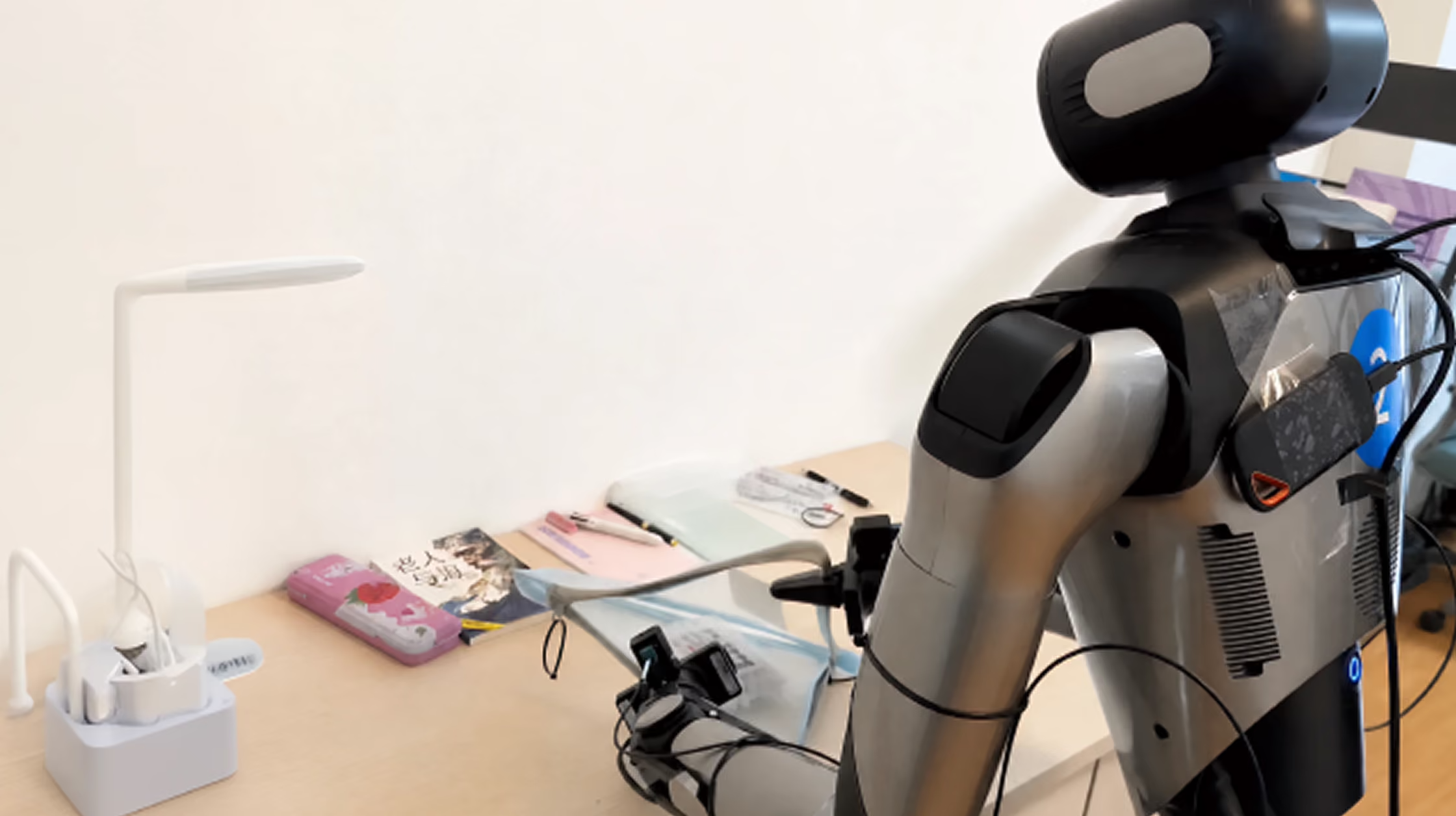
In the real-world training environments, everyday objects — sofas, table lamps, even a cup of coffee — are no longer “unstructured clutter.” They are assigned 3D semantic identities that make the scene machine-readable and training-ready.
Across multiple scenario layouts (e.g., home, industrial and supermarket), robots practice task execution in realistic workflows, building the operational experience required for Physical AI systems that must perceive, plan, and act in the real world.
From collection to dataset: BRIC Robo + BASE Platform
High-quality physical AI datasets are not defined by raw volume alone. What matters is whether real-world experience can be converted into structured and reusable training signals.
At BodenAI, data produced in the training facility is:
- Captured and Collected with BRIC Robo, BodenAI’s self-developed embodied data collection platform.
- Labeled and Processed on BASE Platform, BodenAI’s self-developed data annotation platform.
- Delivered as a high-quality dataset sourced from real environments.
This pipeline is designed to reduce friction between data collection → data annotation → dataset output, enabling faster iteration for embodied systems.
Key metrics (Phase 1)
Below are key operational and quality metrics from BodenAI’s Phase-1 Physical AI Dojo:
- Total data volume: 7,500 hours
- Capacity utilization: 100%
- Maximum capacity: 7,500 hours
- Data validity rate: 95%
- Task success rate: 95%
What’s next in 2026
In 2026, BodenAI will further strengthen the AI infrastructure buildup, centered around deployment-ready data collection and delivery.
The focus areas include Physical AI, LLMs, and Autonomous Driving, with one goal: to build the data foundation that makes frontier AI applications deployable in production.