
Industry Insights
September 18, 2026
Building Embodied Intelligence Starts With Better Egocentric Data

As Physical AI moves from controlled demonstrations toward large-scale real-world interaction, the quality of training data is becoming a fundamental constraint on embodied intelligence.
For us, one of the most important developments is the rapid expansion of egocentric data.
First-person data captures the physical world from the perspective of the person or agent performing an action. It provides information that is difficult to obtain from external cameras alone: how the environment changes relative to the actor, how hands interact with objects, how actions unfold over time, and how visual observations correspond to physical behavior.
This makes egocentric data particularly valuable for robotics, behavior cloning, human-robot interaction, AR/VR, and increasingly, Physical AI foundation models.
But scaling egocentric data introduces a critical technical bottleneck:
How accurately can we reconstruct the hand that is actually performing the interaction?
For many egocentric tasks, the answer directly affects the quality of the downstream dataset.
At BodenAI, we have been working on this problem as part of our broader egocentric data infrastructure. Our recent development of ChronoHand focuses specifically on the precision, temporal consistency, and deployment efficiency required for large-scale Ego-centric data production.
Why Hand Reconstruction Is a Critical Layer in Egocentric Embodied Intelligence
In first-person interaction data, the hand is often the most direct physical interface between the human and the environment.
A hand reaching toward an object, grasping it, rotating it, pushing it, or releasing it contains information about the underlying action.
For embodied intelligence, this information can be represented as a chain:
Visual Observation → Hand State → Object Interaction → Action → Environment Transition
If hand reconstruction is inaccurate, errors can propagate through the entire chain.
A small spatial error in a joint position can affect:
- hand-object interaction estimation;
- action segmentation;
- pose estimation;
- motion trajectory extraction;
- behavior representation;
- robot imitation learning;
- downstream embodied model training.
Temporal instability creates another problem.
A hand trajectory that is individually accurate in every frame can still be unsuitable for model training if the reconstructed motion contains excessive frame-to-frame jitter.
The model may interpret reconstruction artifacts as real physical movement.
This creates two competing requirements:
High spatial accuracy
and
high temporal consistency.
For large-scale egocentric data infrastructure, both are necessary.
The Precision-Smoothness Trade-Off in Ego Hand Reconstruction
Existing approaches to Ego hand reconstruction can broadly expose a fundamental engineering trade-off.
Single-frame inference can achieve strong per-frame localization because every frame is processed independently. However, without temporal constraints, fast movement, motion blur, occlusion, and viewpoint changes can introduce substantial frame-to-frame instability.
Temporal optimization approaches address this problem by incorporating information across multiple frames.
The resulting trajectories can become smoother, but aggressive temporal smoothing may alter the spatial position of individual joints. In other words, improving temporal consistency can come at the cost of 2D projection accuracy.
For an offline visualization system, this trade-off may be acceptable.
For an embodied AI data pipeline, it is much more problematic.
The training data needs to preserve both:
where the hand actually is
and
how the hand actually moves.
This is the design space in which we developed ChronoHand.
ChronoHand: A Temporal Hand Reconstruction Architecture for Egocentric Data
ChronoHand is designed around a simple principle:
Temporal consistency should improve hand reconstruction without sacrificing spatial precision.
Instead of treating temporal smoothing as a separate post-processing operation, ChronoHand incorporates temporal modeling directly into the reconstruction architecture.
The system combines three major ideas:
- Dual-branch decoupling
- Temporal modeling
- Closed-loop geometric optimization
Together, these components allow spatial localization, global hand reconstruction, and temporal consistency to be optimized as a unified system.
ChronoHand uses a 32-frame temporal window and follows a many-to-many streaming inference paradigm.
During deployment, inference proceeds chunk by chunk. Overlapping frames from the previous window provide temporal prior information for the next window, enabling streaming inference without requiring future frames.
The visual backbone uses ViT-H, with lightweight trainable heads built on top of the pretrained visual representation.
The architecture is designed to retain strong visual representations while keeping the downstream reconstruction pipeline practical for real-time data production.
Dual-Branch Decoupling: Separating Global Pose From Local Precision
Hand reconstruction contains two fundamentally different estimation problems.
The first is the estimation of global hand properties:
- global pose;
- hand shape;
- depth;
- screen visibility.
The second is precise localization of individual joints in image space.
These problems have different optimization characteristics.
Global pose and shape estimation operate in a structured parametric space, while 2D joint localization is fundamentally an image-plane coordinate estimation problem.
Forcing both objectives into the same feature representation can create unnecessary optimization interference.
ChronoHand therefore uses a dual-branch architecture.
Global Branch
The global branch aggregates global information through a hand token.
It estimates:
- continuous 6D rotation representation;
- MANO shape parameters;
- depth;
- on-screen probability.
This branch focuses on the global articulated state of the hand.
Local Branch
The local branch focuses on image-space joint localization.
Temporal context is injected into spatial tokens and produces a 16 × 12 spatial representation, corresponding to 192 spatial tokens.
The branch generates 21-channel joint heatmaps and applies spatial softmax to obtain sub-grid-level joint coordinates.
These heatmaps also provide joint-level visual descriptors that are subsequently used for refinement.
Mutual Cross-Attention
The two branches are not isolated.
After parallel inference, mutual cross-attention allows them to exchange information.
The global branch provides articulated hand structure to the local branch.
The local branch provides fine-grained image evidence back to the global representation.
The final joint position is then refined through a residual offset:
p_final = p_init + Δp
This separation allows global hand geometry and local image evidence to be optimized for their respective objectives while still benefiting from each other.
Temporal Modeling Without Destroying Spatial Precision
Temporal modeling is central to egocentric embodied intelligence because hand motion is inherently continuous.
But simply applying temporal attention to corresponding spatial locations can introduce another problem.
In an egocentric crop, the hand itself moves through the image.
The same spatial grid location in two consecutive frames does not necessarily correspond to the same physical point on the hand.
Applying position-wise temporal attention therefore risks creating incorrect cross-frame correspondences.
ChronoHand takes a different approach.
The original spatial tokens are first compressed through pooling into a smaller number of semantic tokens.
For a 32-frame sequence, the temporal transformer operates on:
32 × 8 = 256 tokens
rather than directly modeling every spatial location across every frame.
This allows the model to capture temporal relationships at the semantic level without assuming that identical image coordinates represent identical physical locations.
The result is a more robust temporal representation for dynamic hand motion.
Temporal Completion Under Occlusion
Occlusion is particularly challenging for egocentric hand reconstruction.
A joint may disappear from the visual observation for several frames while remaining physically continuous in the underlying motion trajectory.
ChronoHand uses temporal context to recover missing information from surrounding observations.
Detection failures are treated explicitly rather than being converted into fabricated visual observations.
This distinction is important.
A missing detection should not automatically mean that the previous frame's pixels are reused as a substitute for the current observation.
Instead, the system preserves the actual image observation while explicitly modeling its reliability.
This allows the model to distinguish between:
the hand is not reliably detected
and
the hand is genuinely outside the camera view.
That distinction becomes important when the resulting data is used downstream.
Closed-Loop Geometric Optimization
Temporal modeling alone does not guarantee geometric accuracy.
ChronoHand therefore introduces a closed-loop geometric optimization mechanism.
The first stage estimates the hand's pose and projects it into image space.
The predicted projection is then compared with the refined 2D joint observations.
This creates a geometric feedback signal.
The system can then:
Predict → Project → Compare → Correct → Reconstruct Again
This is implemented through two important components:
- a differentiable closed-form projection solver;
- GeoFeedback geometric refinement.
Differentiable Closed-Form Translation
Rather than directly predicting all translation parameters through a neural regression head, ChronoHand solves the in-plane translation using a weighted least-squares formulation.
The optimization uses:
- refined 2D joint coordinates;
- canonical MANO joints;
- camera intrinsics;
- confidence weights derived from the local branch.
The resulting solution is differentiable and can therefore participate in end-to-end training.
This creates an important structural constraint.
The network does not need to learn an unconstrained mapping for every translation parameter.
Instead, geometric relationships are explicitly enforced by the reconstruction process.
This reduces ambiguity between root pose and translation and makes the system more physically constrained.
GeoFeedback: Closing the Reconstruction Loop
After the first geometric solution, ChronoHand performs a second refinement stage through GeoFeedback.
The module uses three types of information:
- visual features sampled at the predicted projection;
- disagreement between predicted projection and refined 2D coordinates;
- relative scale and depth cues.
The feedback module predicts residual corrections for:
- pose;
- shape;
- depth.
The system then reruns the MANO forward process and the geometric solver.
This creates a closed loop:
Initial Prediction → Geometric Projection → Error Feedback → Parameter Refinement → Geometric Re-Solution
One important design constraint is that GeoFeedback does not directly predict an additional in-plane translation residual.
This preserves the geometric constraint established by the closed-form solver instead of reopening the pose-translation ambiguity through another unconstrained regression path.
Designing Temporal Smoothing Without Smoothing Away Real Motion
Temporal smoothness is valuable, but excessive smoothing can be harmful.
If a model simply minimizes the difference between consecutive predictions, it may learn to suppress genuine high-frequency motion.
That would improve a numerical smoothness metric while making the reconstructed motion physically less accurate.
ChronoHand addresses this through a parameter-level temporal smoothing head.
The module operates on the reconstructed parameter sequence and uses second-order temporal differences.
The key is that the temporal loss is aligned with the difference distribution of the ground-truth sequence rather than forcing the second derivative toward zero.
This allows the model to distinguish between:
real movement
and
high-frequency reconstruction noise.
The smoothing module is also zero-initialized.
At initialization, the system therefore behaves like the original frame-level reconstruction baseline. Temporal refinement is learned progressively during training rather than being introduced as an arbitrary initialization bias.
This design principle is applied consistently across the additional residual modules.
Real-Time Inference Matters for Physical AI Data Infrastructure
A reconstruction model can achieve strong benchmark performance and still be difficult to use in production.
For large-scale egocentric data collection, inference efficiency is part of the system design.
ChronoHand was evaluated under a 30 FPS real-time inference setup on a single A800 GPU.
This is important because egocentric data infrastructure needs to process continuous streams rather than isolated benchmark samples.
In a production environment, the reconstruction pipeline may need to operate across:
- large numbers of capture devices;
- long-duration recordings;
- diverse environments;
- multiple simultaneous data streams;
- continuously expanding datasets.
The difference between offline post-processing and real-time inference therefore becomes an infrastructure consideration rather than merely a model-performance consideration.
ChronoHand on the ARCTIC Benchmark
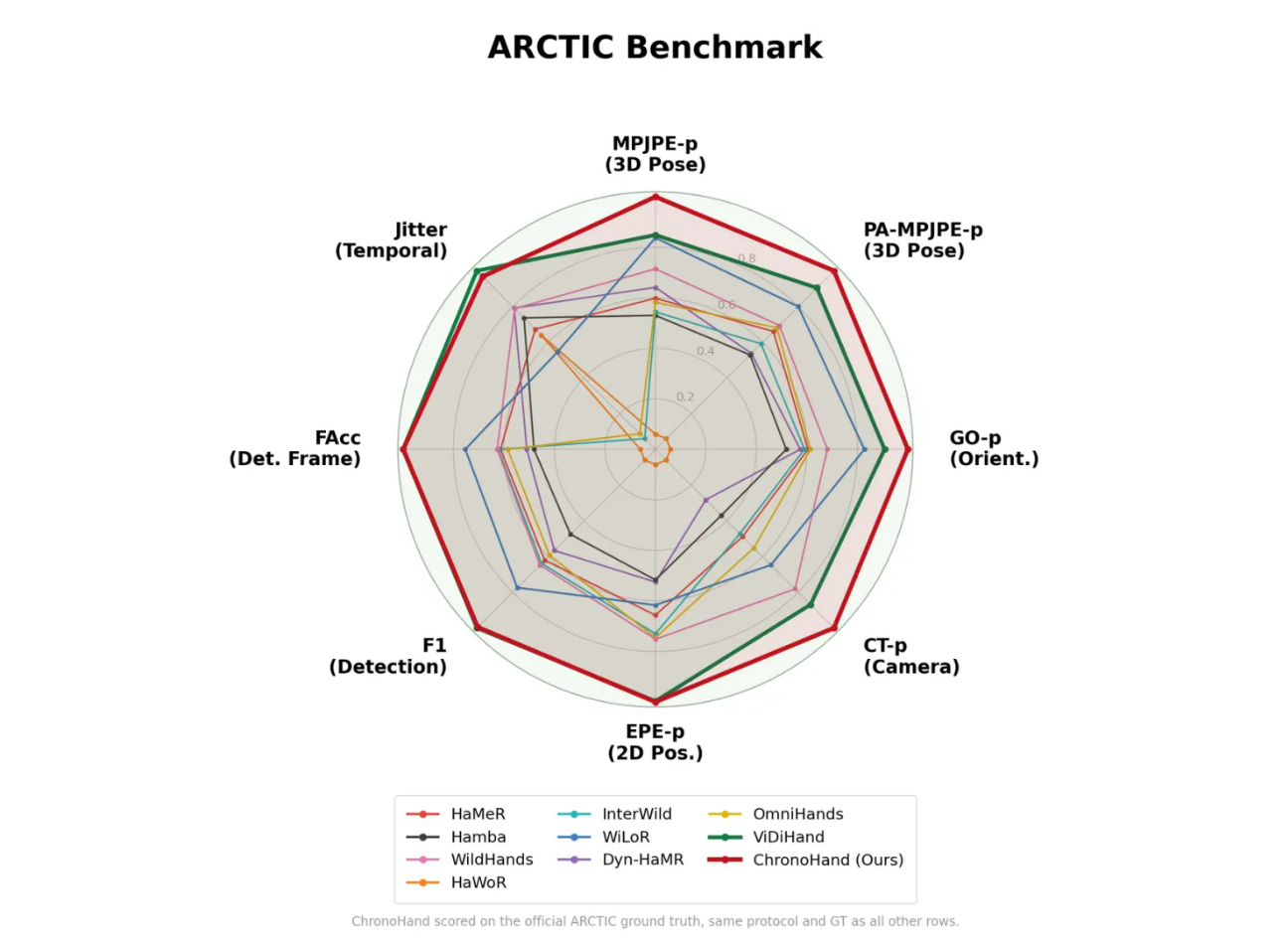
We evaluated ChronoHand on the official ARCTIC p2 validation set using a coverage-aware evaluation protocol and a real detector pipeline.
The results demonstrate the intended balance between reconstruction accuracy and temporal stability.
ChronoHand achieved the best results across five reconstruction accuracy metrics:
The corresponding reductions compared with the evaluated ViDiHand baseline were:
- MPJPE-p: 20.9% lower
- PA-p: 19.1% lower
- EPE-p: 3.9% lower
- GO-p: 21.3% lower
- CT-p: 34.0% lower
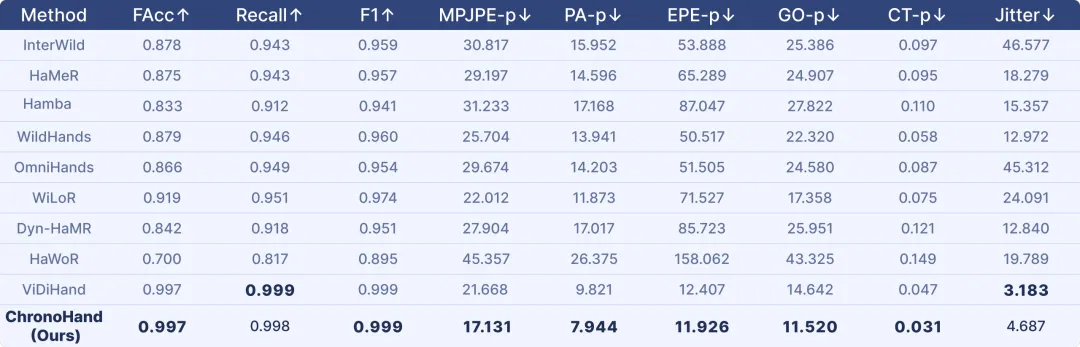
Detection performance remained extremely strong, with:
FAcc = 0.997
Recall = 0.998
F1 = 0.999
At the same time, ChronoHand achieved a Jitter score of 4.687, maintaining substantially improved temporal stability while preserving the reconstruction accuracy required for downstream data generation.
More importantly, these results were obtained under a 30 FPS real-time inference configuration on a single A800 GPU.
For us, this combination matters more than optimizing a single benchmark metric in isolation.
The practical objective is to achieve:
spatial precision + temporal consistency + real-time throughput
within one deployable pipeline.
Validating Egocentric Reconstruction Under Difficult Physical Interactions
Benchmark numbers provide one perspective.
Real-world interaction provides another.
We therefore examine ChronoHand under several challenging conditions that frequently appear in egocentric data collection.
Heavy Occlusion
When parts of the hand disappear behind objects, frame-level methods can lose critical joint information.
ChronoHand can use temporal context from surrounding frames while the global branch provides an articulated hand prior.
The geometric solver then provides an additional consistency constraint.
This creates three complementary information sources:
global hand structure + temporal context + geometric consistency
rather than relying on the visible pixels of a single frame.
Overlapping Hands
Two hands can overlap heavily during object interaction.
This creates ambiguity not only at the image level but also in temporal association.
Our data processing strategy normalizes left-hand observations into a unified right-hand coordinate representation where appropriate, reducing the amount of hand-specific information the network needs to learn.
Temporal trajectories then provide additional evidence for separating the two hands.
This is particularly useful for interaction sequences where the hands repeatedly enter and leave overlapping regions.
Fast Motion
Rapid hand movement is one of the clearest failure modes for frame-independent reconstruction.
Motion blur and viewpoint changes can cause large frame-to-frame fluctuations.
ChronoHand combines sequence-level temporal modeling with parameter-level temporal refinement.
The objective is not to eliminate motion.
It is to suppress reconstruction artifacts while preserving the underlying movement trajectory.
This distinction is essential for embodied intelligence because motion itself is part of the training signal.
From ChronoHand to Egocentric Data Infrastructure
ChronoHand is not an isolated model development effort.
It addresses a specific layer of the broader egocentric data pipeline.
At production scale, the complete workflow can be viewed as:
Ego Data Collection
↓
Sensor and Temporal Alignment
↓
Hand Reconstruction
↓
Interaction Understanding
↓
Task Segmentation
↓
Data Annotation
↓
Quality Evaluation
↓
Dataset Management
↓
Physical AI Training Data
Hand reconstruction sits near the beginning of this chain.
If the reconstruction layer introduces systematic errors, those errors can propagate into interaction labels, action trajectories, and downstream training datasets.
This is why we consider perception models such as ChronoHand part of the data infrastructure layer, rather than treating them only as standalone computer vision models.
The goal is to make every stage of the pipeline contribute to a higher-quality representation of physical interaction.
Building Egocentric Data for Embodied Intelligence
The evolution of Physical AI is creating a new requirement for data infrastructure.
We need to move beyond datasets that describe what objects look like.
We need datasets that capture:
what an agent sees,
how the agent moves,
how the agent interacts with objects,
how the environment changes,
and how those changes unfold over time.
Egocentric data provides a natural foundation for this representation.
But first-person video alone is not enough.
The data pipeline needs to transform raw observations into structured interaction information while preserving the physical relationships embedded in the original sequence.
This is why we focus on the complete data lifecycle:
Collection → Curation → Reconstruction → Annotation → Evaluation → Management
ChronoHand represents one layer of that system.
Its purpose is not simply to improve a hand reconstruction benchmark.
The larger objective is to make high-quality Ego-centric data more reliable and scalable for Physical AI, robotics, behavior learning, and embodied intelligence.
The Future of Egocentric Embodied Intelligence Is a Data Infrastructure Problem
The next generation of embodied models will require increasingly large amounts of real-world interaction data.
But scaling the volume of data alone will not solve the problem.
The quality of the underlying physical representation will become increasingly important.
For egocentric embodied intelligence, that means preserving:
Perspective
The data must represent the world from the agent's actual viewpoint.
Temporal continuity
Actions and observations must remain correctly aligned.
Spatial accuracy
Physical interactions must be represented with sufficient geometric precision.
Behavioral diversity
The dataset must contain meaningful variations in tasks, environments, objects, and execution strategies.
Interaction semantics
The relationship between the agent, objects, actions, and resulting states must remain recoverable.
Production scalability
The entire pipeline must operate reliably as collection volume increases.
This is the direction we are pursuing at BodenAI: building data infrastructure that connects real-world collection with the structured, high-quality data required by Physical AI systems.
Our work spans egocentric data collection, multimodal interaction data, robotics data, data curation, annotation, quality evaluation, and custom data pipelines.
ChronoHand is one example of how we approach this problem from the infrastructure layer: solving a specific technical bottleneck while keeping the requirements of the complete data production pipeline in view.
The central question is no longer simply:
How much egocentric data can we collect?
It is:
How accurately can we convert real-world human interaction into structured data that an embodied model can learn from?
For us, that is the real engineering challenge behind egocentric embodied intelligence.
If you are building an egocentric dataset, scaling Physical AI data collection, or developing a multimodal training pipeline, talk to our technical team about your collection architecture, reconstruction requirements, data quality framework, and scaling strategy.
ChronoHand Open Source
ChronoHand has also been open-sourced as part of our effort to advance research and engineering around Ego-centric hand reconstruction.