
Industry Insights
September 24, 2026
Physical AI Training Data: 7 Things Commercial-Grade Robotics Datasets Need in 2026
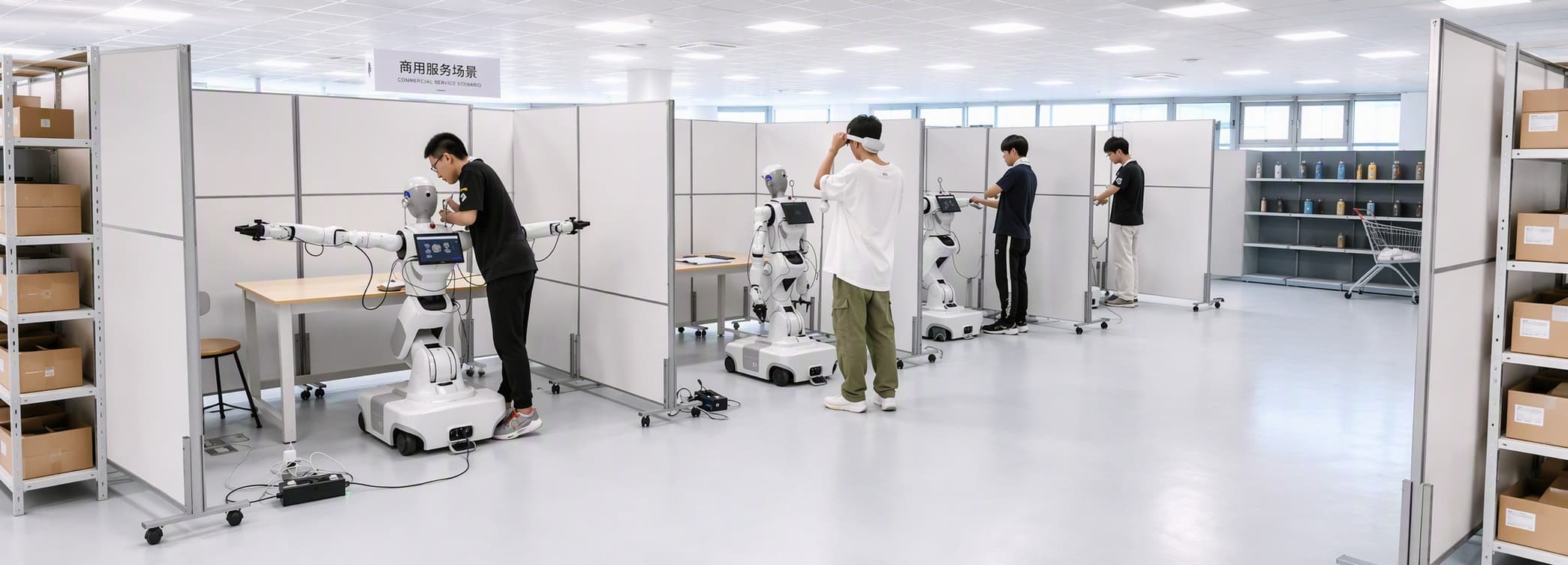
Physical AI is moving from controlled research environments into factories, warehouses, retail spaces, homes, and other real-world settings. As robots become capable of perceiving their surroundings, following instructions, manipulating objects, and adapting to changing conditions, the requirements for training data are changing with them.
A few thousand demonstrations may be enough to validate a robotics research idea. Commercial deployment requires something different: commercial-grade physical AI training datasets that are diverse, structured, multimodal, traceable, and representative of the environments where robots will actually operate.
Unlike conventional computer vision datasets, physical AI training data must connect perception with action. A useful dataset may need to capture video, robot states, trajectories, depth, force or tactile information, environmental conditions, task outcomes, and other signals within a consistent temporal framework.
This makes physical AI data less like a static collection of labeled images and more like an infrastructure problem.
What Are Commercial-Grade Physical AI Training Datasets?
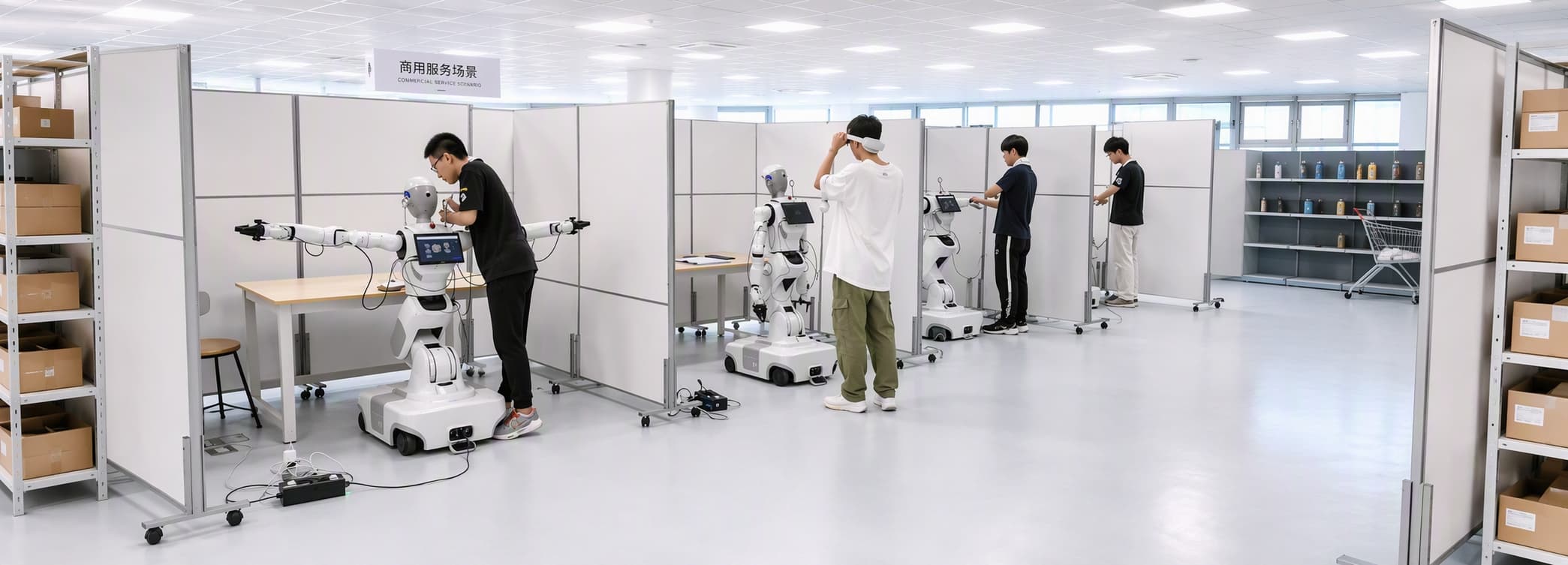
Commercial-grade physical AI training datasets are production-oriented datasets designed to support the development, fine-tuning, evaluation, and deployment of robots and other embodied AI systems.
The defining characteristic is not simply dataset size. Instead, commercial-grade data needs to provide sufficient quality, diversity, consistency, and task relevance for models that are expected to operate outside a laboratory.
Depending on the application, a physical AI dataset can contain:
- RGB images and video
- Egocentric or robot-mounted video
- Depth and 3D information
- LiDAR point clouds
- IMU and other sensor signals
- Robot joint states and motion trajectories
- Force and tactile data
- Teleoperation demonstrations
- Human motion or interaction data
- Environmental and object metadata
- Task instructions and action sequences
- Success, failure, and recovery events
The exact combination depends on the robot and learning objective. A warehouse mobile robot does not require the same dataset as a humanoid robot learning household manipulation.
Why Physical AI Needs a Different Data Strategy
Traditional AI systems can often learn from large collections of web images, text, or audio. Physical AI systems have an additional constraint: their predictions lead to physical actions.
A robot does not simply need to recognize a cup. It needs to understand where the cup is, how it is oriented, whether it can be grasped, how much force to apply, and how its movement will affect the surrounding environment.
This creates a perception-action relationship:
Perception → State Understanding → Action → Physical Interaction → Outcome
Training data therefore needs to preserve the relationship between what the robot observes and what it does.
For example, a manipulation dataset may need to capture:
- The initial position of an object
- The robot's visual observation
- The instruction or task goal
- The robot's movement trajectory
- The grasp or contact event
- The object's resulting state
- Whether the task succeeded
- How the robot recovered from an unsuccessful attempt
A dataset containing only images of objects cannot provide this complete learning signal.
The Core Components of a Commercial-Grade Robotics Dataset
- Real-World Multimodal Data
Physical AI models need exposure to the complexity of the physical world.
Real environments contain lighting changes, reflective surfaces, unexpected object positions, occlusions, different materials, human interactions, sensor noise, and other variations that are difficult to reproduce perfectly in simulation.
For this reason, real-world data remains an important component of production robotics training. For commercial applications, collecting these modalities consistently is often more valuable than simply increasing the number of video frames.
- Robot and Egocentric Video
The viewpoint of the data matters.
A third-person camera may provide useful information for understanding a complete scene, but a robot often makes decisions based on sensors mounted on its body, head, wrist, or other positions.
Egocentric and robot-mounted video can therefore provide a closer representation of the visual input available during deployment.
For manipulation tasks, wrist-mounted cameras can capture hand-object interactions, while head-mounted or forward-facing cameras can provide information about the robot's navigation environment.
The dataset should also preserve metadata such as camera position, resolution, frame rate, and timestamps so that visual observations can be aligned with robot actions.
- Motion and Proprioceptive Data
Visual information tells a model what the environment looks like. Robot state data helps describe what the robot is doing.
Depending on the platform, this can include:
- Joint positions
- Joint velocities
- Joint torques
- End-effector poses
- Gripper states
- Base velocity
- Robot trajectories
- Action commands
These signals become particularly important for imitation learning, behavior cloning, and Vision-Language-Action (VLA) systems.
Without accurate synchronization between observations and actions, a dataset may contain large amounts of information but provide weak training signals.
- Teleoperation and Demonstration Data
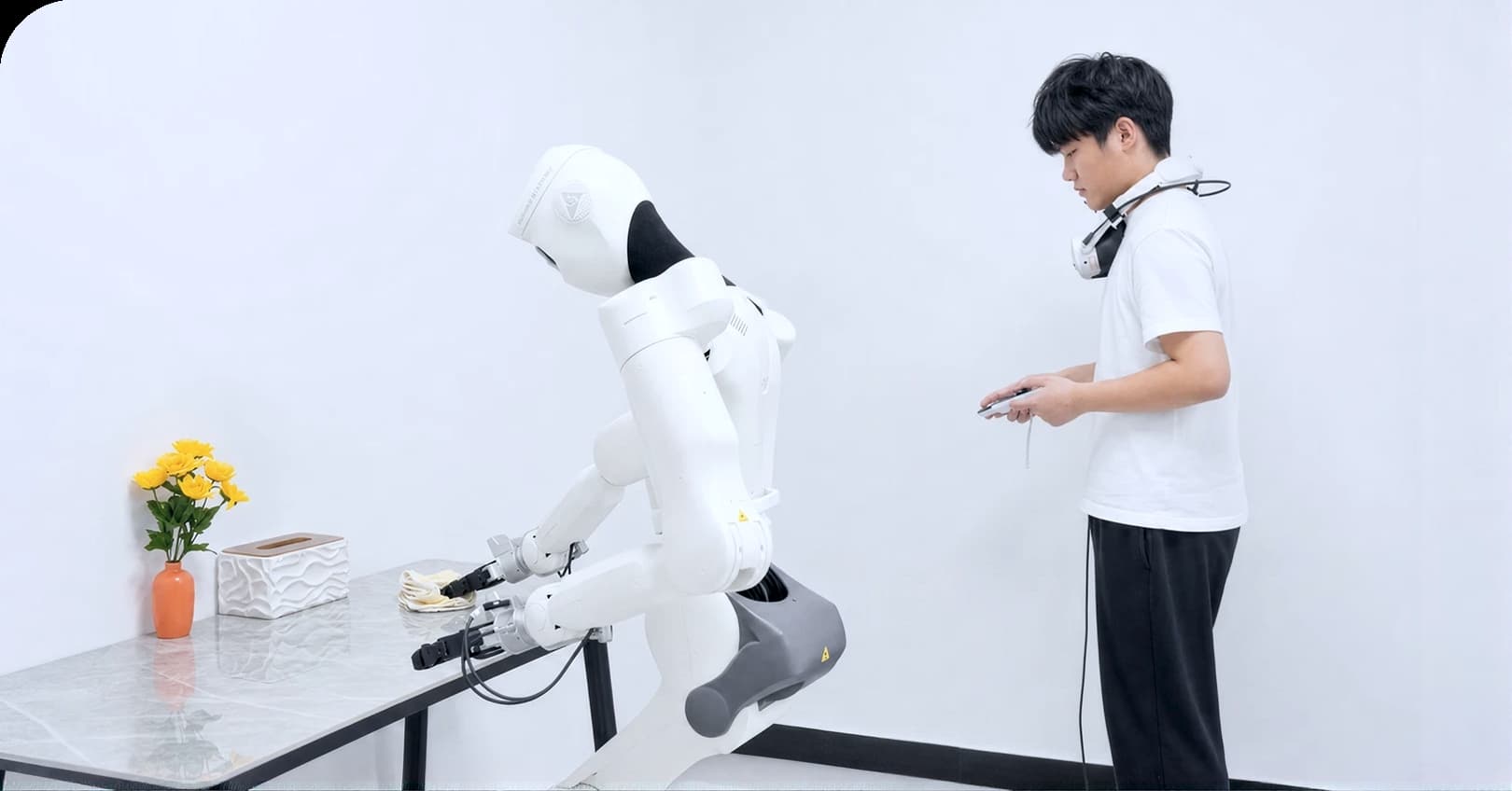
Teleoperation provides a practical way to capture human-guided robot behavior.
An operator can demonstrate how a robot should approach an object, grasp it, manipulate it, recover from an error, or complete a multi-step task. The resulting trajectory can become a training example for imitation learning.
However, simply recording teleoperation sessions does not automatically produce high-quality training data.
Commercial datasets need clearly defined task specifications, consistent collection procedures, quality checks, and appropriate metadata.
The important question is not only:
How many demonstrations were collected?
It is also:
What behaviors, states, and variations do those demonstrations cover?
Dataset Diversity Matters More Than Raw Volume
One of the common mistakes in physical AI data development is treating dataset size as the primary measure of quality.
A dataset can contain millions of samples while representing a very narrow distribution.
Consider a robot trained to pick up a box. If every demonstration uses the same box, table, lighting, camera position, and grasping strategy, the model may perform well under those exact conditions but struggle when the environment changes.
Commercial-grade datasets should deliberately introduce meaningful variation.
Environment Diversity
Data can vary across:
- Homes
- Warehouses
- Offices
- Retail environments
- Manufacturing facilities
- Laboratories
- Other application-specific locations
Object Diversity
Variation can include:
- Shape
- Size
- Material
- Weight
- Color
- Orientation
- Surface properties
- Packaging condition
Behavioral Diversity
Multiple successful strategies can help models learn that a task does not always have a single valid trajectory.
Failure and recovery demonstrations can also be valuable because real robots inevitably encounter unsuccessful grasps, unexpected obstacles, object movement, and other deviations.
Temporal Diversity
Long-horizon tasks require more than isolated action samples.
For example, assembling a component may involve:
Locate → Reach → Grasp → Align → Insert → Verify → Recover
A useful dataset needs to preserve these temporal relationships rather than reducing the task to disconnected frames.
Annotation and Synchronization Are Part of Data Quality
Physical AI data is inherently multimodal.
A single trajectory may contain camera streams, depth, robot states, tactile information, action commands, and task metadata. These streams can operate at different frequencies and experience different transmission delays.
If the timestamps are inconsistent, the model may associate the wrong robot action with the wrong visual observation.
This is why production-grade physical AI data requires more than annotation.
A robust pipeline should address:
- Sensor synchronization
- Coordinate systems
- Timestamp alignment
- Data validation
- Trajectory segmentation
- Task-level metadata
- Annotation consistency
- Dataset versioning
- Quality assurance
The goal is to transform raw sensor recordings into structured training samples that can be consumed by a model training pipeline.
Simulation and Real-World Data Should Work Together
Simulation plays an important role in physical AI development.
Virtual environments can generate large numbers of scenarios without the hardware cost, safety constraints, and operational limitations associated with physical robots. They are particularly useful for reinforcement learning, environment variation, and controlled testing.
However, simulation does not perfectly reproduce the physical world.
Differences in contact dynamics, material properties, sensor noise, lighting, object deformation, and human behavior can create a sim-to-real gap.
A practical data strategy therefore combines both sources.
Real-world data → model training → failure analysis → targeted simulation → real-world validation
Instead of choosing between simulation and real-world collection, robotics teams can use each for the problems it solves best.
What Makes a Dataset Commercial-Ready?
Before purchasing or commissioning a physical AI dataset, enterprise teams should evaluate more than sample count.
- Task Relevance
Does the dataset represent the actual tasks the model needs to perform?
A large general robotics dataset may be less useful than a smaller dataset closely aligned with the target application.
- Embodiment Coverage
Different robot platforms have different kinematics, sensors, action spaces, and control constraints.
If the target system is a humanoid robot, data from other embodiments may still be useful for pretraining, but additional embodiment-specific data may be necessary for downstream training.
- Environmental Coverage
Does the dataset include enough variation in physical environments to support generalization?
- Multimodal Alignment
Are video, robot states, trajectories, and other sensor streams accurately synchronized?
- Data Quality and QA
Are there defined acceptance criteria, review processes, and mechanisms for detecting corrupted or inconsistent samples?
- Scalability
Can the data pipeline support additional tasks, environments, robot platforms, or collection volumes as the project grows?
- Dataset Traceability
Enterprise teams should be able to understand where data came from, how it was processed, which version was used, and how it entered the final training set.
These factors become increasingly important when datasets move from research experiments to commercial robotics development.
How BodenAI Approaches Physical AI Data
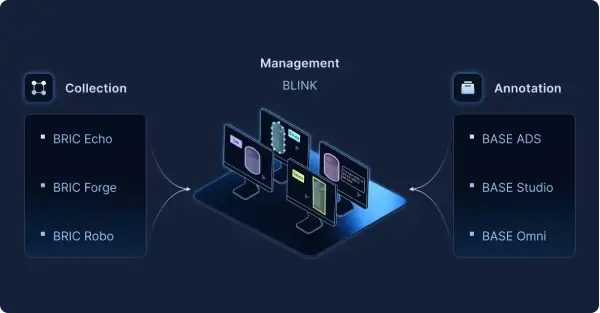
BodenAI treats Physical AI data as a broader infrastructure challenge rather than simply an annotation task.
Its data infrastructure brings together data collection, curation, annotation, and management for Physical AI and other AI applications. The platform includes tools such as BRIC for data acquisition, BASE for annotation, and Blink for data management.
Its Physical AI dataset portfolio is designed around diversity, accuracy, and efficiency, with both off-the-shelf and custom-built data streams available for different development requirements.
This approach is particularly relevant for commercial robotics teams because the data requirement rarely remains static.
A team may initially need data for foundation-model pretraining, then require additional manipulation trajectories, new environments, failure cases, or robot-specific data during fine-tuning and evaluation.
A scalable data infrastructure allows these requirements to become part of an ongoing data development cycle rather than isolated collection projects.
From a Dataset to a Continuous Physical AI Data Engine
The next stage of Physical AI development is unlikely to be defined by a single static dataset.
As robots move into more complex environments, every deployment can expose new failure modes.
A production data loop can therefore look like:
Collect → Curate → Train → Evaluate → Identify Failures → Collect Targeted Data → Retrain → Validate
This changes how commercial teams should think about physical AI datasets.
Instead of asking only:
How many hours of robot data do we need?
A more useful question is:
Which physical-world experiences are missing from our current training distribution?
That distinction helps connect data acquisition directly to model capability.
Building a Commercial-Grade Physical AI Data Foundation
Commercial Physical AI requires data that reflects the complexity of physical interaction.
High-quality training datasets need to combine real-world multimodal data, robot trajectories, task demonstrations, environmental diversity, accurate synchronization, annotation, quality control, and scalable data management.
Simulation can expand the scenario space, while real-world data provides the physical grounding needed for deployment. Together, they can support a continuous loop of training, evaluation, failure discovery, and targeted data generation.
For teams building humanoid robots, manipulation systems, autonomous machines, or other embodied AI applications, the data foundation is becoming as important as the model architecture itself.
BodenAI provides Physical AI datasets and data infrastructure designed to support this development process, from data collection and annotation to dataset management and scalable physical-world data operations.
If your team is evaluating commercial-grade physical AI training datasets or needs a custom data pipeline for a specific robot, task, or deployment environment, you can talk with the BodenAI team about your data requirements. Contact BodenAI