
Industry Insights
July 31, 2026
Ego-Centric for Physical AI | Technical Research & Data Support

Introduction
Research on Physical AI has gradually shifted focus from digital modal generation to embodied intelligent agents that interact with the tangible physical environment. In this evolving research direction, the concept of ego-centric for Physical AI has become a mainstream technical path for building generalizable robot foundation models. Its core feature lies in model pre-training based on large-scale egocentric multi-modal sensory data collected from the first-person perspective of robots.
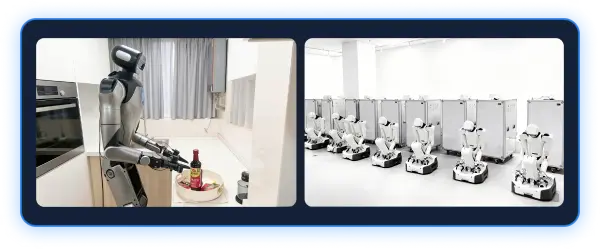
Compared with third-party fixed-angle shooting data, egocentric perception data is more aligned with the cognitive mode of embodied agents. It can record spatial depth information, motion trajectories, hand-object interactive details and real-time environmental changes synchronously. However, many research teams face practical obstacles in the implementation process: insufficient volume of standardized egocentric labeled data, inconsistent data collection specifications, and lack of matched supporting training and verification frameworks.
To address the data and infrastructure barriers in ego-centric model development, BodenAI has built two accessible resources for researchers and engineering teams: standardized physical robot datasets and a complete set of Physical AI technical frameworks. This article will systematically sort out the definition, technical value, implementation difficulties and supporting resource landing paths of the ego-centric system.
Basic Definition and Technical Value of Ego-Centric for Physical AI
Core Connotation of Ego-Centric Model
The ego-centric model is a type of embodied foundation model trained on synchronized multi-dimensional egocentric data, including first-person RGB video, depth frame images, robot joint motion trajectories, force feedback signals and language task annotations. After sufficient pre-training, the model can form three core capabilities for physical scene interaction:
- Egocentric spatial reasoning: Judging object accessibility, occlusion relationship and relative position based on the visual perspective of the robot’s own camera;
- Cross-hardware embodiment transfer: Adapting manipulation logic to different carriers such as humanoid robots, mobile collaborative arms and dual-arm operating robots;
- Physical environment implicit modeling: Learning the physical attributes of objects such as weight, friction and collision response from massive interactive demonstration data.
Traditional robot control models are mostly trained on segmented third-person video clips or single-scene limited data sets, which are difficult to form stable generalization ability. The ego-centric technical route requires continuous, multi-scene and multi-hardware teleoperation trajectory data as the training base, which puts forward high requirements for data collection quantity and standardization.
Why Egocentric Data Is Important for Physical AI Iteration
From the perspective of model iteration and deployment stability, egocentric data brings several practical improvements to vision-language-action (VLA) models:
- Match the input logic of mainstream physical AI foundation models: Most current open-source VLA policy models are designed to receive first-person sensor stream data as the main input, and third-party perspective data will form obvious domain deviation during sim-to-real migration;
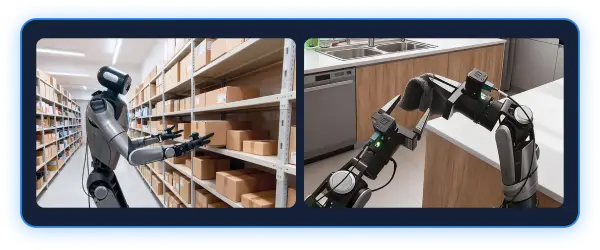
- Record fine-grained manipulation actions that are hard to capture externally: Subtle grabbing posture adjustment, liquid pouring amplitude, fabric folding deformation and tool assembly actions can only be completely recorded by the robot’s onboard egocentric camera;
- Support adaptive task execution in unknown scenes: Models trained on rich egocentric interactive data can complete simple unseen household, retail and industrial tasks without additional targeted fine-tuning;
- Reduce the test cost of physical machine verification: Real collected egocentric trajectory data can be used to calibrate physical parameters in simulation engines, lowering the trial-and-error frequency of physical robot debugging.
Common Practical Barriers to Building Ego-Centric Models
Teams engaged in ego-centric research generally encounter two major bottlenecks in actual project advancement:
High Threshold for Self-built Egocentric Datasets
A usable ego-centric pre-training corpus needs to cover multiple dimensions: different robot hardware platforms, diversified application scenarios, complete types of manipulation tasks, and synchronized motion data under static and moving base states. If relying on internal independent collection, the team needs to invest in building physical robot laboratories, configure teleoperation control equipment, and set up special personnel for data annotation and cleaning. Most small and medium-sized R&D teams and university laboratories are restricted by budget and site conditions, and it is difficult to accumulate data of sufficient scale and scene richness. In addition, open-source public datasets generally have problems such as short single task duration, uneven labeling quality and single scene coverage, which cannot meet the long-term iterative needs of foundation models.
Lack of Supporting Closed-Loop Technical Frameworks
Even with qualified egocentric training data, the whole process from model pre-training, simulation augmentation to physical machine effect verification still needs matched pipeline support, including data automatic annotation tools, simulation environment parameter calibration modules, and multi-hardware model deployment and test platforms. Discrete tools will increase the difficulty of process docking and result reproducibility.
Ego-Centric Construction from BodenAI
Standardized Egocentric Physical AI Datasets
- Data scale and coverage: The library accumulates tens of thousands of real-world task samples and thousands of hours of continuous egocentric recording content, covering mainstream humanoid robots, mobile manipulators and dual-arm collaborative robots on the market;
- Scenario and task classification: Data is sorted into four vertical categories: daily household operations, office sorting work, supermarket and pharmacy standardized workflows, and industrial assembly and sorting operations. Specific tasks include clothing folding, tableware arrangement, shelf goods placement, pharmaceutical box sorting, small parts assembly and conveyor line picking;
- Unified data format: All episodes adopt time-synchronized storage standards, including egocentric video frames, joint motion trajectories, text task labels, base motion state tags and complete metadata files, which can be directly imported into mainstream VLA model training frameworks without secondary format conversion;
- Preprocessing work completed in advance: The dataset has undergone frame screening, invalid segment removal and unified annotation standards, reducing the data cleaning workload of the research team.
Full-Lifecycle Physical AI Technical Solution
- Batch data collection and automatic annotation pipeline: Support continuous collection of new egocentric interactive data through deployed robot terminals, and realize batch automatic labeling of task content and motion tracks to supplement the iterative training corpus of foundation models;
- Simulation environment sim-to-real calibration module: Use real egocentric trajectory data to adjust physical parameters in the virtual simulation platform, generate a large number of occluded scenes, cluttered desktop environments and other edge case synthetic egocentric data, so as to enhance the model’s adaptability to complex actual scenes;
- Cross-robot model compatibility deployment framework: The trained ego-centric model can be migrated and verified on multiple robot hardware devices covered by the dataset library, facilitating researchers to test the cross-body generalization ability of policy models;
- Physical machine batch verification conditions: The platform supports model effect testing on a fleet of physical robots arranged in household, retail and industrial simulated scenes, so as to quantify the actual execution performance of the model after pre-training and fine-tuning.
The overall framework forms a closed loop from data collection, model training, virtual scene augmentation to physical machine verification, which can simplify the process management of ego-centric project development for technical teams.
Building Ego-Centric Models Based on BodenAI Resources
Combined with the above two resource portals, teams can refer to this stable implementation path for project advancement:
- Select and download targeted egocentric training datasets on https://www.boden.ai/datasets according to research directions (such as household service robots or industrial manipulators);
- Understand the supporting training, simulation and verification tool chain through the introduction on https://www.boden.ai/solutions/physical-ai, and access the corresponding technical framework;
- Complete the basic pre-training of the ego-centric vision-language-action model relying on standardized egocentric trajectory data;
- Use the simulation module in the Physical AI solution to generate synthetic edge case data for data augmentation and improve model robustness;
- Carry out physical machine task test in the real robot verification environment, observe the zero-shot execution effect of the model in different scenes;
- Continuously add newly collected real egocentric data to the training set through the platform’s continuous data update mechanism to complete iterative optimization of the foundation model.
Applicable Research and Landing Scenarios of Ego-Centric Technology
Household General-Purpose Assistant Robots
Teams developing domestic service robots can use household scene egocentric datasets to train ego-centric models, enabling robots to complete daily tasks such as kitchen finishing, laundry sorting and liquid pouring based on first-person spatial perception.
Retail and Pharmacy Service Robots
In supermarket shelf replenishment, pharmaceutical box sorting and inventory management scenarios, egocentric spatial judgment ability helps robots locate target items in disorderly storage environments without pre-set fixed coordinate maps.
Industrial Mobile Manipulating Equipment
For factory small parts assembly, conveyor line sorting and hardware installation work, the depth perception ability learned from egocentric data can improve the stability of precise grabbing and assembly actions of mobile manipulators.
Academic Laboratory Foundation Model Research
University research groups can use the unified standard open dataset to carry out reproducible ego-centric algorithm research, and complete horizontal benchmark comparison with mainstream open-source embodied AI models, avoiding the heavy capital investment of building independent data collection laboratories.
Conclusion
Ego-Centric for Physical AI is a feasible technical route to improve the real-scene generalization ability of embodied intelligent robots, and high-quality, large-scale egocentric perception training data is the core prerequisite for the implementation of this route.
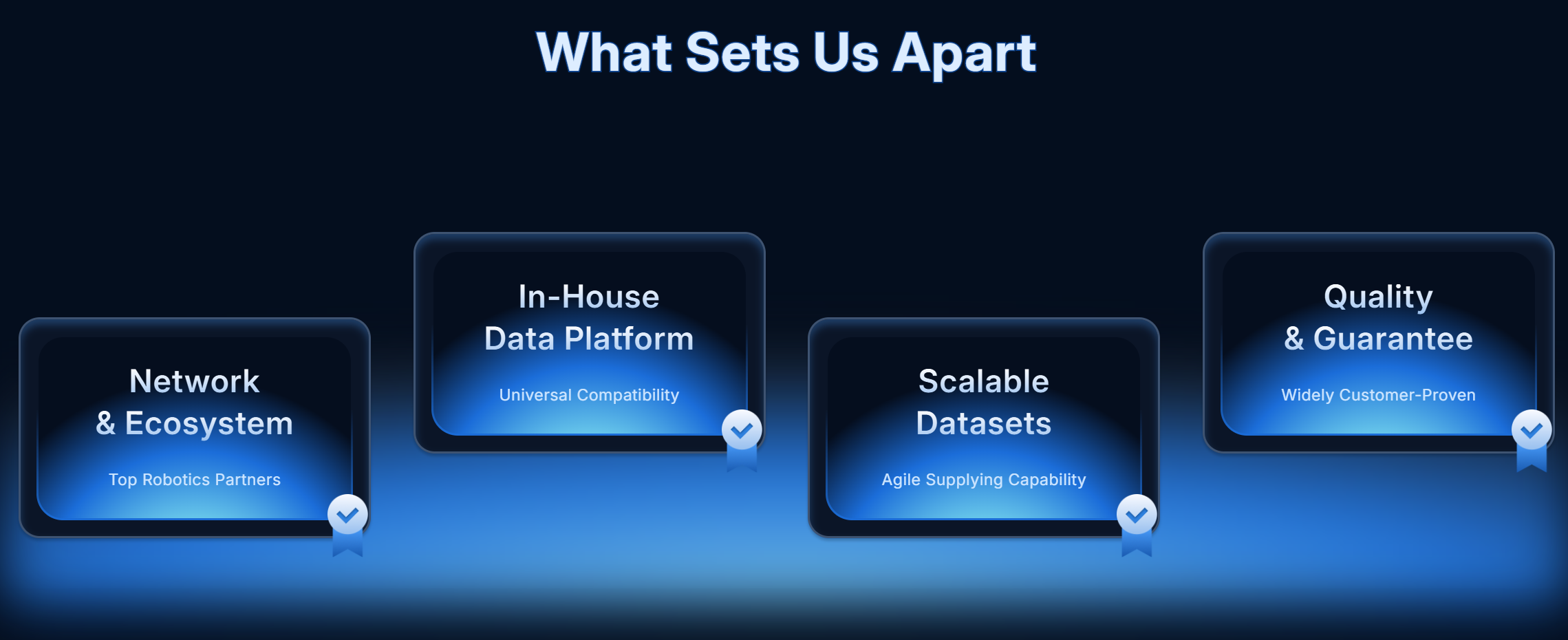
For most R&D teams, independent full-link construction of data collection and model training frameworks will bring higher time and capital costs. BodenAI provides a relatively complete solution through the open dataset library at https://www.boden.ai/datasets and the full-process Physical AI technical system at https://www.boden.ai/solutions/physical-ai.
Technical personnel can browse the detailed data specifications and framework functions through the two links above, select matching resources according to their own project research objectives, and carry out the development and iterative work of ego-centric physical embodied foundation models.