
Industry Insights
November 11, 2026
Egocentric Data for Robot Training: How It Works
Why Robot Training Needs Egocentric Data
Many conventional robotics datasets rely on external cameras to record an entire scene. These recordings are useful for understanding robot trajectories and overall task execution, but the camera perspective is independent of the robot.
An embodied agent experiences the environment differently.
As a robot moves its arm toward an object, the object's position in the camera frame changes. The robot's end effector may partially occlude the object during grasping. Once the object is picked up, its visual position changes together with the robot's movement.
These observations are directly connected to the robot's actions.
Egocentric data preserves this relationship by recording the environment from a camera attached to or moving with the agent. Instead of treating visual information as an independent input, it provides a continuous observation stream associated with the agent's physical behavior.
This is particularly relevant to:
- Robot manipulation
- Imitation learning
- Behavior cloning
- Visuomotor policy learning
- Teleoperation
- Human-to-robot demonstration
- Embodied foundation models
The objective is not simply to teach a model to recognize an object. It is to help the model understand how observations correspond to actions within a physical environment.
What Should an Egocentric Robot Dataset Capture?
A useful egocentric dataset typically contains more information than RGB video.
Depending on the application, a training sample may combine several synchronized modalities:
Visual observations
RGB, stereo, RGB-D, or other camera streams provide information about objects, surfaces, spatial relationships, and environmental context.
Robot state
Joint positions, velocities, gripper state, end-effector pose, and other proprioceptive signals describe the physical configuration of the robot.
Spatial information
Depth maps, point clouds, camera poses, and coordinate transformations can provide geometric information that is difficult to infer from RGB images alone.
Actions
Action trajectories or control commands establish what the robot did after observing a particular state.
Task and object metadata
Object identity, task category, environment, demonstration ID, and other metadata make datasets easier to filter, analyze, and reuse.
Temporal information
Timestamps and episode boundaries connect individual observations into meaningful sequences.
The resulting data structure can be viewed as a continuous relationship:
Observation → Robot State → Action → Environment Change → New Observation
This relationship is fundamental to many robot learning approaches.
Raw Egocentric Video Is Not Training Data
A common misconception is that collecting thousands of hours of first-person video automatically creates a valuable robotics dataset.
In practice, raw video contains substantial amounts of information that may be irrelevant or difficult to use.
A ten-minute recording of a manipulation task could contain several minutes of idle motion, repeated actions, failed attempts, camera shake, occlusions, and frames with little useful interaction.
Training pipelines therefore need to transform continuous recordings into meaningful task episodes.
For example, a raw recording could be segmented into:
Approach → Reach → Grasp → Lift → Transport → Place → Release
Each segment can then be associated with relevant observations, robot states, actions, and annotations.
This conversion from continuous sensor streams to structured episodes is one of the most important steps in building high-quality egocentric training data.
Temporal Segmentation Matters
Robot behavior is inherently sequential.
A single image showing a gripper near an object does not indicate whether the robot is preparing to grasp it, moving away from it, or recovering from a failed attempt.
Temporal context provides this information.
For this reason, egocentric datasets often require temporal segmentation and event labeling. Important boundaries may include:
- Start and end of an action
- Object contact
- Grasp initiation
- Successful grasp
- Object release
- Task completion
- Task failure
- Environmental state changes
These annotations allow training systems to distinguish meaningful actions from visually similar but behaviorally different states.
For long-horizon manipulation tasks, temporal structure can become particularly important because multiple subtasks may occur within a single continuous episode.
Multimodal Synchronization Is a Core Data Problem
Egocentric robot data frequently comes from multiple sensors operating at different sampling rates.
A camera may record video at 30 or 60 frames per second, while robot state information may be sampled at a different frequency. Force sensors, tactile sensors, or other devices may introduce additional streams.
Without accurate synchronization, the resulting dataset can contain incorrect observation-action relationships.
Consider a grasping event. If the video frame showing physical contact is associated with a robot state recorded several milliseconds earlier, the dataset may incorrectly represent the robot's configuration at the moment of contact.
Therefore, a production-quality data pipeline needs to account for:
- Timestamp alignment
- Sensor synchronization
- Camera calibration
- Coordinate transformations
- Missing frames
- Sensor dropouts
- Sampling-rate differences
These are not merely engineering details. They directly affect the integrity of the training data.
Annotation for Egocentric Robot Data
Egocentric datasets also present annotation challenges that differ from standard image datasets.
The moving viewpoint can create:
- Motion blur
- Frequent occlusion
- Changing object scale
- Self-occlusion
- Complex backgrounds
- Rapid viewpoint changes
- Small interaction regions
For this reason, conventional object detection labels may not be enough.
Depending on the learning objective, annotation can include object identity, object state, hand or gripper position, action category, temporal boundaries, interaction events, trajectories, and task outcomes.
For example, identifying a cup in a frame is relatively straightforward. Determining whether the robot is reaching for the cup, grasping it, lifting it, or placing it somewhere requires temporal and contextual information.
This makes video annotation and temporal event labeling important components of egocentric data preparation.
Data Diversity Is Critical for Generalization
A robot trained on highly repetitive demonstrations may perform well under controlled conditions but struggle when the environment changes.
Egocentric datasets therefore need meaningful variation.
Relevant dimensions can include:
- Object appearance
- Object size and shape
- Workspace configuration
- Lighting conditions
- Camera viewpoint
- Robot configuration
- Human demonstration style
- Task execution speed
- Object placement
- Successful and unsuccessful attempts
For example, a manipulation model trained only on one table layout may learn correlations specific to that environment rather than the underlying task.
Dataset curation should therefore prioritize behavioral and environmental diversity, not simply dataset volume.
More video does not necessarily mean more useful training information.
Egocentric Data Across Robot Learning Tasks
The same first-person data can support different learning objectives when it is structured appropriately.
Imitation Learning
Human or robot demonstrations can provide examples of how tasks are performed. Egocentric observations can be paired with corresponding actions to create demonstration trajectories.
Behavior Cloning
Observation-action pairs can be used to learn a policy that maps perceived states to demonstrated actions.
Robotic Manipulation
First-person visual data can capture fine-grained relationships between the end effector and manipulated objects.
Teleoperation
Teleoperated demonstrations can generate synchronized visual observations and control trajectories for downstream policy learning.
Embodied Foundation Models
Large-scale multimodal datasets can provide training signals across tasks, environments, objects, and behaviors, supporting models designed to operate across diverse physical scenarios.
In each case, the value of the data depends on how well observations, actions, and outcomes remain connected.
Building a Training-Ready Egocentric Dataset
A scalable pipeline can be organized into several stages:
Data Collection → Synchronization → Quality Control → Episode Segmentation → Annotation → Curation → Validation → Training
At the collection stage, the goal is to capture sufficient sensor and task information.
Synchronization aligns the different modalities.
Quality control removes corrupted or unusable recordings.
Segmentation converts continuous recordings into task-relevant episodes.
Annotation adds semantic and temporal information.
Curation improves diversity, removes unnecessary redundancy, and creates balanced subsets.
Finally, validation ensures that the resulting dataset meets the requirements of the downstream training pipeline.
This workflow highlights an important distinction: data collection and data infrastructure are different problems.
A robotics team can collect large amounts of video and still lack an efficient system for turning that data into reusable training assets.
Scaling Egocentric Data for Physical AI
As robot learning projects scale, data management becomes increasingly complex.
A production dataset may contain millions of frames, multiple sensor modalities, thousands of task episodes, different robot platforms, and continuously evolving annotation schemas.
The infrastructure must therefore support more than file storage.
A scalable Physical AI data infrastructure should make it possible to:
- Ingest multimodal sensor data
- Maintain temporal relationships between data streams
- Track dataset metadata
- Manage annotation workflows
- Perform quality control
- Create task-specific dataset subsets
- Preserve data provenance
- Version datasets
- Reuse existing data for new training objectives
This infrastructure allows data teams and robotics researchers to move from isolated data collection projects toward a continuous data development cycle.
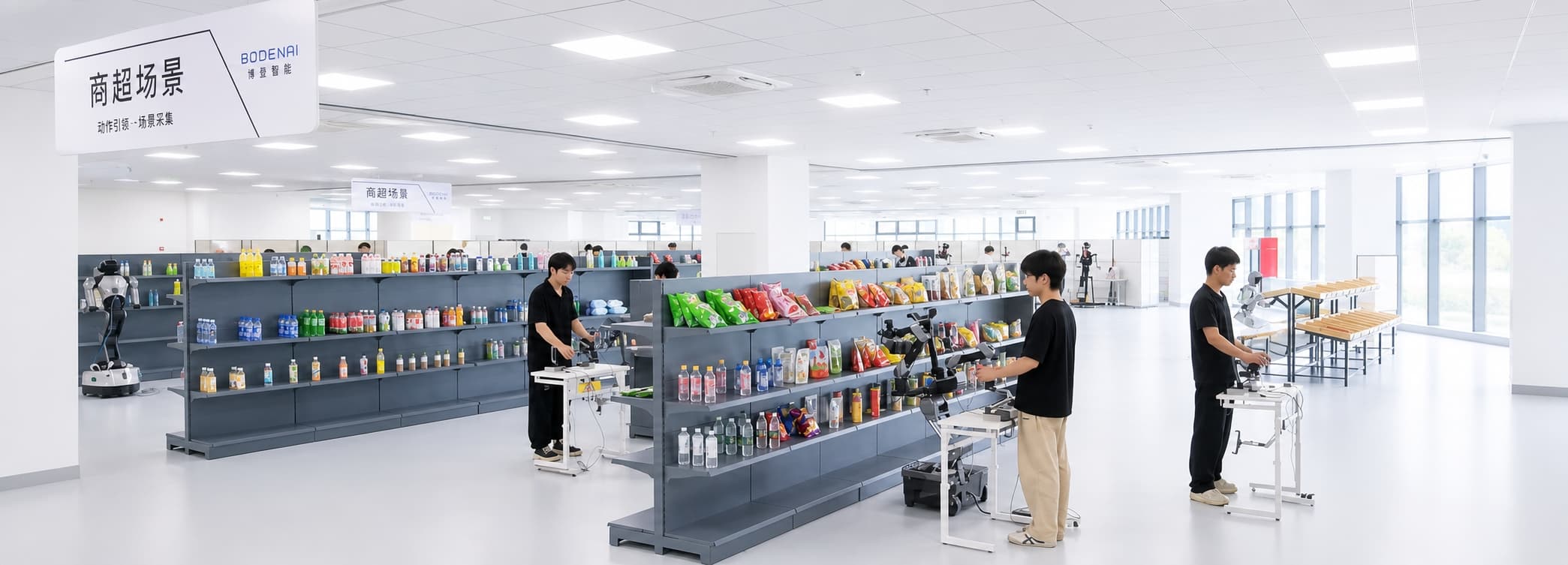
For teams developing real-world robotics and Physical AI systems, BodenAI's Physical AI data infrastructure can support the data workflows required to turn complex real-world observations into structured resources for model development.
The Future of Egocentric Robot Training Data
As robots become capable of longer and more complex tasks, the demand for high-quality first-person data is likely to expand.
The next challenge is not simply collecting more egocentric video. It is creating datasets that preserve the complete relationship between perception, state, action, interaction, and outcome.
This requires better multimodal synchronization, more precise temporal annotations, broader task diversity, stronger quality-control processes, and infrastructure capable of managing large-scale embodied data.
Egocentric data is therefore best understood as part of a larger Physical AI data pipeline. When raw first-person observations are converted into structured, synchronized, and reusable training datasets, they can provide a critical foundation for teaching robots how to perceive and act in the physical world.