
Industry Insights
September 21, 2026
Embodied AI Data Infrastructure: Building Better Offline RL for Robotics
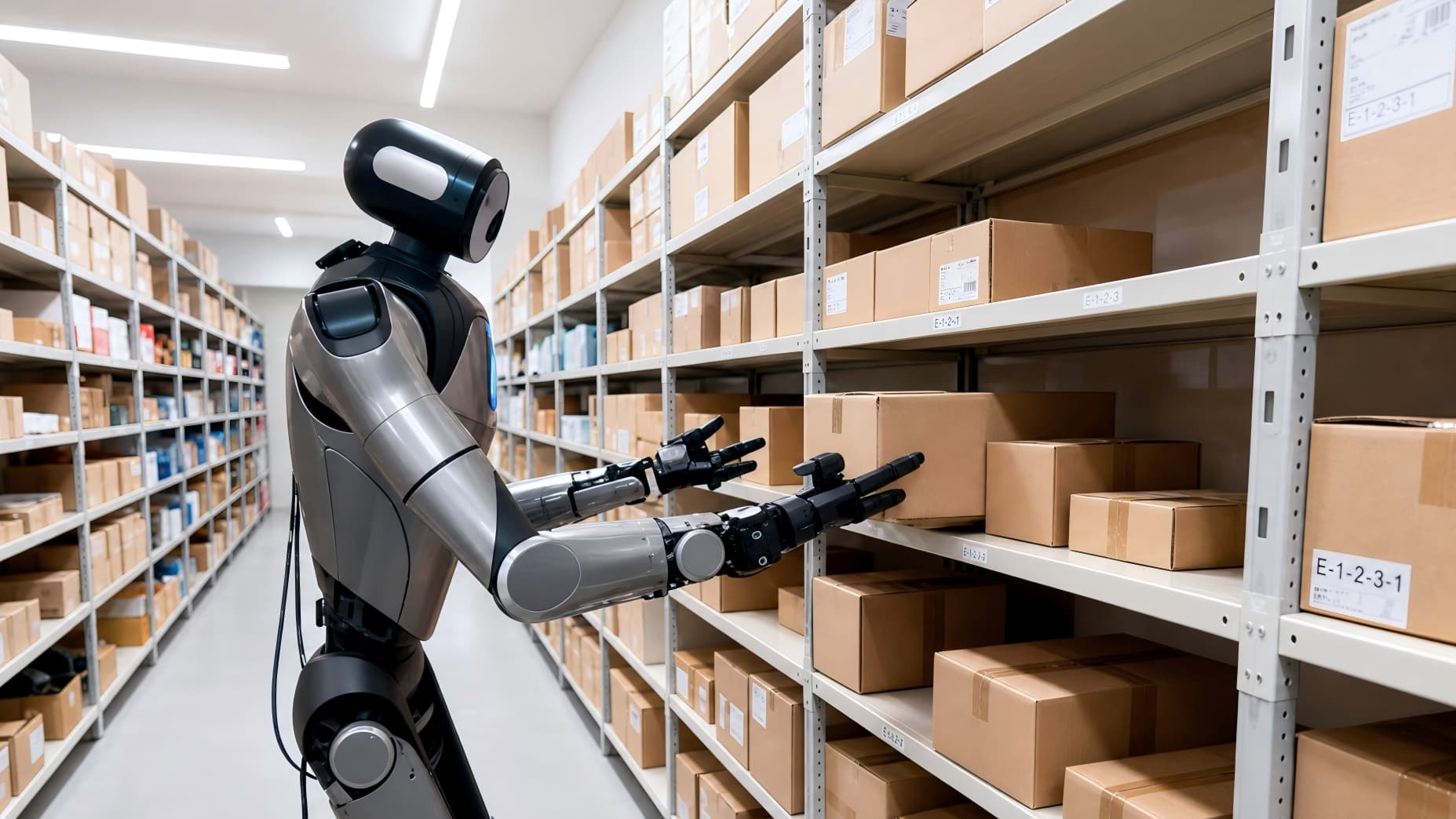
Embodied AI is moving beyond models that can perceive and reason about the physical world. The next challenge is enabling robots to learn from what actually happens during interaction: successful actions, failed attempts, human interventions, environmental changes, and the consequences of each decision.
This is where offline reinforcement learning (offline RL) becomes increasingly important.
Unlike online RL, which requires an agent to continuously interact with an environment while learning, offline RL trains policies from previously collected datasets. This is particularly relevant to robotics because physical exploration is expensive, slow, and sometimes unsafe. Real-world robots can generate large volumes of operational data, but turning those logs into useful training data requires much more than simply storing camera videos.
For embodied AI developers, the challenge is becoming a data infrastructure problem.
Why Offline RL Matters for Embodied AI
Robots operate in environments where every action has a physical consequence. A robot grasping an object, navigating around a person, or inserting a component into an assembly can generate a sequence of observations, actions, rewards, and outcomes.
Online reinforcement learning can learn directly from these interactions, but repeatedly experimenting with physical robots introduces practical constraints. Hardware wears out, environments change, human supervision may be required, and unsafe exploration can damage equipment or surrounding objects.
Offline RL provides another path: collect interaction data first, then use that dataset to train and evaluate policies without requiring the robot to be physically active throughout the learning process.
Research on real-robot offline RL has shown that datasets can contain more than successful demonstrations. Near-optimal and suboptimal trajectories can also provide useful information, while multi-task data can improve generalization in some settings. At the same time, simply increasing dataset size does not automatically improve policy performance, making data quality and dataset composition critical.
This changes the role of robotics data.
The objective is no longer just to collect demonstrations. It is to build a structured record of robot-environment interaction that can support policy learning, evaluation, error analysis, and future iterations.
What Data Does Robot Offline RL Actually Need?
A useful offline RL dataset needs to preserve the temporal relationship between what a robot observes, what it does, and what happens next.
A typical trajectory may include:
- RGB or RGB-D camera streams
- Joint positions and velocities
- End-effector poses
- Force and torque measurements
- Robot actions and control commands
- Gripper states
- Environment or scene information
- Human teleoperation signals
- Intervention events
- Task success or failure
- Rewards or outcome signals
- Timestamps and synchronization information
This multimodal structure is important because embodied AI is fundamentally temporal.
A single image may show that an object is present, but it does not explain how the robot reached that state, which action caused the object to move, or whether the previous action produced a desirable outcome.
For offline RL, those relationships are part of the training signal.
That is also why robotics data infrastructure has different requirements from conventional computer vision datasets. High-dimensional sensor streams must remain synchronized across time, while trajectories need to retain enough context for models to learn from both successful and unsuccessful behavior.
From Robot Logs to Training-Ready Data
Raw robot logs are rarely ready for offline RL.
A scalable data pipeline needs to transform heterogeneous recordings into consistent training examples without destroying the temporal information contained in the original trajectories.
A practical pipeline typically includes four stages:
Collection → Curation → Annotation → Dataset Management
During collection, the infrastructure should capture sensor and robot-state information at the required temporal resolution. Missing frames, inconsistent timestamps, or incomplete actuator data can make an otherwise large dataset difficult to use.
Curation then removes corrupted recordings, duplicates, unusable trajectories, and irrelevant segments. More importantly, curation can organize data according to robot type, task, environment, difficulty, and outcome.
Annotation adds higher-level information that may not be directly available from robot logs. For example, trajectories can be associated with task stages, intervention points, object interactions, success states, or failure modes.
Finally, dataset management makes the resulting data searchable, versioned, and reproducible.
This layer becomes especially important when datasets are continuously expanded. A research team may need to answer questions such as:
- Which trajectories were collected with a specific robot?
- Which tasks contain human interventions?
- Which environments are underrepresented?
- Which failures occur most frequently?
- Which dataset version was used to train a particular policy?
- Can a new policy be evaluated against exactly the same held-out trajectories?
Without this infrastructure, increasing data volume can actually make experimentation harder.
Offline RL Needs More Than “Good Demonstrations”
Traditional imitation learning often focuses heavily on high-quality demonstrations. Offline RL can make use of a broader distribution of experience, including imperfect or suboptimal behavior.
That distinction matters for physical AI.
A robot that always receives perfect demonstrations may learn what successful behavior looks like, but it has less information about what happens when actions deviate from the ideal trajectory.
Offline RL can instead use a mixture of experience to learn from the relationship between actions and outcomes. Recent work on cross-embodiment offline RL is also exploring how heterogeneous robot trajectories can be combined to build more transferable control priors. However, the research also highlights a challenge: differences between robot embodiments can introduce conflicting learning signals when datasets become increasingly heterogeneous.
This means a robotics data infrastructure should not treat every trajectory as interchangeable.
Metadata about the robot embodiment, sensors, control configuration, task, environment, and data-collection method becomes part of the dataset itself.
The Role of Simulation and Real-World Data
Simulation remains an important component of embodied AI infrastructure. GPU-accelerated simulation can generate large amounts of experience without physically operating thousands of robots, while domain randomization and physics modeling can help expose policies to diverse conditions.
But simulation does not eliminate the need for real-world data.
Real robots encounter friction, sensor noise, object variability, unexpected contacts, lighting changes, imperfect calibration, and human behavior that are difficult to reproduce completely in simulation.
For this reason, an effective offline RL pipeline can combine:
Simulation data + teleoperation data + autonomous rollouts + intervention data + failure data + evaluation data
The value of each source depends on the training objective.
Simulation can provide scale and diversity. Teleoperation can provide controlled demonstrations. Autonomous rollouts can reveal how a policy behaves in realistic conditions. Human interventions can identify situations where the current policy fails. Evaluation trajectories can provide a consistent benchmark for measuring improvement.
The infrastructure challenge is connecting these sources without losing their provenance.
Scaling Robot Data Infrastructure Across Embodiments
As embodied AI systems expand from individual robotic arms to mobile manipulators and humanoids, data becomes increasingly heterogeneous.
Different robots may have different:
- Degrees of freedom
- Cameras and sensor configurations
- Control frequencies
- Action spaces
- Coordinate systems
- End-effectors
- Embodiment constraints
A scalable data infrastructure therefore needs a common representation while preserving robot-specific information.
This is particularly relevant to cross-embodiment learning. Recent research has investigated offline RL across heterogeneous robot datasets and found that grouping robots according to morphological similarity can help reduce conflicts between different embodiments.
For data infrastructure, this suggests that metadata and dataset organization should be designed for cross-robot learning from the beginning rather than added later.
What a Production-Grade Offline RL Data Stack Looks Like
A production-oriented embodied AI data stack can be thought of as several connected layers:
Robot and sensor layerCollect synchronized multimodal data directly from physical robots and teleoperation systems.
Data ingestion layerTransfer large volumes of video, sensor, action, and state data into scalable storage while preserving timestamps and metadata.
Curation and annotation layerIdentify usable trajectories, segment tasks, label outcomes, and enrich data with task and environment information.
Dataset management layerVersion datasets, track provenance, manage access, and make trajectories searchable by robot, task, scene, and outcome.
Training layerFeed curated datasets into offline RL, imitation learning, world-model, or multimodal policy training pipelines.
Evaluation layerMaintain standardized datasets and held-out trajectories for measuring policy improvements.
Continuous learning layerCapture new real-world experience and feed useful trajectories back into the data pipeline.
The final layer closes the loop.
A deployed robot generates new experience. That experience becomes new training data. The improved policy is evaluated and deployed again. In this architecture, data infrastructure becomes part of the learning system rather than a storage system sitting beside it.
Building the Data Foundation for Physical AI
This is the direction we take at BodenAI.
For Physical AI and robotics, we provide data collection, curation, annotation, and data management as part of a unified data infrastructure. Our production-grade robotics datasets cover more than 310,000 samples and 10,000 hours of real-environment data, with examples spanning multiple robot platforms, environments, and tasks.
The datasets include teleoperation data across robots such as Zerith H1, Realman RS-01/RS-02, LejuRobot Kuavo4Pro, AgileX Aloha, Astribot S1/Sq, and AgiBot Elf-G1, with tasks ranging from object organization and food preparation to conveyor sorting, pharmacy operations, and supermarket activities.
For teams developing embodied foundation models or robot policies, this type of real-world data can complement simulation and existing demonstration datasets. More importantly, it provides the data foundation needed to experiment with different learning approaches without rebuilding the collection pipeline for every project.
Explore BodenAI robotics datasets
From Data Collection to Continuous Robot Learning
The next phase of embodied AI will not be defined only by larger models or larger GPU clusters.
Compute determines how quickly models can be trained. Simulation determines how much experience can be generated virtually. But data infrastructure determines whether real-world experience can actually become reusable intelligence.
For offline RL, this distinction is especially important. The objective is not simply to accumulate more robot recordings. It is to build datasets that preserve the relationship between perception, action, intervention, outcome, and context.
As robots become more capable and more diverse, the organizations that can continuously collect, structure, evaluate, and reuse real-world interaction data will have a stronger foundation for iterative policy development.
The future of embodied AI therefore depends on more than training infrastructure.
It depends on a reliable data layer connecting real-world interaction → structured datasets → offline RL → policy evaluation → deployment → new experience.
That is the infrastructure required to turn robot experience into continuous learning.