
Industry Insights
November 27, 2026
Embodied AI Training Data: What Makes Robots Smarter?
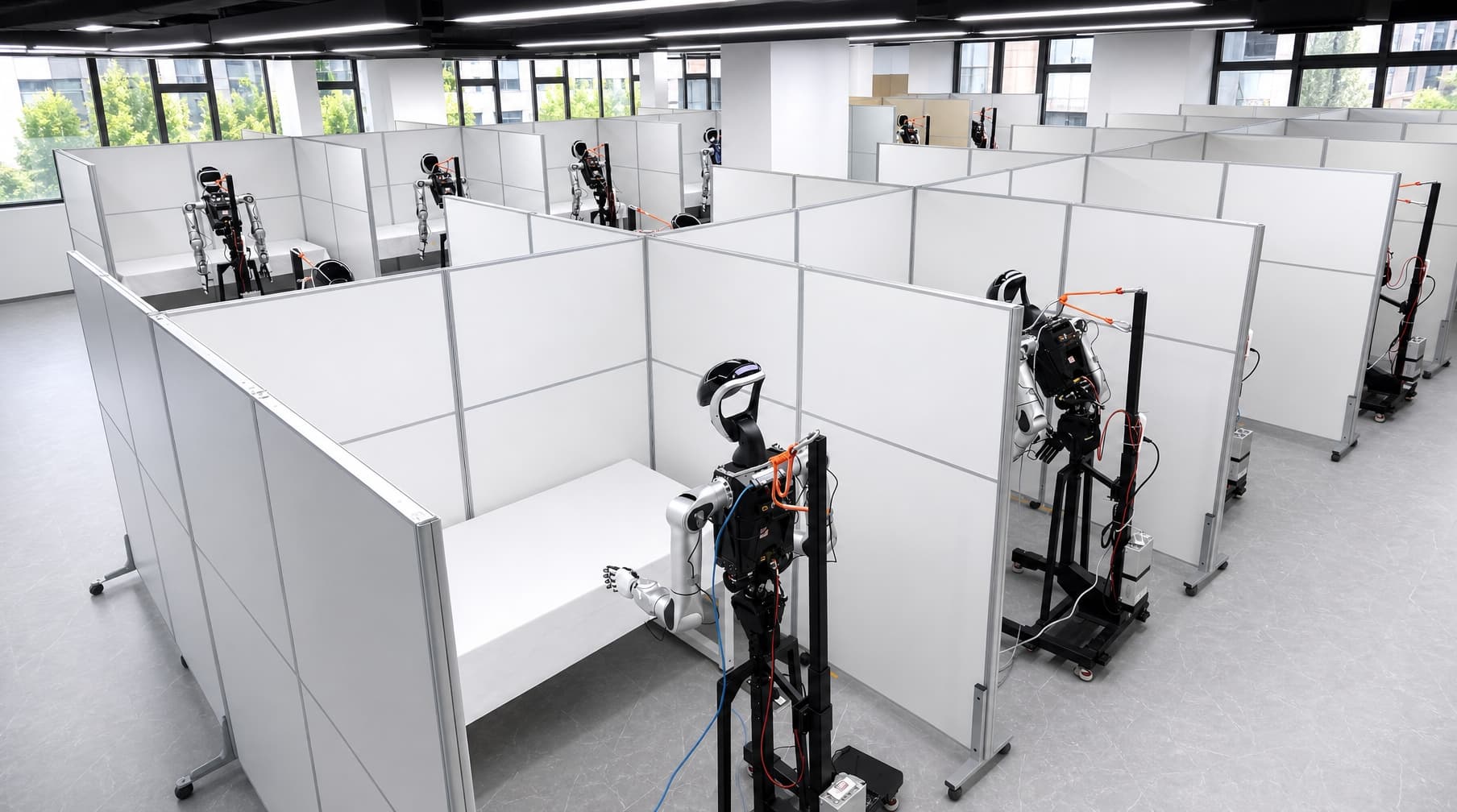
As robots move beyond controlled demonstrations and into factories, laboratories, warehouses, and everyday environments, one challenge is becoming increasingly clear: building intelligent robots requires far more than developing larger AI models. Robots need extensive experience interacting with the physical world, and that experience must be captured in a form that AI systems can learn from.
Unlike conventional AI training datasets built around text or static images, robotics datasets must represent the relationship between perception, movement, physical interaction, and task outcomes. A robot needs to learn not only what an object looks like, but also how to approach it, grasp it, manipulate it, and respond when something goes wrong.
For robotics manufacturers, Physical AI developers, and research institutions, the challenge is no longer simply collecting more data. It is building datasets that provide meaningful physical experience at scale.
At BodenAI, we help robotics teams address this challenge through integrated Physical AI data infrastructure, covering real-world data acquisition, curation, multimodal annotation, and data management.
Explore our Physical AI data infrastructure to see how we help transform physical interactions into structured training resources.
Why Embodied AI Needs a Different Kind of Training Data
The development of large language models demonstrated how large-scale datasets can unlock new AI capabilities. However, physical intelligence presents a different data challenge.
Robots operate in environments where objects move, surfaces change, contact forces vary, and actions produce immediate physical consequences. A video showing someone picking up a cup may communicate the general intention of the task, but it does not necessarily provide the precise joint positions, grasp trajectories, contact conditions, or force feedback required to reproduce that action on a robot.
As highlighted in industry reporting by TechCrunch on the challenges of collecting robot training data, physical interaction data is difficult to acquire and standardize at the scale required for advanced robotics.
A useful embodied AI training dataset therefore needs to connect several information streams:
- Visual observations: RGB images, video, depth information, and first-person recordings.
- Spatial information: 3D point clouds, object positions, orientations, and environmental geometry.
- Robot states: Joint positions, end-effector poses, and movement configurations.
- Action trajectories: Control commands, movement sequences, and manipulation behavior.
- Interaction signals: Force, tactile feedback, contact events, and object-state changes.
- Task information: Natural language instructions, task stages, and execution outcomes.
The value of these modalities comes from their relationships. When visual observations, robot movements, and physical feedback are correctly synchronized, they provide a much richer representation of how an action unfolds.
Where Does Embodied AI Training Data Come From?
No single collection method can capture every type of physical experience a robot needs. Current robotics research increasingly explores combinations of real-world demonstrations, human activity recordings, teleoperation, and simulation.
Real-World Robot Demonstrations
Real-world robot data provides direct evidence of how machines interact with physical environments.
A robotic arm assembling components, a mobile robot navigating a warehouse, or a humanoid manipulating household objects can generate valuable observations about actual physical conditions.
These recordings help models learn from real object properties, environmental constraints, and unexpected interactions that may be difficult to reproduce in controlled simulations.
However, real-world collection involves substantial operational requirements. Robots must be configured, sensors calibrated, environments prepared, and data streams synchronized. Collecting more hours does not necessarily improve a dataset if the recordings repeatedly capture the same narrow range of tasks.
The objective should be to expand meaningful coverage across different environments, objects, robot configurations, and interaction scenarios.
Teleoperation and Human Demonstrations
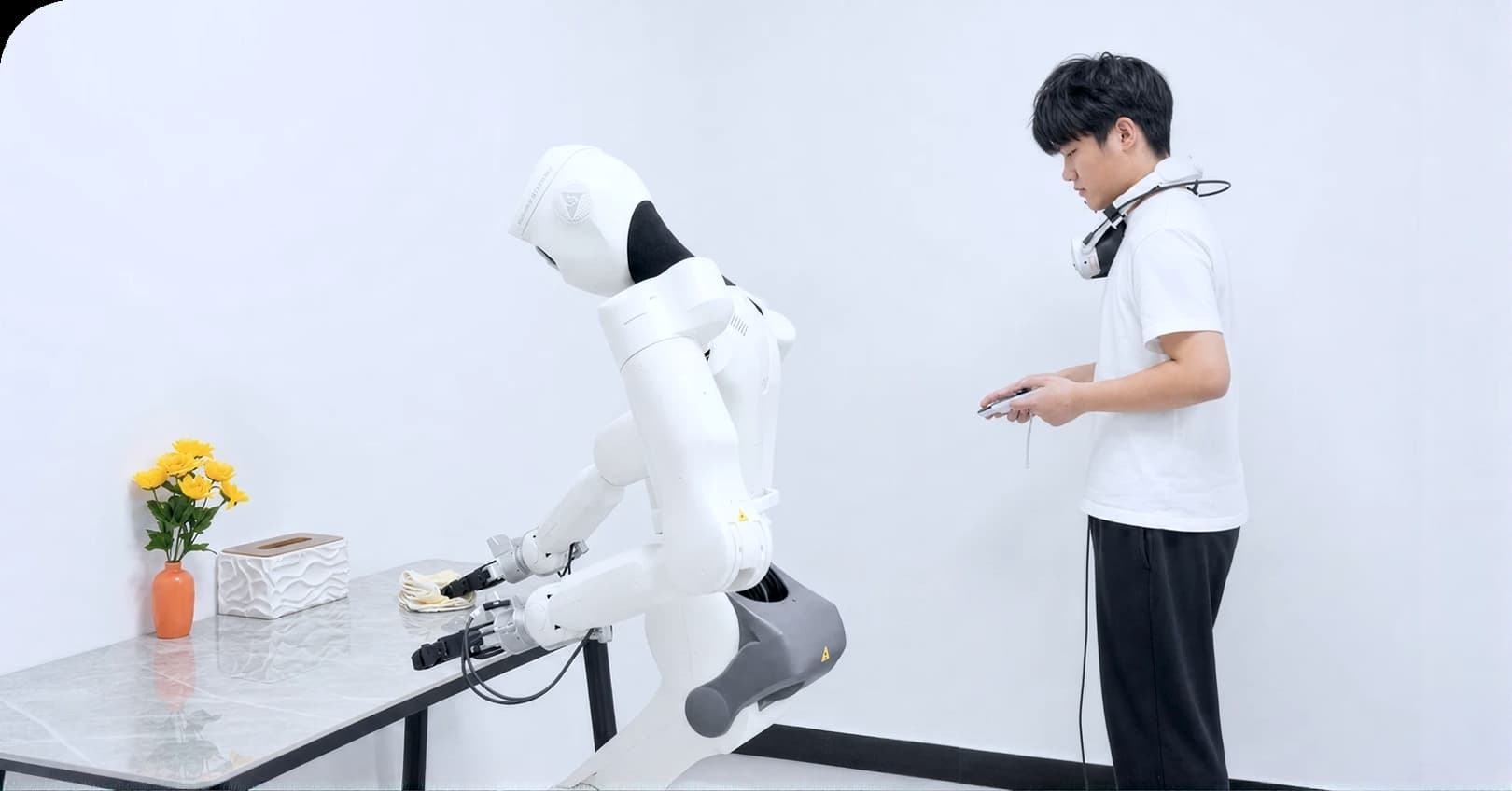
Teleoperation allows human operators to control robots while recording their actions and corresponding observations.
This approach is particularly useful for manipulation tasks that require precise coordination, such as picking up unfamiliar objects, assembling components, or performing two-handed operations.
Human demonstrations provide examples of successful task execution and can help establish an initial behavioral foundation for imitation learning.
Recent IEEE research on teleoperation-based data collection and automatic annotation also highlights the importance of supporting heterogeneous robotic systems, synchronized recordings, and automated processing.
However, demonstrations should not be treated as perfect representations of robot behavior. Human movements may need to be adapted to different robot embodiments, joint configurations, and physical constraints.
First-Person Human Activity Data
Another emerging direction is collecting human activity data through wearable cameras and motion-tracking devices.
Everyday activities such as opening containers, organizing objects, preparing food, and handling tools contain useful information about object interactions and task sequences.
These recordings can help models learn broader relationships between human intentions and physical actions.
Nevertheless, human movement is not identical to robot movement. Human activity recordings may provide useful visual and behavioral context, but robot-specific demonstrations and embodiment-aware data remain important for learning executable actions.
Simulation-Generated Training Data
Simulation provides a complementary way to expand training experiences.
Developers can generate controlled scenarios, vary object positions, adjust environmental conditions, and explore interactions that may be expensive or difficult to reproduce with physical robots.
Research and industry discussions increasingly examine how simulated practice and physical-world validation can work together. As explored in WIRED's coverage of simulation-based robot learning, simulation can allow robots to practice movements and discover strategies before performing tasks in the real world.
The remaining challenge is Sim-to-Real transfer. Differences in friction, mass, inertia, sensor behavior, and contact dynamics can cause simulated performance to diverge from physical execution.
For this reason, simulation is most valuable when combined with real-world data and systematic validation.
What Makes High-Quality Embodied AI Training Data?
The size of a dataset is only one part of its value. For robotics teams, data quality directly affects what a model can learn and how reliably it can apply that knowledge in unfamiliar situations.
Several factors deserve particular attention.
Diversity of physical experiences
Training datasets should cover different objects, environments, tasks, movement patterns, and interaction conditions. A robot trained on repetitive demonstrations may perform well in familiar settings but struggle when object positions or environmental conditions change.
Accurate temporal synchronization
Visual observations, joint states, action commands, and sensor readings must correspond to the correct moments in a trajectory. Poor synchronization can create misleading relationships between what a robot observes and how it responds.
Consistent annotation
Task boundaries, object states, movement trajectories, and interaction outcomes need clear and consistent labeling standards. Annotation should reflect the requirements of the intended learning task rather than simply describe what appears in individual frames.
Complete trajectories
Successful actions are important, but incomplete attempts, execution errors, and recovery behaviors also contain valuable learning signals. Preserving the context surrounding an interaction helps researchers understand how a robot reaches a particular outcome.
Reliable data provenance
Researchers and engineering teams need to know how datasets were collected, which robot embodiments were involved, what processing was performed, and how different dataset versions relate to one another.
Together, these factors determine whether training data can support reproducible research, model fine-tuning, and practical robotics development.
From Data Collection to Continuous Robot Learning
Embodied AI training should not be considered a one-time dataset preparation exercise.
As robots encounter more complex environments, evaluation reveals situations where existing models struggle. These performance gaps can guide the next round of targeted data collection.
For example, a robot may successfully grasp objects on a clean laboratory table but struggle with partial occlusion, unfamiliar object shapes, or unstable surfaces.
Instead of simply collecting more demonstrations of successful grasps, developers can focus on the missing scenarios.
This creates a continuous development cycle:
Data Collection → Curation → Annotation → Model Training → Evaluation → Failure Analysis → Targeted Data Collection
This process connects data production with actual model performance.
For robotics companies, it supports ongoing development across different tasks and environments. For universities and research institutions, it creates opportunities to improve experimental reproducibility and investigate how different data distributions influence learning outcomes.
BodenAI supports this broader workflow through its integrated Physical AI platform:
- BRIC: Data acquisition utilities for physical-world and robotic data collection.
- BASE: Multimodal annotation tools supporting images, video, LiDAR, trajectories, and other data types.
- BLINK: Data management capabilities for organizing and managing data workflows.
Our approach connects data acquisition, processing, annotation, and management rather than treating them as isolated operations.
Learn more about how Physical AI data infrastructure supports embodied intelligence.
Meet BodenAI at CES 2027
The growing importance of Physical AI is also bringing robotics data and infrastructure into broader industry conversations.
Taking place January 6–9, 2027, in Las Vegas, CES 2027 will bring together technology companies, enterprise leaders, researchers, and innovators across artificial intelligence, robotics, and other emerging technology sectors.
BodenAI will participate in CES 2027, connecting with robotics manufacturers, Physical AI developers, and research teams to exchange ideas about real-world data collection, multimodal training datasets, and scalable data infrastructure.
We look forward to discussing how better data workflows can help accelerate the development of intelligent robots and support the transition from experimental capabilities to real-world applications.
Building More Capable Robots Starts with Better Data
The next stage of embodied AI will depend on how effectively robots learn from physical experience.
Real-world demonstrations, teleoperation, human activity recordings, and simulation each provide different forms of training information. Their value increases when they are combined through reliable data processing, accurate annotation, and continuous evaluation.
For robotics manufacturers and research institutions, building a scalable training data pipeline is becoming an essential part of developing more adaptable and reliable intelligent systems.
At BodenAI, we are building the data infrastructure that helps turn physical-world interactions into structured, usable training resources.
Train at Scale. Validate in Reality.
Connect with BodenAI to discuss your embodied AI training data and Physical AI data infrastructure requirements.