
Industry Insights
November 24, 2026
How OTS Training Datasets Are Shaping Robotics Development
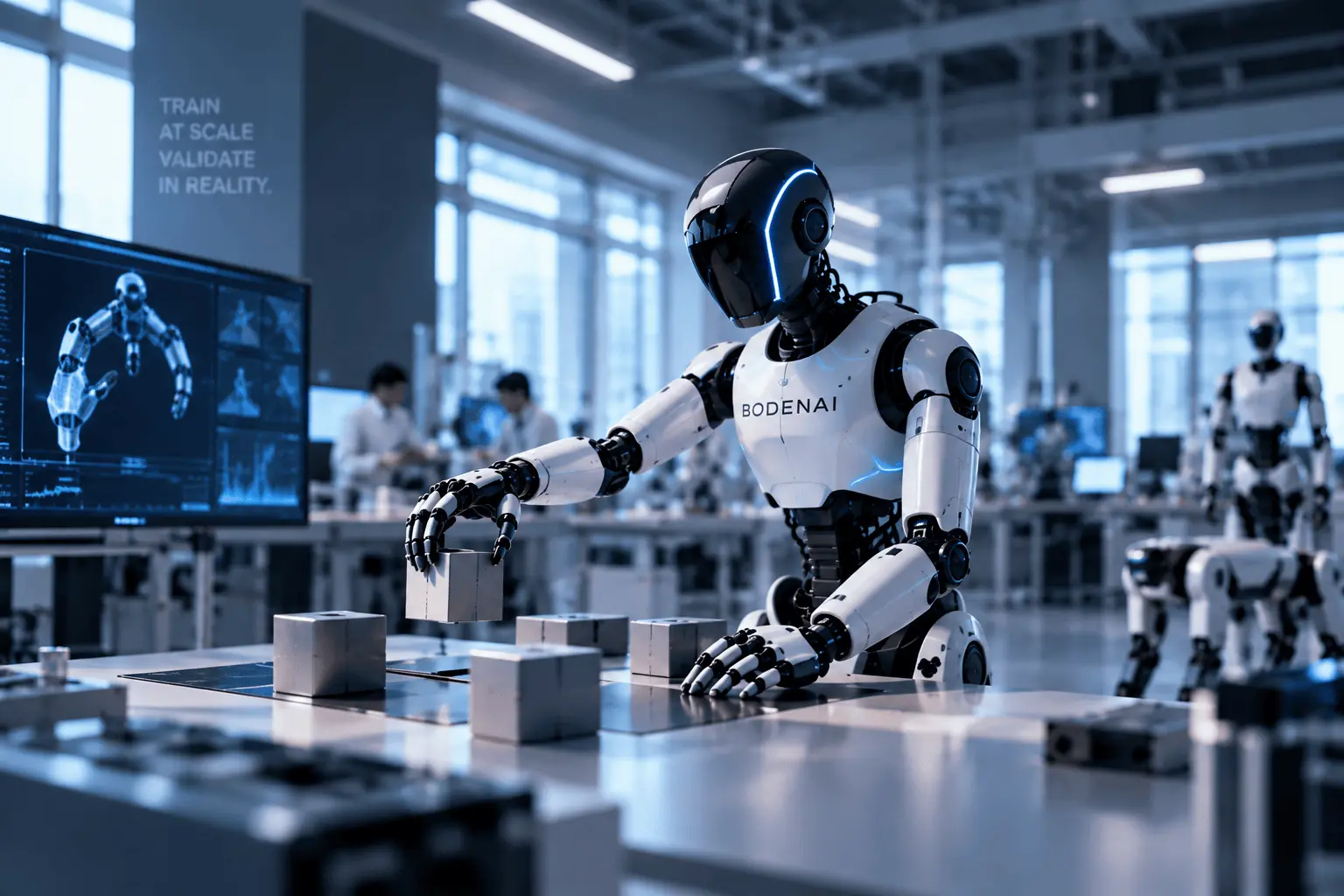
Building a capable robot takes more than sophisticated hardware and a powerful AI model. A robot must be able to recognize objects, understand its surroundings, respond to changing conditions, and carry out physical tasks reliably. All of these capabilities depend heavily on the quality of the data used during training.
As Physical AI moves closer to real-world deployment, access to reliable robotics training data has become a growing challenge for developers, robotics companies, and research institutions. Collecting enough real-world demonstrations, integrating different sensor streams, and maintaining consistent data quality can take considerable time and resources.
This is where OTS training datasets become useful. Ready-to-use datasets give development teams a starting point for training and evaluating robotic systems without having to build every data resource from scratch. However, finding data that actually matches a robot's capabilities and intended tasks requires more consideration than simply choosing a large dataset.
At BodenAI, we help robotics companies and research teams build the data foundation behind Physical AI development. Through integrated data collection, curation, annotation, and management capabilities, our Physical AI data infrastructure supports teams working with complex, multimodal robotics data, from initial experimentation to larger-scale model development.
Understanding OTS Training Datasets in Robotics
OTS, or off-the-shelf, training datasets are pre-existing datasets that development teams can access and use for specific training, testing, or research purposes.
In traditional computer vision, an off-the-shelf dataset might contain thousands of labeled images showing different objects or scenes. Robotics datasets are more complex because they need to capture not only what a robot sees, but also how it interacts with the physical environment.
Consider a robot learning to pick up an object from a table. Visual information can help it identify the object and estimate its position, but that is only part of the task. The model also needs to learn how the robot approaches the object, positions its gripper, adjusts its movements, and responds when the grasp does not go as expected.
A useful robotics training dataset may therefore combine camera recordings, depth information, joint positions, robot trajectories, gripper states, tactile feedback, and action sequences. When these different data streams are properly aligned, they provide a much more complete picture of the interaction between the robot and its environment.
This makes OTS training datasets valuable for a range of Physical AI applications, including robotic manipulation, navigation, object handling, humanoid robotics, and embodied intelligence research.
Why More Robotics Data Does Not Always Mean Better Training
It is tempting to assume that larger datasets automatically produce better-performing models. In practice, the relationship between data volume and model performance is more complicated.
A robot trained on thousands of demonstrations from a single controlled environment may still struggle when it encounters unfamiliar objects, different lighting conditions, or unexpected obstacles. Similarly, a dataset containing extensive visual information may offer limited value if it lacks the corresponding robot actions needed for learning physical interactions.
What matters is whether the data reflects the situations a robot is expected to handle.
For robotics developers, this means paying attention to the diversity of tasks, environments, objects, and physical interactions represented in a dataset. A manipulation model, for example, benefits from demonstrations involving different object shapes, grasping positions, surface conditions, and task outcomes. These variations help expose the model to a broader range of possible interactions.
The same principle applies to humanoid robots and other multi-purpose platforms. Their training requirements often extend beyond a single task or environment, making data diversity an important consideration from the beginning of development.
What Should You Look for in an OTS Robotics Dataset?
Not every available dataset will fit every robotics project. Before incorporating an OTS dataset into a training workflow, development teams need to understand how the data was collected, what information it contains, and whether it is compatible with their target system.
One important consideration is embodiment compatibility. Different robots have different joint configurations, degrees of freedom, end-effectors, and control systems. Demonstrations collected using one platform may not translate directly to another. Even when the underlying task is similar, additional processing or adaptation may be necessary to make the data useful.
Another consideration is multimodal synchronization. Physical AI models often learn from multiple sources of information at the same time. Camera footage, depth measurements, joint states, and action commands need consistent timestamps and coordinate references. If these streams are poorly aligned, the model may learn incorrect relationships between what it observes and how it should respond.
Annotation quality also deserves attention. Robotics datasets may require labels describing object states, movement trajectories, contact events, task stages, and action outcomes. Inconsistent annotation can make it difficult to combine different data batches or reproduce training results.
Finally, teams should consider how easily a dataset can be maintained and reused. Clear metadata, standardized formats, version control, and traceable processing workflows become increasingly important as datasets grow. These practices help researchers understand where training data came from and make it easier to identify problems when model performance changes.
Combining OTS Datasets with Custom Robot Data
Off-the-shelf datasets can accelerate development, but they rarely cover every requirement of a specific robotics application.
For example, a research group developing a humanoid robot for household manipulation may find existing object-grasping demonstrations useful for initial experiments. However, those datasets may not include the particular household objects, robot configurations, or interaction sequences needed for the group's target tasks.
This does not make the existing datasets useless. Instead, it highlights the value of combining reusable data with targeted collection.
OTS datasets can provide a foundation for initial training, benchmarking, and experimentation. Custom-collected demonstrations can then address missing scenarios, platform-specific requirements, and areas where the model needs additional experience.
For commercial robotics companies, this approach can also make data development more manageable. Rather than repeatedly collecting information that already exists, teams can focus their resources on the data gaps that matter most to their products.
The key is to evaluate datasets according to the intended training objective. A dataset that works well for visual recognition may not be sufficient for learning complex manipulation behavior, while a collection of robot demonstrations may require additional metadata and processing before it can be integrated into a larger training pipeline.
Building a Scalable Data Pipeline for Physical AI
As robotics projects move beyond early experiments, data management becomes a more significant engineering challenge.
Collecting demonstrations is only one part of the process. Teams also need to organize raw recordings, synchronize sensor information, standardize formats, annotate relevant interactions, and check data quality before using the results for training.
Without a consistent workflow, datasets collected at different times or across different robot platforms can become difficult to combine. Small inconsistencies in timestamps, coordinate systems, or annotation standards may create additional work for researchers and model engineers.
BodenAI addresses these challenges through an integrated Physical AI data infrastructure designed around the needs of robotics development.
Its BRIC, BASE, and Blink solutions support different stages of the data lifecycle, including data acquisition, annotation, and management. This allows teams to approach robotics data as a connected workflow rather than a collection of disconnected tools and processes.
For organizations working with real-world robot demonstrations, the RW-RL-Dataset release offers a practical example of large-scale data development. Jointly released by BodenAI, PIA, and the Shanghai Jiao Tong University MINT Lab, the dataset includes more than 1,000 hours of real-robot interaction data across four robot families, nine scenario domains, and more than 30 task templates.
For robotics developers and researchers, this kind of resource illustrates the importance of collecting data across different embodiments and operating scenarios. It also highlights the role of structured data infrastructure in making large-scale robotics datasets more useful for model development.
Looking Ahead: Physical AI and CES 2027
The growing interest in Physical AI is bringing robotics hardware, intelligent systems, and AI infrastructure into closer conversation. Industry events provide an opportunity for developers, researchers, and technology companies to follow these developments and explore potential collaborations.
CES 2027 will take place from January 6 to 9, 2027, in Las Vegas, Nevada. The event brings together companies and innovators across consumer technology, robotics, AI, and other emerging technology sectors.
For organizations developing intelligent robots, these industry conversations are increasingly relevant. Progress in robot hardware needs to be matched by advances in training data, model development, and the infrastructure required to support real-world deployment.
Moving Physical AI Development Forward with Better Data
The development of Physical AI depends on more than access to large amounts of training data. Models need information that accurately represents physical interactions, connects perception with action, and reflects the environments in which robots are expected to operate.
OTS training datasets offer a practical starting point for robotics research and development. When combined with targeted data collection, consistent annotation, and scalable data management, they can help teams build a stronger foundation for training and evaluating intelligent robotic systems.
For companies developing humanoid robots, autonomous systems, or robotic manipulation models, investing in the right data pipeline early can make a meaningful difference as projects become more complex.
BodenAI supports robotics companies and research institutions with Physical AI data infrastructure, from real-world data acquisition to annotation and dataset management. If your team is developing a robotics model or exploring new training data requirements, get in touch with BodenAI to discuss how we can support your next stage of development.