
Industry Insights
September 21, 2026
How to Build an Embodied AI Data Ecosystem Partner
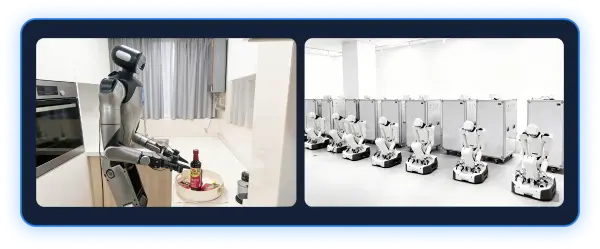
Embodied AI is changing how artificial intelligence interacts with the physical world. Unlike traditional AI systems that primarily work with text, images, or other digital information, embodied AI must perceive its surroundings, understand spatial relationships, make decisions, and execute physical actions through robots or autonomous machines.
That difference creates a fundamental challenge: robots need much more than large datasets. They need the right data, collected from the right environments and processed in a way that supports physical-world intelligence.
As robotics moves from research laboratories toward industrial deployment, the data pipeline is becoming an increasingly important part of the technology stack. Robotics companies, AI researchers, and autonomous systems developers therefore need more than a data vendor. They need an embodied AI data ecosystem partner that can support data collection, processing, annotation, quality control, and continuous iteration as models evolve.
What Is an Embodied AI Data Ecosystem?
An embodied AI data ecosystem connects the different layers required to train and improve intelligent physical systems.
At the center is the robot or embodied AI model. Around it are multiple sources of training data and infrastructure, including:
- Real-world robot demonstrations
- First-person and egocentric video
- RGB and depth imagery
- LiDAR and 3D spatial data
- Human motion and manipulation data
- Robot trajectories and sensor data
- Simulation and synthetic data
- Multimodal instruction and interaction data
- Evaluation and failure-case datasets
These sources do not exist independently. A robot learning to manipulate an object, for example, may need visual observations, hand or gripper trajectories, object properties, environmental context, and information about whether the action succeeded.
The result is a data ecosystem rather than a single dataset.
For embodied AI teams, the challenge is connecting these data sources into a repeatable pipeline that can support model training, evaluation, and iteration.
Why Embodied AI Needs a Different Data Strategy
Internet-scale data has been extremely effective for training language and vision models because enormous amounts of digital content already exist.
Physical intelligence is different.
A photograph can show what a cup looks like, but it does not tell a robot how much force is required to pick it up. A video can show a person opening a drawer, but it does not necessarily provide the structured information needed for a robot to reproduce the movement safely.
Embodied AI needs data that captures interaction and physical consequences, not just appearance.
This makes several dimensions particularly important:
Spatial Context
Robots need to understand where objects are located, how they relate to one another, and how their environment changes over time.
Temporal Information
Physical tasks are sequences of actions. A model must understand not only what happened, but also what happened before and after an action.
Action and Trajectory Data
Demonstrations need to connect perception with movement. This can include human demonstrations, robot trajectories, manipulation sequences, and other interaction data.
Diversity
Real environments are rarely identical to training environments. Different objects, layouts, lighting conditions, surfaces, users, and unexpected events all influence robot performance.
Failure Cases
Successful demonstrations are not enough. Data showing failed actions, unexpected interactions, collisions, and recovery behavior can help models learn how to operate outside ideal conditions.
Together, these requirements make embodied AI data considerably more complex than conventional image or text datasets.
From Data Collection to Model-Ready Data
Building an effective embodied AI dataset is not simply a matter of collecting more information.
The raw data must move through a structured pipeline.
A typical workflow may include:
Data collection → preprocessing → annotation → quality control → validation → dataset versioning → model training → evaluation → new data collection
This loop is especially important for robotics because model performance can reveal gaps in the dataset.
For example, if a robot performs well when objects are clearly separated but struggles in cluttered environments, the next data iteration may need more cluttered scenes and manipulation examples. If the robot fails under unusual lighting, the dataset may need broader environmental variation.
The data ecosystem therefore becomes a continuous feedback loop between model behavior and data development.
What to Look for in an Embodied AI Data Ecosystem Partner
As robotics teams scale, building every component of the data pipeline internally can become difficult. A capable ecosystem partner should be able to support different stages of the process without creating another disconnected workflow.
Multimodal Data Capabilities
Embodied AI rarely relies on a single data modality.
A practical data infrastructure should support combinations of vision, video, LiDAR, audio, text, trajectories, and other sensor or interaction data. BodenAI's platform, for example, is designed to support multimodal data workflows covering vision, video, LiDAR, text, audio, and trajectories.
This matters because robotics datasets increasingly combine multiple streams to represent both the robot and its environment.
Flexible Data Pipelines
Different robotics projects require different annotation structures, task definitions, and validation rules.
A fixed annotation workflow may work for a narrow dataset but become restrictive as the project expands.
BodenAI's platform provides customizable templates, flexible task orchestration, and modular workflow architecture designed to support both R&D projects and enterprise-scale AI data operations.
For robotics teams, this type of flexibility makes it easier to adapt the data pipeline as models and use cases change.
Explore the BodenAI data platform to see how multimodal data workflows can be managed in one environment.
Human-in-the-Loop Quality Control
Automation can accelerate data processing, but physical AI often requires expert judgment.
Annotations may involve complex spatial relationships, long-horizon actions, temporal consistency, or subtle differences between successful and unsuccessful behavior. These are areas where human review remains valuable.
A structured human-in-the-loop process can combine expert execution, dedicated QA, sampling audits, consistency checks, and final validation. BodenAI describes a multi-stage quality-control system built around these processes and reports 99%+ accuracy across million-scale datasets.
The objective is not simply to produce more labeled data. It is to produce data that remains consistent and useful when it enters the model-training pipeline.
Data Security Is Part of the Ecosystem
Embodied AI datasets can contain commercially sensitive information, proprietary robot behavior, facility environments, customer information, or other restricted data.
As a result, security cannot be treated as an afterthought.
A data ecosystem partner should have clear controls for data isolation, access management, operational logging, storage, and transmission.
BodenAI's security framework includes project-level data isolation, role-based access control, operation logging and audit trails, secure storage and encrypted transmission, ISO 27001-aligned internal security management processes, and dedicated secure production environments for sensitive datasets. Its compliance framework also includes privacy management, anonymization, de-identification, data minimization, and purpose limitation capabilities.
For organizations developing proprietary robotics systems, these controls can be an important part of evaluating a long-term data partner.
Learn more about BodenAI's security and data quality practices.
Scaling the Embodied AI Data Pipeline
The data requirements of a robotics project can change dramatically between prototype and production.
Early-stage teams may begin with a relatively small collection of demonstrations. As the model becomes more capable, they may need millions of examples covering more objects, environments, tasks, and edge cases.
This creates several scaling requirements:
- Higher data-processing throughput
- Consistent annotation standards
- Support for multiple modalities
- Repeatable QA processes
- Dataset version management
- Continuous data iteration
- Secure handling of sensitive information
- Infrastructure that can support large-scale datasets
BodenAI's infrastructure is designed for production-scale data operations, with PB-scale cumulative processing capabilities and support for multimodal datasets across robotics, autonomous driving, and foundation-model applications.
The goal is to make data development an ongoing engineering capability rather than a series of isolated annotation projects.
Building a Stronger Embodied AI Ecosystem
The development of embodied intelligence will involve many different technologies: robot hardware, foundation models, simulation environments, sensors, compute infrastructure, data collection systems, and evaluation frameworks.
Data connects many of these layers.
Better hardware can generate richer observations. Better data can improve model training. Better models can identify new failure cases. Those failure cases can then guide the next round of data collection.
This creates a continuous cycle:
Collect → understand → train → evaluate → identify gaps → collect again
A strong embodied AI data ecosystem partner helps make this cycle faster, more consistent, and easier to scale.
For robotics companies, the question is therefore not simply where to obtain a dataset. It is how to build a data infrastructure that can evolve alongside the robot and the model.
Choosing a Long-Term Data Partner for Physical AI
Embodied AI is moving toward increasingly complex physical tasks, from manipulation and warehouse automation to autonomous systems and industrial robotics. As these applications mature, data quality, multimodal coverage, workflow flexibility, security, and scalability will become increasingly interconnected.
The right data ecosystem partner should be able to support that entire lifecycle rather than solving only one stage of the process.
BodenAI provides an integrated data platform for multimodal AI workflows, including physical AI and robotics data collection, custom data pipelines, large-scale validation, and continuous data operations.
For teams building the next generation of physical AI, a scalable data foundation can be as important as the model itself.
Explore the BodenAI Platform to see how an end-to-end data infrastructure can support your embodied AI development workflow.