
Industry Insights
November 24, 2026
Physical AI Applications: 6 Industries Transforming with Robotics
Introduction
Robots have been used in factories and warehouses for decades, but a new generation of intelligent machines is changing what automation can achieve. Instead of following fixed instructions, Physical AI systems can perceive their surroundings, interpret tasks, make decisions, and adjust their movements based on real-world conditions.
This shift is expanding robotics beyond repetitive industrial operations into environments that require more flexible manipulation, navigation, and human interaction. From picking unfamiliar objects in warehouses to handling tools on production lines, Physical AI is bringing machines closer to performing tasks that previously required human judgment and coordination.
Yet, moving from a successful demonstration to reliable real-world performance remains a major challenge. Robots need to learn from diverse physical interactions, not just visual examples or simulated movements.
At BodenAI, we provide real-world Physical AI data infrastructure, supporting data collection, curation, annotation, and management for robotics development. Our solutions help robotics companies and research teams build the datasets needed to train and evaluate intelligent systems across different environments and tasks. Explore our Physical AI data infrastructure to understand how structured real-world experience supports the development of embodied intelligence.
Manufacturing: From Repetitive Automation to Adaptive Manipulation
Manufacturing remains one of the most practical applications of Physical AI. Traditional industrial robots perform well in predictable environments, but production lines often involve variations in component positions, material properties, and assembly requirements.
Physical AI makes it possible to develop robots that can adapt to these changes.
Consider electronic component assembly. A robot must identify a component, estimate its position and orientation, select an appropriate grasp, and place it accurately. If the component shifts or the initial grasp fails, the robot needs to adjust its actions rather than simply repeat a predefined movement.
Other applications include gear assembly, bearing installation, conveyor sorting, and battery installation.
These tasks require more than object recognition. Training data needs to capture synchronized visual observations, robot joint states, end-effector poses, action trajectories, and interaction outcomes. For more complex manipulation, force and tactile information can also help models understand physical contact.
Logistics and Warehousing: Intelligent Picking and Material Handling
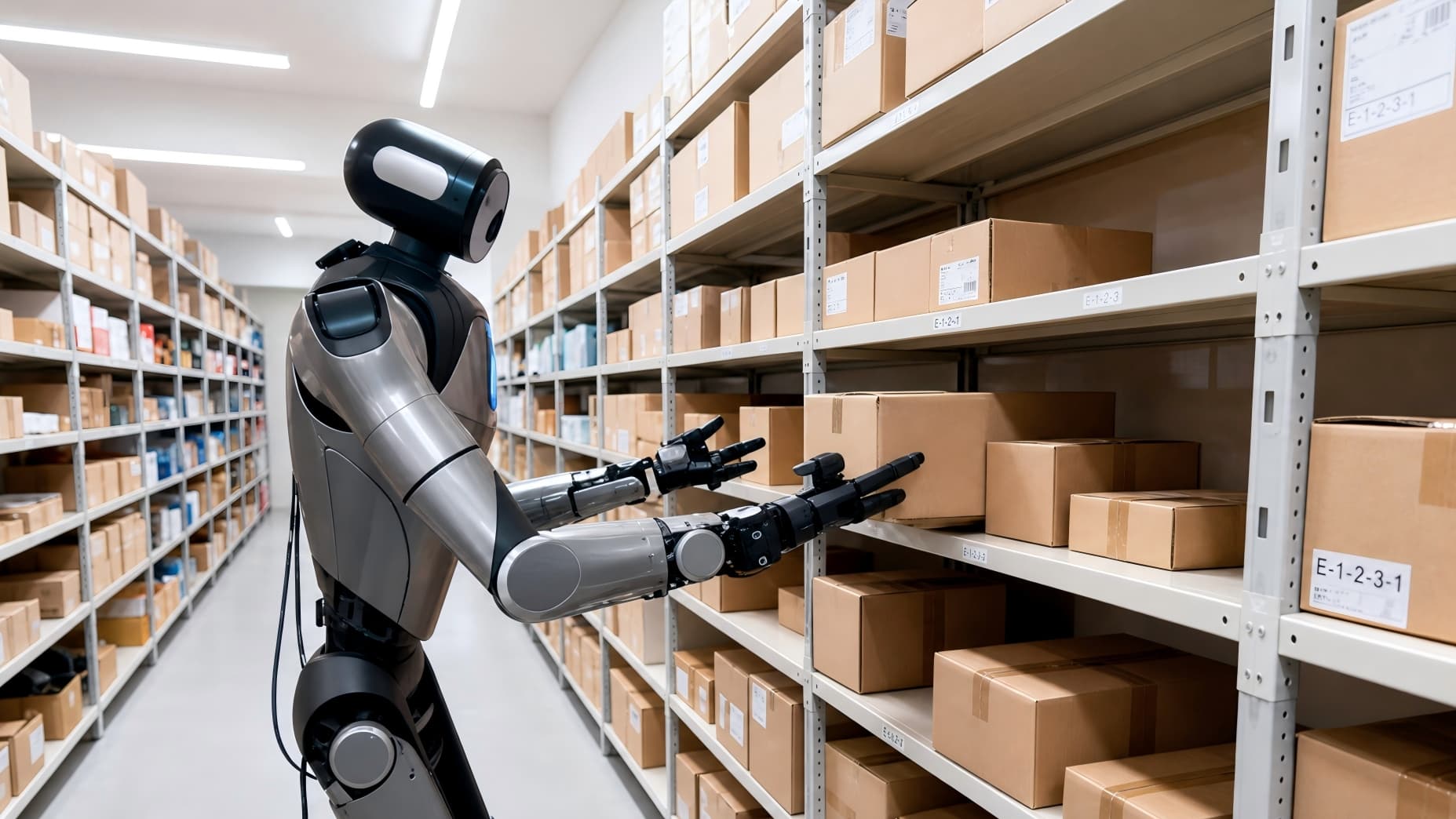
Warehouses are dynamic environments where robots encounter different package sizes, changing inventory arrangements, moving people, and unexpected obstacles.
Physical AI can improve autonomous picking, parcel sorting, shelf organization, and material transportation.
One particularly challenging application is robotic bin picking. A robot must identify objects in a cluttered container, estimate their positions, determine which item to pick first, and select a suitable grasping strategy. Partially hidden objects and irregular arrangements make the task difficult.
Successful picking also requires feedback. A robot needs to recognize whether an object has been securely grasped, whether it has slipped, and whether another attempt is necessary.
This makes multimodal training data particularly valuable. First-person video, depth information, object poses, gripper states, and action trajectories can provide a more complete picture of the interaction than isolated camera images.
Healthcare and Pharmacy: Precision in Human-Centered Environments
Healthcare applications require robots to operate in environments where precision, consistency, and safety are essential.
Potential applications include pharmacy inventory handling, laboratory material transportation, hospital logistics, and rehabilitation assistance.
Pharmacy automation offers a useful example. A robotic system may need to identify packages, locate specific items, pick them from shelves, and organize them according to a defined workflow. These operations involve object recognition, precise manipulation, and reliable task sequencing.
Unlike a controlled industrial workstation, healthcare environments also involve people moving through shared spaces and frequently changing operational conditions.
For research and development teams, training data should represent different object arrangements, human interactions, environmental conditions, and task outcomes. This allows models to learn more than a single ideal operating sequence.
Household Robotics: Learning Everyday Human Activities
Household environments are among the most demanding applications for general-purpose robots because everyday tasks involve numerous objects, unfamiliar layouts, and continuous physical interaction.
Tasks such as folding clothes, preparing food, organizing cookware, cleaning surfaces, and putting household items away require several capabilities to work together.
A robot preparing food, for example, must recognize ingredients and utensils, understand their spatial relationships, coordinate its hands, and adapt to changes in object positions throughout the task.
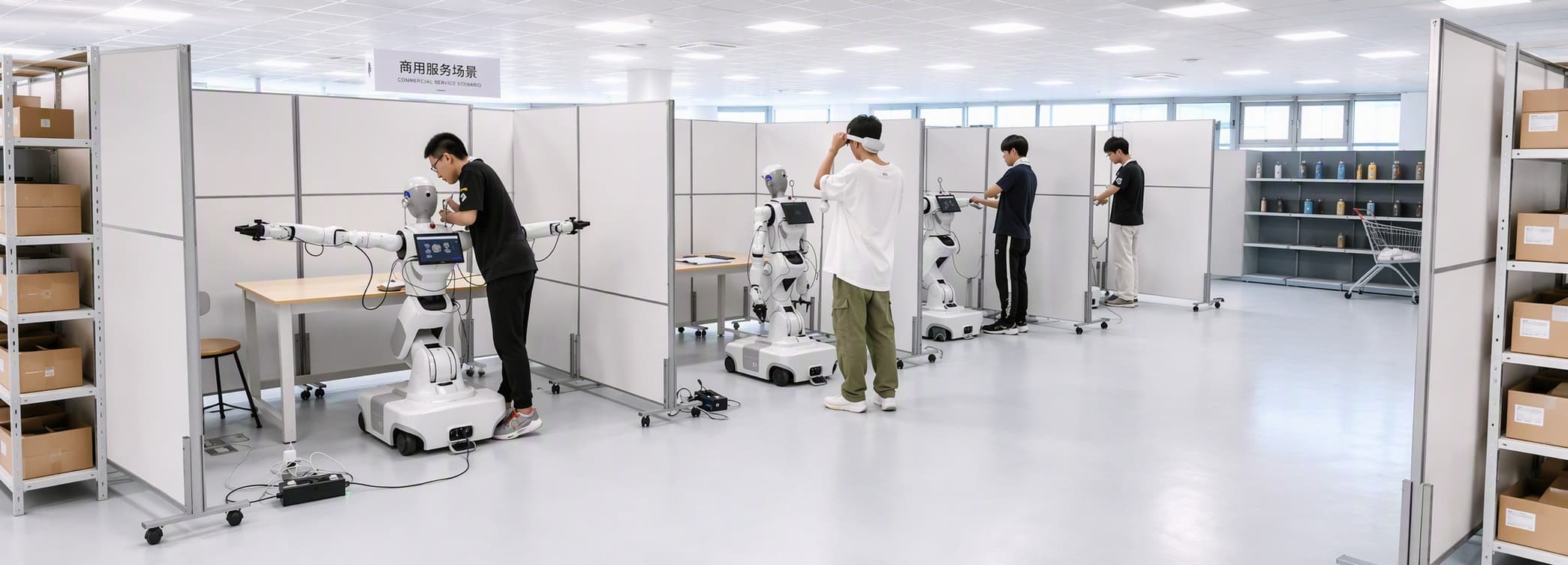
First-person or egocentric data is particularly useful here. It captures activities from the perspective of the person performing them, including hand movements, object interactions, and changes in the surrounding environment.
Human demonstrations can provide valuable learning signals for imitation learning and robot manipulation models. However, these recordings need to be properly structured and aligned with robot actions before they can support reliable model training.
Agriculture and Construction: Operating in Unstructured Environments
Agriculture and construction demonstrate the need for Physical AI to function outside carefully controlled workspaces.
In agriculture, robots can assist with crop monitoring, fruit picking, weed identification, and precision spraying. A harvesting robot needs to distinguish ripe produce from surrounding vegetation, estimate its position, plan an approach, and manipulate it without causing damage.
Construction introduces a different set of challenges. Robots may need to transport materials, inspect infrastructure, navigate changing work areas, or position components around other workers and equipment.
Both industries involve environmental conditions that can change significantly between tasks. Lighting, weather, terrain, object positions, and physical obstacles all influence robot performance.
Training datasets must therefore represent meaningful environmental variation rather than relying exclusively on repetitive demonstrations collected in one setting.
Research and Education: Advancing Robot Foundation Models
For universities, laboratories, and robotics research institutions, Physical AI creates opportunities to investigate more general approaches to machine intelligence.
Research areas include vision-language-action models, imitation learning, reinforcement learning, multimodal perception, dexterous manipulation, and robot foundation models.
These approaches require datasets that connect observations with actions and physical outcomes.
For example, a manipulation research project may require synchronized video, joint configurations, end-effector poses, object states, and action trajectories. A navigation project may place greater emphasis on spatial information, environmental perception, and movement sequences.
The challenge is not simply obtaining more data. Researchers need consistent data formats, reliable synchronization, clear task definitions, and sufficient diversity to evaluate whether a model can generalize to unfamiliar conditions.
Access to structured real-world robotics datasets can help research teams reduce data preparation work and focus more on model development and experimentation.

Why Real-World Data Matters Across Physical AI Applications
Although these industries have different requirements, they share a fundamental challenge: robots must understand how their actions affect the physical world.
A video can show a person picking up an object, but it does not necessarily explain the robot's joint movements, applied force, contact conditions, or whether the grasp was successful.
This is why Physical AI development increasingly depends on multimodal data that connects perception, movement, and interaction.
At BodenAI, our infrastructure supports this process through:
- BRIC: High-performance data acquisition utilities for collecting physical-world and robotics data.
- BASE: Annotation tools supporting multiple data types and structured data production.
- Blink: A data management system for organizing and managing large-scale AI data workflows.
Our approach connects data collection, curation, annotation, and management into a unified workflow, helping robotics developers build training resources for different embodiments, tasks, and environments.
Explore our embodied AI datasets solution to learn more about the role of real-world data in Physical AI development.
Meet BodenAI at CES 2027
The expansion of Physical AI is bringing robotics, artificial intelligence, and industrial technology into closer collaboration.
Taking place January 6–9, 2027, in Las Vegas, CES 2027 is a major global technology event featuring developments in artificial intelligence, robotics, manufacturing, healthcare, and other emerging fields.
BodenAI will participate in CES 2027, connecting with robotics companies, technology developers, and research institutions to exchange insights on the future of Physical AI and embodied intelligence data infrastructure.
For robotics teams exploring intelligent manipulation, humanoid systems, or industrial automation, the event offers an opportunity to discuss the technologies and data foundations needed to move from experimental prototypes to practical applications.
We look forward to meeting industry partners and exploring new opportunities to support Physical AI development through high-quality real-world data and scalable data infrastructure.
Conclusion
Physical AI is expanding the possibilities of robotics across manufacturing, logistics, healthcare, household operations, agriculture, construction, and academic research.
However, the success of these applications depends on more than increasingly capable robot hardware. Intelligent machines need diverse physical experiences, reliable multimodal data, and continuous opportunities to learn from both successful and unsuccessful interactions.
As robotics moves toward more adaptive and general-purpose systems, data infrastructure will play an increasingly important role in connecting real-world experience with model training and evaluation.
At BodenAI, we are building the infrastructure to support this transition, helping robotics developers and research teams turn physical-world data into the foundation for more capable intelligent machines.
Train at Scale. Validate in Reality.