
Industry Insights
July 31, 2026
Physical AI Data Pipeline Platform | Secure Production-Grade Workflows
Physical AI is fundamentally different from traditional generative AI. While most LLMs rely on static text and image datasets, embodied AI systems — including autonomous robots, self-driving platforms, and interactive physical agents — learn from real-world, multimodal sensor data. Video, LiDAR point clouds, audio, motion trajectories, and environmental context all need to be perfectly aligned, accurately labeled, and consistently updated for models to perform reliably in physical environments.
For most AI teams, this is where traditional workflows break down. Juggling disjointed tools for data collection, manual labeling, scattered task management, and patchwork security processes creates endless bottlenecks. Data formats clash, labeling quality fluctuates, scaling becomes nearly impossible, and sensitive sensor data faces unnecessary security risks. This is why a dedicated, unified physical AI data pipeline platform is no longer optional — it’s the foundation of scalable, deployable physical AI development.
BodenAI solves these exact industry pain points with a fully integrated data workflow system. Its all-in-one platform covers every link in the physical AI data chain, from raw data capture and multimodal annotation to lifecycle management and strict quality assurance. You can explore the full suite of pipeline capabilities here. For teams prioritizing data safety, compliance, and production-grade quality control, BodenAI’s dedicated security and quality framework delivers enterprise-level protection.
Limitations of Legacy Physical AI Data Workflows
Most research and engineering teams still rely on fragmented, makeshift data stacks built for generic computer vision or text AI tasks. These tools simply aren’t designed for the unique demands of physical AI, leading to consistent, costly roadblocks in model training and deployment.
Disconnected software tools create constant workflow friction. Data collected via one system often needs manual reformatting to work with labeling tools, leading to lost time, misaligned sensor timestamps, and corrupted dataset consistency. Generic labeling platforms lack native support for LiDAR, motion tracking, and multimodal fusion, forcing teams to build custom, hard-to-maintain workarounds.
Quality and scalability are equally problematic. Ad-hoc manual labeling leads to inconsistent annotation standards, hidden dataset biases, and subtle logical errors that cause physical AI models to fail in real-world scenarios. On top of that, disjointed workflows can’t keep up with the PB-scale data processing needs required to refine and iterate modern robotics and autonomous systems.
Finally, security and compliance become major liabilities. Scattered data storage, limited access control, and missing audit trails put sensitive automotive, robotics, and industrial sensor data at risk of leakage or non-compliance with global privacy standards.
BodenAI: All-In-One Physical AI Data Pipeline Platform
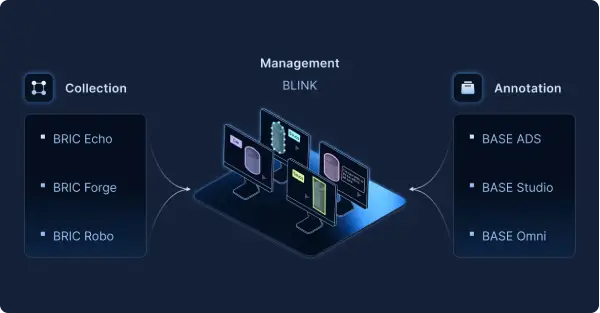
BodenAI’s unified platform reimagines the physical AI data pipeline from the ground up, merging data collection, annotation, task orchestration, and lifecycle management into one modular, flexible system. Built specifically for embodied intelligence, autonomous driving, and robotics development, it eliminates tool silos and unifies every step of data processing for physical AI models.
The platform’s product suite is divided into three core interconnected modules: BRIC for data collection, BASE for professional annotation, and BLINK for full pipeline management. Together, they create a seamless closed-loop workflow tailored for complex physical AI data scenarios.
Multimodal Data Collection with BRIC Suite
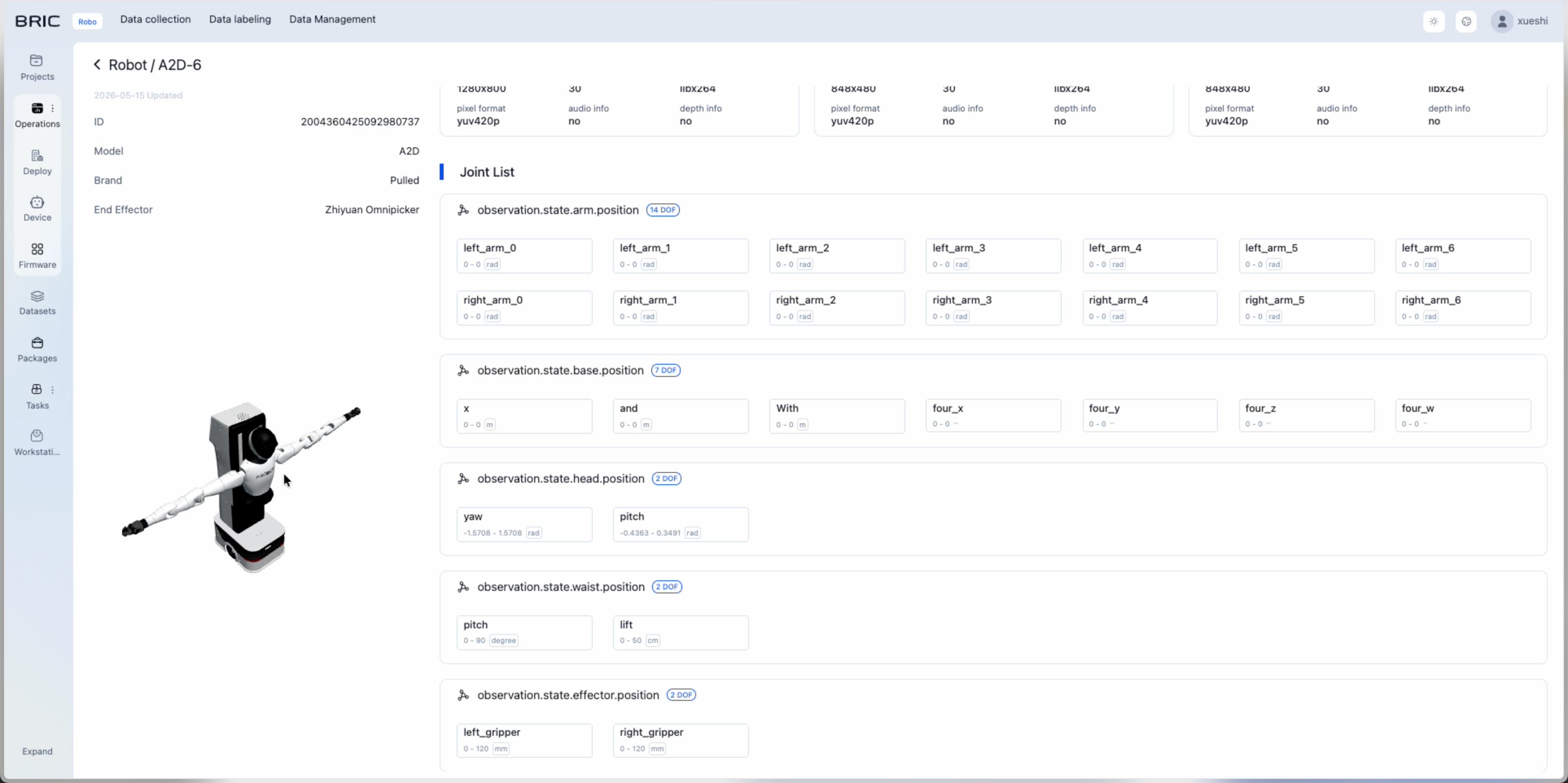
High-quality physical AI models start with high-quality real-world data. The BRIC series of tools simplifies large-scale, multimodal data capture for robotics and autonomous systems. BRIC Robo specializes in robot and embodied agent data collection, accurately capturing synchronized motion, visual, and tactile sensor data. BRIC Echo and BRIC Forge support scalable real-world and synthetic scene data generation, perfectly suited for autonomous driving LiDAR and video dataset building.
All captured data flows directly into the platform’s annotation system without manual conversion or formatting fixes, cutting out the busywork that slows down most AI development teams.
Accurate Custom Annotation via BASE Suite
Complex physical AI data demands precise, customizable labeling — and that’s exactly what the BASE annotation toolkit delivers. Including BASE ADS, BASE Studio, and BASE Omni, this module supports every data type physical AI teams work with: images, video, LiDAR point clouds, audio, text, trajectory data, and more.
Teams can leverage fully dynamic, customizable labeling templates to match unique project requirements, whether building automotive perception models or service robot interaction systems. The platform also includes practical task management features: pending task tracking, flow records, batch reassignment, and task suspension controls. Paired with multi-stage human-in-the-loop quality checks, this system consistently delivers 99%+ labeling accuracy even for million-scale datasets.
Pipeline Orchestration with BLINK Management
Scaling physical AI development requires full visibility and control over every dataset and task. BLINK serves as the platform’s central control hub, unifying all collection and annotation workflows in one intuitive dashboard. Its modular, reusable architecture lets teams start small for R&D prototype projects and rapidly expand to enterprise-scale data operations as their models mature.
The platform also supports continuous data iteration, letting teams constantly refresh and optimize training datasets to reduce the gap between simulation and real-world physical AI performance. This flexible orchestration works across industries, covering autonomous driving, industrial robotics, embodied intelligence, and foundation model + robot fusion scenarios.
Core Production-Grade Platform Strengths
Unlike generic data tools built for lab testing, BodenAI’s platform is engineered for real production environments. It supports large-scale distributed data validation, full multimodal data compatibility, and continuous workflow iteration. Its cross-industry adaptability means teams across automotive, manufacturing, and consumer robotics can tailor the pipeline to fit their unique use cases without rebuilding workflows from scratch.
Enterprise-Grade Security & Data Quality
Physical AI datasets often contain highly sensitive data: proprietary robot motion logs, real-world road footage, industrial environment sensor data, and private scene information. Cutting corners on security and quality doesn’t just create compliance issues — it produces unsafe, unreliable AI models that fail in physical environments.
BodenAI embeds rigorous security protocols and quality control systems directly into its pipeline architecture. Full details on these production-grade safeguards are available at https://www.boden.ai/resources/security, where teams can review the platform’s trust-engineered data protection and quality assurance frameworks built for LLM, autonomous driving, and embodied intelligence use cases.
Data Security & Compliance Controls
To protect client and project data, the platform enforces strict data isolation between all teams and organizations, eliminating cross-project data leakage risks. Fine-grained role-based access control ensures every team member only accesses the data and tasks relevant to their role. Every operation on the platform is fully logged and auditable, delivering complete transparency for compliance reviews.
All data storage and transmission is fully encrypted, with dedicated secure production environments reserved for the most sensitive datasets. Aligned with ISO 27001 security standards and ISO 27701 privacy frameworks, the platform includes built-in data anonymization, de-identification tools, and data minimization mechanisms. These features help teams operate compliant data pipelines across global regions while adhering to major privacy regulations.
Multi-Stage Human-In-The-Loop QA
Guaranteeing clean, reliable physical AI data requires systematic quality control, not random spot checks. BodenAI’s layered QA process starts with expert-level data collection and base annotation, followed by full inspections from a dedicated QA team and random sampling audits by senior domain experts.
Every dataset undergoes strict consistency checks, logical validation, and distribution bias testing to ensure alignment between input data, annotations, and model output requirements. A final client acceptance step locks in dataset quality before data is used for model training. This rigorous system eliminates AI-generated data contamination and maintains 99%+ delivery accuracy, even at PB-scale data volumes.
Why Teams Choose BodenAI’s Platform
Most mainstream data platforms are designed for static computer vision or text-based AI. They lack native multimodal fusion support, robotics-specific data tools, and enterprise security features — making them inefficient and risky for physical AI development.
BodenAI stands out with a truly end-to-end workflow. Every stage from data capture to final dataset delivery works natively within the platform, no third-party integrations or manual workarounds required. This drastically cuts down workflow friction and human error.
It’s also built for scale. While generic tools struggle with large sensor datasets, BodenAI’s infrastructure supports PB-scale data processing, perfectly matching the demands of production-level robotics and autonomous driving projects. Most importantly, security and quality are core, foundational features — not afterthoughts. Teams don’t need to layer on external compliance or QA tools, simplifying their entire data operation stack.
Final Thoughts
In physical AI development, model performance ultimately depends on data quality, consistency, and security. Fragmented, manual data workflows will always limit how reliably your robots and embodied systems perform in the real world. A unified physical AI data pipeline platform removes these limitations, creating a stable, scalable foundation for continuous model improvement and real-world deployment.
If you’re looking to streamline your physical AI data workflows, scale your dataset operations, and enforce enterprise-grade data security and quality, BodenAI’s integrated platform delivers everything you need in one unified solution.
Explore the full end-to-end data pipeline capabilities: https://www.boden.ai/platform
FAQ
What is a Physical AI data pipeline platform?
A physical AI data pipeline platform is an integrated system built specifically for embodied intelligence, robotics, and autonomous driving. It unifies multimodal data collection, annotation, task management, quality assurance, and secure storage, solving the unique challenges of real-world physical sensor data processing that generic AI data tools cannot address.
How does a unified data pipeline improve physical AI model performance?
By eliminating tool silos and manual data processing errors, the platform ensures perfect alignment across multimodal sensor data and annotations. Consistent quality checks and continuous dataset iteration reduce sim-to-real gaps, helping physical AI models generalize better and operate more reliably in real-world environments.
What types of data does the BodenAI physical AI pipeline support?
It natively supports all core physical AI data types, including LiDAR point clouds, video, audio, images, text, and robot motion trajectory data, with fully customizable labeling templates to fit custom project needs.
Can the platform adapt for both small R&D teams and large enterprise projects?
Absolutely. Its modular design supports agile, lightweight workflows for small research teams and seamlessly scales to PB-level enterprise data processing for large automotive and robotics manufacturers.