
Industry Insights
November 11, 2026
Physical AI Training Data for Robot Models

From Algorithm-Centric to Data-Centric Thinking
Why training data is the real bottleneck
In Physical AI and robotics, many teams still focus primarily on model architectures and algorithms. They iterate on policy networks, planners, and multimodal fusion, expecting performance to grow linearly with model complexity. In practice, the limiting factor is often training data: which environments it comes from, how it is structured into datasets, and whether it remains stable and trustworthy over time.
From a project perspective, several issues recur:
1. Real-world data collection is expensive and slow.
2. Scene coverage is narrow and misses long-tail conditions.
3. Multimodal, temporal annotation pipelines are difficult to build.
4. Data handling must meet strict expectations for security and transparency.
Project-first view of Physical AI
Instead of starting with “which architecture should we use?”, teams gain more by asking “what does the robot actually need to do, and what data supports that?”. This project-first view helps design training data strategies that are aligned with deployment goals, rather than collecting data reactively after models have been chosen.
Scene-Driven Planning: Defining What the Robot Must Do
Scenes and tasks as the basis for data requirements
Different Physical AI robots demand different training data. A home assistant robot works in kitchens and living rooms; a warehouse robot operates among racks, boxes, and pallets; a store-facing robot interacts with product displays and dense visual clutter.
Each scene implies specific needs:
1. Visual and depth signals for perception.
2. Task descriptions and language instructions for semantic understanding.
3. Action trajectories and contact data for control and manipulation.

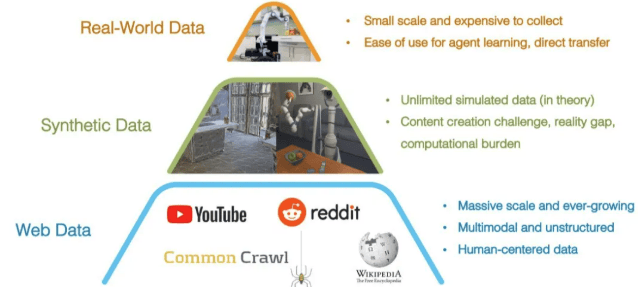
Three layers of data for Physical AI robots
Data for Physical AI robots can be viewed in three layers:
Perception layer
RGB images, video, depth maps, LiDAR point clouds, joint states, and force readings allow robots to recognize objects and understand spatial layouts.
Understanding layer
Task descriptions, scene narratives, and language commands tie goals and constraints to the observed environment.
Control layer
Fine-grained action sequences—end-effector poses, contact events, and sub-action boundaries—capture how tasks are executed and recovered from errors.
Why scenes should drive data, not models
When scenes and tasks are defined first, teams know which modalities are necessary, which environments must be covered, and how to evaluate success. This prevents collecting large volumes of data that do not match deployment conditions and simplifies later benchmarking.
Ego-Centric Datasets: Learning from the Robot’s Own Viewpoint
What an ego-centric dataset is
An ego-centric dataset is built from the viewpoint of the robot or human operator, as a continuous, multimodal stream. Instead of third-person surveillance footage, it records what the acting agent actually sees and experiences during tasks.
Sources typically include:
1. Head-mounted cameras on human operators.
2. Chest- or shoulder-mounted devices.
3. Robot-onboard sensors combining cameras, depth, and inertial data.
Why ego-centric data matters for Physical AI
For Physical AI robot models, ego-centric datasets are central because they:
1. Preserve temporal continuity
Models observe sequences of actions and reactions, not just isolated frames. This is crucial for learning robust policies and recovery behaviors.
2. Capture interaction-centric viewpoints
Cameras and sensors register the scene at the moment of contact: grasping, opening, pushing, and navigating around obstacles.
3. Reflect real decision conditions
Ego-centric data carries occlusions, lighting variation, human presence, and clutter—conditions that robots may encounter during real-world operation.
Key design dimensions for ego-centric datasets
Effective ego-centric datasets require attention to:
1. Viewpoint stability and relevance
Devices must be mounted in ways that mirror natural observation and manipulation habits.
2. Task diversity and failure retention
Datasets should include successful executions, near misses, and failures, so models can learn boundary behavior.
3. Scene transferability
Data spanning homes, offices, industrial facilities, and stores can support cross-scene generalization.
From Fully In-House Collection to Combined Data Strategies
Limits of collecting everything yourself
Teams often begin with the assumption that all data must be self-collected. This offers control but quickly reveals constraints:
1. Robot availability and operator time limit collection throughput.
2. Accessible environments dictate scene diversity.
3. Building multimodal, temporal annotation pipelines is costly.
4. Managing data security and lifecycle becomes a major engineering task.
Logic of a combined data strategy
A combined data strategy addresses these constraints by layering sources:
1. General ego-centric datasets
Provide broad distributions over everyday interactions and environments.
2. Project-specific data
Capture enterprise-specific layouts, workflows, and constraints.
4. Simulation data
Support low-risk exploration and early testing of policies.
Benefits for Physical AI training
For Physical AI robots, combined strategies enable:
1. Faster initialization on general skills.
2. More targeted internal collection focused on unique requirements.
3. Iterative adaptation of data sources as scenes and tasks evolve.
BodenAI Datasets: Real-World Starting Points for Robot Projects
BodenAI’s role in Physical AI and robotics data
BodenAI focuses on data infrastructure for Physical AI and robotics, building real-world multimodal training data so teams can start from physical-world distributions rather than assembling collection stacks from scratch.
Data types available in BodenAI datasets
On the BodenAI datasets page, the available data types include:
Robotics datasets
Multimodal data centered on robot tasks and teleoperation trajectories, spanning diverse environments.
Visual datasets
Image and video data for perception and scene understanding components.
Audio and interaction datasets
Material capturing more complex agentic behavior and interaction dynamics.
These resources can be delivered with consistent formats and metadata to support integration into relevant training workflows.
Physical AI robotics data with real-world characteristics
For Physical AI, BodenAI’s robotics datasets may include several relevant characteristics:
Multi-scene coverage
Data can originate from homes, offices, industrial sites, and retail spaces.
Rich action sequences
Long-duration teleoperation trajectories can capture detailed manipulation, from simple pick-and-place to multi-step tasks.
Ego-centric perspectives
Streams from operator or robot viewpoints give models access to how tasks are perceived and executed over time.
Using BodenAI datasets as a pre-training distribution
BodenAI datasets can serve as pre-training distributions for Physical AI robot models. Models can first learn general patterns of perception and action, then adapt using project-specific data. This approach can:
1. Reduce cold-start challenges when internal data is limited.
2. Provide a baseline for evaluating architectures.
3. Help identify the gap between general behavior and enterprise-specific demands.
Integrating BodenAI Data into Training Pipelines
Aligning formats, metadata, and tasks
Integrating BodenAI datasets into existing pipelines involves:
Format alignment
Matching images, sequences, and action representations to model input structures.
Metadata mapping
Ensuring labels and task descriptors correspond to the project’s taxonomy.
Pipeline routing
Configuring preprocessing, augmentation, training, and evaluation stages to handle new data sources.
Three layers of data for Physical AI robots
A practical integration path for Physical AI projects
A typical path can be described as follows:
Task and scene specification
Define target environments and operations, such as kitchen tasks or warehouse box handling.
Dataset selection and mapping
Choose relevant BodenAI datasets and map them to the project’s input and label formats.
Initial training and exploration
Train models on these datasets to establish baseline capabilities and test architectural options.
Project-specific fine-tuning
Introduce self-collected data from enterprise scenes to refine behavior and adapt to specific layouts.
Combining BodenAI data with internal data
In this workflow, BodenAI and internal data play distinct roles:
1. BodenAI provides a general distribution baseline.
2. Internal data delivers enterprise distribution adjustment.
This allows teams to allocate internal resources to unique scenarios while leveraging a structured data foundation for common capabilities.
Secure and Trusted Data Processing Environments
Data handling as a core part of the strategy
As Physical AI projects scale, questions about where and how data is processed become central. A secure and trusted data processing environment is therefore a fundamental part of the overall data strategy.
BodenAI’s approach to secure and trusted processing
BodenAI builds secure and trusted data processing environments through practices such as:
Infrastructure-level safeguards
Isolation and encryption during collection, storage, and transmission help mitigate unauthorized access risks.
Fine-grained access control
Role-based permissions can limit access according to assigned responsibilities, while detailed logs support transparent and auditable data usage.
Sensitivity minimization
Sensitive-information masking, de-identification, and data-minimization measures can reduce unnecessary exposure of identifiable information.
Implications for Physical AI and robotics projects
For Physical AI robots, these practices can provide:
1. Long-term, manageable stewardship of training data.
2. A stable basis for collaboration across engineering, data, and business teams.
3. An environment in which data strategies can evolve without undermining trust.
BodenAI as a Physical AI Data Engine Builder
Data infrastructure for Physical AI
Within its Physical AI business line, BodenAI builds data infrastructure that supports the collection, processing, annotation, delivery, and ongoing maintenance of robotics data.
This approach is intended to support the data requirements of Physical AI projects, including multimodal perception, ego-centric task execution, robot manipulation, navigation, and scene understanding.
Company qualifications and management systems
BodenAI publicly lists management system certifications and capability credentials that cover information security, privacy information management, quality management, IT service management, data management, and process maturity.
Relevant qualifications listed by BodenAI include:
1. ISO/IEC 27001:2022 Information Security Management System.
2. ISO/IEC 27701:2019 Privacy Information Management System.
3. GB/T 19001-2016 / ISO 9001:2015 Quality Management System.
4. ISO/IEC 20000-1:2018 Information Technology Service Management System.
5. CMMI® Maturity Level 5 against the CMMI® v3.0 Model DEV view.
6. DCMM (GB/T 36073-2018) Data Management Capability Maturity Level 2 (Managed).
Acting as a data engine builder
In long-term Physical AI collaborations, BodenAI acts as a data engine builder:
1. Platform capabilities unify collection, annotation, and delivery.
2. Specialized data teams help maintain consistency and quality.
3. Engineering workflows support continuous data updates and dataset expansion.
This engine-centric perspective treats data infrastructure as an ongoing capability rather than a one-off project artifact.
Project-Level Physical AI Data Strategies
Three layers of a coherent data strategy
A coherent Physical AI data strategy can be organized into three layers:
General ego-centric dataset
Provides broad physical-world experience for basic perception and action skills.
Project-specific data
Refines behavior to match enterprise scenes, workflows, and constraints.
BodenAI datasets
Offer structured starting distributions and expandable resources as projects scale.
Treating training data as foundation engineering
When teams treat training data as foundation engineering, they can:
1. Plan data collection and dataset construction alongside model and hardware roadmaps.
2. Adjust data strategies as scenes and business objectives evolve.
3. Build Physical AI robots grounded in well-managed, continuously improving data foundations.
By combining ego-centric datasets, project-owned data, and BodenAI’s Physical AI data infrastructure, teams can establish a practical path to deploy and iterate robots in the physical world with greater stability and confidence—within a data budget that is planned rather than improvised.
FAQ
How should a Physical AI team decide whether to use ego-centric data, project-specific data, or both?
Use ego-centric datasets to establish general perception-action patterns across diverse interactions, then use project-specific data to cover the layouts, objects, workflows, safety boundaries, and exception cases that are unique to the deployment environment. The appropriate balance depends on how far the target scene differs from the available general data distribution.
What should be checked before mapping external robotics datasets into an internal training pipeline?
Teams should validate sensor modalities, coordinate systems, timestamp synchronization, action representations, task taxonomies, annotation definitions, metadata completeness, and data licensing or permitted-use boundaries. These checks help prevent incompatibilities that may only emerge during training or evaluation.
Why should failure trajectories be retained in Physical AI training data?
Failure trajectories can reveal recovery actions, contact errors, perception ambiguities, and operational boundaries. Retaining them in a clearly labeled and reviewable form can help teams evaluate whether a model distinguishes successful completion from incomplete, unsafe, or unstable task execution.
How can enterprise teams assess whether a data processing environment is suitable for Physical AI projects?
Teams can review whether the environment supports controlled access, data isolation, encryption during storage and transmission, traceable operational logs, sensitivity-minimization measures, defined delivery processes, and clear data lifecycle responsibilities. The review should be aligned with the organization’s own security and procurement requirements.