
Industry Insights
September 24, 2026
Building Raw Massive Datasets for Embodied AI: How BodenAI Turns Real-World Robot Data Into Training Infrastructure
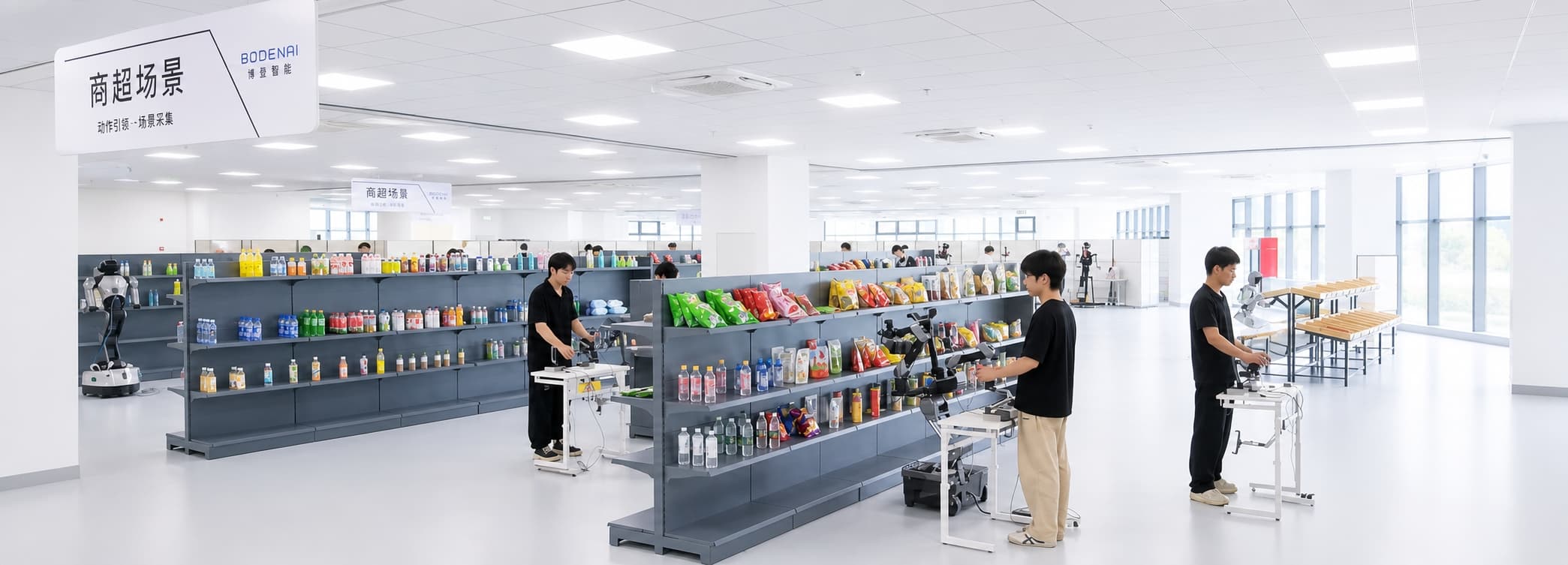
Embodied AI is moving from controlled demonstrations to robots that must operate reliably in real environments. As this shift happens, one constraint is becoming increasingly difficult to ignore: robots need far more real-world data than conventional AI systems.
A robot learning to manipulate an object does not simply need an image of the object. It needs to understand where the object is, how it moves, how the robot approaches it, what happens when contact occurs, and how the task changes when the environment or object state is different.
This creates a new data requirement.
Instead of building relatively static datasets from images or text, robotics teams need raw, massive, multimodal datasets that capture real-world interactions at scale. These datasets may include video, robot states, actions, trajectories, language instructions, tactile signals, environmental information, and task outcomes.
The challenge is no longer simply collecting more data. It is building the infrastructure capable of turning large volumes of heterogeneous physical-world experience into data that can actually support model training, evaluation, and iteration.
Why Embodied AI Needs Raw Massive Datasets
For generative AI, adding more text, images, or video can expand a model's knowledge and capabilities. Robotics introduces another dimension: physical interaction.
A robot must learn not only what something looks like, but also what happens when it interacts with it.
A single manipulation trajectory can contain:
- Multi-camera video
- Robot joint states
- End-effector poses
- Action commands
- Object states
- Task instructions
- Human demonstrations or teleoperation signals
- Environmental context
- Interaction outcomes
- Failure and recovery behaviors
These signals also operate at different frequencies and timescales.
A camera may capture dozens of frames per second, while robot state data can be recorded at much higher frequencies. Language instructions may occur only once per task, while action trajectories continuously change throughout an episode.
For training, these signals need to remain synchronized and meaningful.
This makes raw embodied AI data fundamentally different from a collection of independent images or videos.
The objective is not simply to create a large dataset.
It is to create a dataset with enough diversity, structure, temporal consistency, and task coverage to help a robot generalize beyond the exact conditions seen during data collection.
From More Data to Better Data Infrastructure
Large-scale robotics data creates an infrastructure problem.
A typical workflow might look simple:
Collect → Annotate → Train
At small scale, this can work.
At production scale, however, robotics teams need to manage much more:
Collect → Organize → Clean → Synchronize → Curate → Train → Evaluate → Identify Gaps → Collect Again
The output of model evaluation becomes an input to the next round of data collection.
For example, a robot may successfully pick up objects in a controlled environment but fail when objects are partially occluded, placed at unusual angles, or surrounded by clutter.
Simply collecting another large volume of generic manipulation data may not solve the problem.
The data pipeline needs to identify the failure distribution and generate or collect targeted examples around those conditions.
This is why Physical AI data infrastructure is becoming an important part of the robotics development stack.
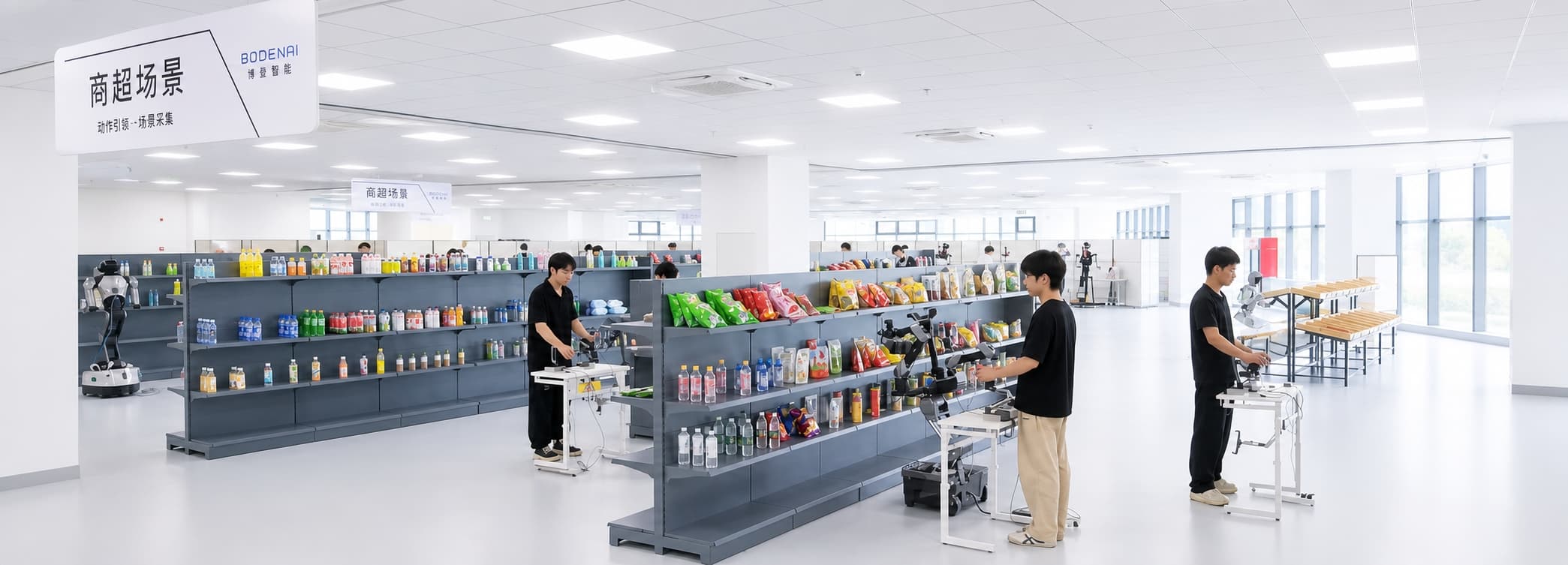
BodenAI approaches this problem as a full-stack data infrastructure challenge, combining data collection, curation, annotation, management, production-grade datasets, simulation, and real-world validation. Its platform is designed around a unified workflow rather than isolated data-processing tools.
What Makes a Raw Massive Embodied AI Dataset Useful?
Raw data is valuable because it preserves information from the physical world before excessive processing removes potentially useful signals.
But raw does not mean unstructured.
For robotics, a useful raw dataset should preserve relationships between different data streams.
Consider a robot grasping a cup.
A useful training sample may need to connect:
Visual Observation + Robot State + Hand Pose + Action + Contact + Task Outcome
If these signals are stored separately without reliable temporal alignment, much of the value is lost.
A scalable Embodied AI data builder therefore needs to think about several dimensions simultaneously.
Multimodal Coverage
Robots increasingly learn from more than RGB cameras.
Depending on the application, datasets may incorporate visual, positional, motion, language, and tactile information.
This becomes especially important for fine manipulation tasks where visual information alone cannot fully describe physical interaction.
Task Diversity
A massive dataset should not consist of millions of repetitions of essentially the same trajectory.
Useful diversity can come from different:
- Objects
- Robot embodiments
- Environments
- Task instructions
- Object configurations
- Motion patterns
- Interaction states
- Human demonstrations
- Failure conditions
The objective is to expand the distribution of experiences available to the model.
Real-World Variation
Physical environments are inherently variable.
Lighting changes. Objects move. Surfaces differ. Humans intervene. Objects become partially occluded. A robot may approach a task from a slightly different position.
Real-world data captures these variations in ways that controlled synthetic environments cannot always reproduce.
Data Quality and Consistency
At massive scale, quality cannot depend entirely on manual inspection.
Collection protocols, sensor synchronization, metadata structures, quality checks, annotation workflows, and dataset versioning all become part of the data infrastructure.
The larger the dataset becomes, the more important these systems are.
BodenAI as an Embodied AI Data Builder
BodenAI positions itself around the idea of “Train at Scale. Validate in Reality.” Its Physical AI offering is designed to connect large-scale data generation with robotics training and real-world validation.
Its infrastructure covers several layers of the Physical AI data lifecycle.
Real-World Data Collection
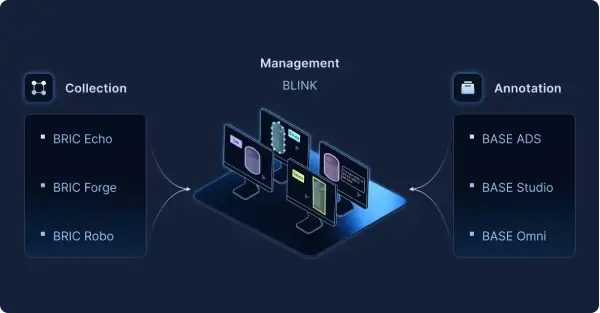
BodenAI's BRIC data acquisition tools are designed for robotics and embodied-agent data collection, including synchronized motion and visual information. Its broader data infrastructure connects collection with annotation and data management rather than treating data capture as an isolated step.
Data Curation and Annotation
Raw robot trajectories need to become structured training assets.
BodenAI's platform combines data collection, annotation, task orchestration, and lifecycle management into a unified pipeline. This allows robotics teams to manage different data types and processing stages within a connected workflow.
Production-Grade Robotics Datasets
BodenAI also provides ready-to-use embodied and robotics datasets covering multiple environments and tasks.
Its published dataset samples include household activities such as food preparation and cookware manipulation, retail scenarios such as supermarket shopping and cleaning, pharmacy tasks, and industrial operations including gear assembly, conveyor sorting, chip installation, bearing installation, and battery installation.
This diversity matters because a robot trained only on one narrow environment may struggle when deployed into a different physical context.
Explore BodenAI's Embodied AI Datasets
Scaling From Robot Data Collection to a Data Engine
A major difference between a robotics data vendor and an Embodied AI data infrastructure provider is the ability to operate the entire data loop.
A production-oriented workflow needs to answer questions such as:
- How should different robot embodiments be integrated?
- How are multiple sensors synchronized?
- How are long trajectories segmented into useful training samples?
- How are failures identified?
- How are rare scenarios collected?
- How can datasets be updated without losing version consistency?
- How can training results inform the next round of data collection?
This is where the concept of a data engine becomes more useful than simply a dataset.
BodenAI's Physical AI solution combines massive-scale data acceleration, Sim-to-Real transfer, corner-case simulation, and environment validation alongside production-grade datasets.
The result is a workflow in which data is not treated as a one-time deliverable.
It becomes part of the continuous model-development cycle.
A Real-World Example: Building Multimodal Tactile Data With Xense Robotics
One example of this approach is BodenAI's strategic collaboration with Xense Robotics.
The two companies entered into a strategic partnership involving a commercial order at the tens-of-millions RMB level, focusing on robot interaction data collection, data governance, and generalized application scenarios involving high-quality tactile data.
The collaboration addresses an important limitation of vision-centric robot learning.
A camera can tell a robot what an object looks like. Tactile sensing can provide additional information about physical contact, texture, force, and interaction states.
For manipulation, these signals can be highly complementary.
The collaboration therefore focuses on combining Xense Robotics' tactile hardware capabilities with BodenAI's data infrastructure and physical-world data collection capabilities.
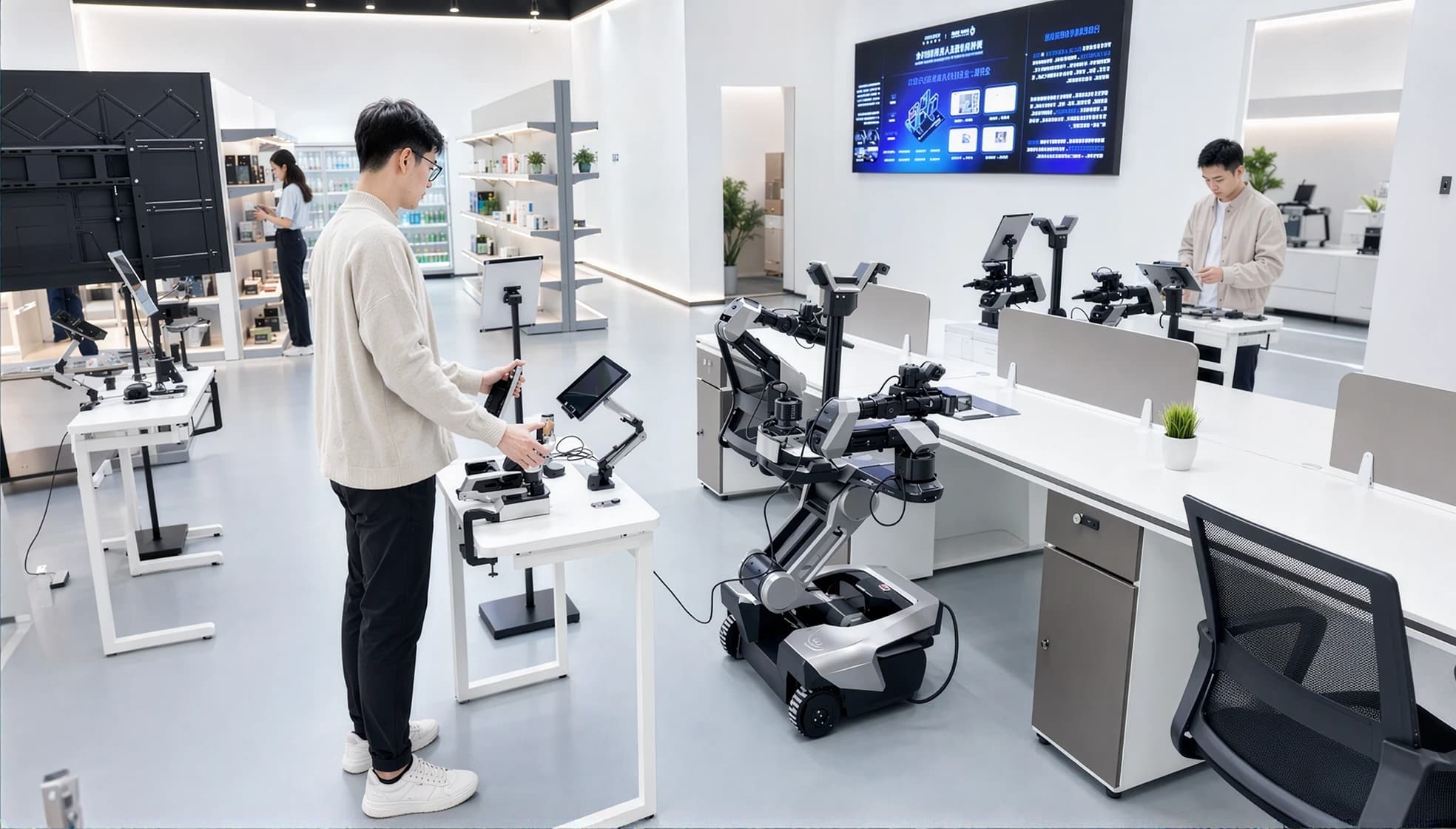
Among the technologies involved is XTac UMI G1, which is being explored for robot manipulation data collection. BodenAI's EgoSight and BRIC Robo platforms are used as part of the broader data infrastructure for integrating physical-world interaction data.
The goal is not simply to collect tactile signals.
It is to create synchronized multimodal datasets in which tactile information can be connected with visual observations, hand poses, robot actions, and task outcomes.
This creates a richer representation of the interaction:
Vision + Tactile + Pose + Action → Physical Interaction
For embodied foundation models, such data can support training, fine-tuning, evaluation, and real-robot reinforcement learning workflows.
Why Tactile Data Changes the Dataset Problem
Tactile data introduces another layer of complexity to robotics data infrastructure.
A robot interacting with an object may simultaneously generate:
- Camera streams
- Tactile sensor signals
- Joint states
- End-effector poses
- Action trajectories
- Task instructions
- Object states
- Interaction outcomes
The value of these signals depends heavily on synchronization.
A tactile event that occurs during contact needs to be associated with the corresponding visual frame, robot state, and action.
Otherwise, the dataset may contain a large amount of sensor information without preserving the physical relationship between those signals.
This is why scaling multimodal robot data is not simply a matter of adding more sensors.
The infrastructure needs to make the data usable together.
BodenAI and Xense Robotics' collaboration focuses on this connection between hardware, multimodal data acquisition, data engineering, and model development.
From Raw Data to Training-Ready Physical Intelligence
The long-term value of a massive dataset is determined by what can be done with it.
For an Embodied AI team, the workflow may eventually look like:
Real-World Interaction → Raw Multimodal Data → Data Engineering → Training Dataset → Model Training → Evaluation → Failure Analysis → Targeted Data Collection
This closed loop changes the role of data.
Data is no longer simply an input to the model.
It becomes a mechanism for discovering what the model does not yet understand.
For example, if a manipulation policy repeatedly fails when handling deformable objects, the next dataset can be deliberately designed around:
- Different object shapes
- Different material properties
- Different initial states
- Different grasp points
- Different camera viewpoints
- Different contact conditions
- Recovery behaviors
This is how raw massive datasets become increasingly useful over time.
The goal is not maximum volume for its own sake.
The goal is maximum learning value per unit of physical-world experience.
Building the Data Foundation for Physical AI
The next stage of embodied AI development will require more than larger models and more compute.
Robotics teams need access to physical-world data at a scale and quality that can support continuous model iteration.
That requires infrastructure capable of connecting:
Real Robots → Real Environments → Multimodal Data → Data Engineering → Training → Evaluation → Real-World Validation
BodenAI is building around this infrastructure model, combining real-world data collection, production-grade datasets, data platforms, simulation, and validation for Physical AI applications. Its current dataset portfolio demonstrates coverage across industrial, household, retail, and pharmacy environments, while its Physical AI solution is designed to support scalable data generation and robotics development.
The collaboration with Xense Robotics illustrates another direction for this data infrastructure: moving beyond vision-only datasets toward multimodal physical interaction data, including tactile sensing.
As embodied models become more capable, the bottleneck will increasingly shift from simply having a model to giving that model enough structured experience of the physical world.
That is the role of an Embodied AI data builder: turning raw, massive, heterogeneous real-world experience into an infrastructure layer that robotics teams can continuously use to train, evaluate, and improve physical intelligence.
Train at Scale. Validate in Reality.