
Industry Insights
September 17, 2026
The Future of Physical AI Robotics Starts With Better Data
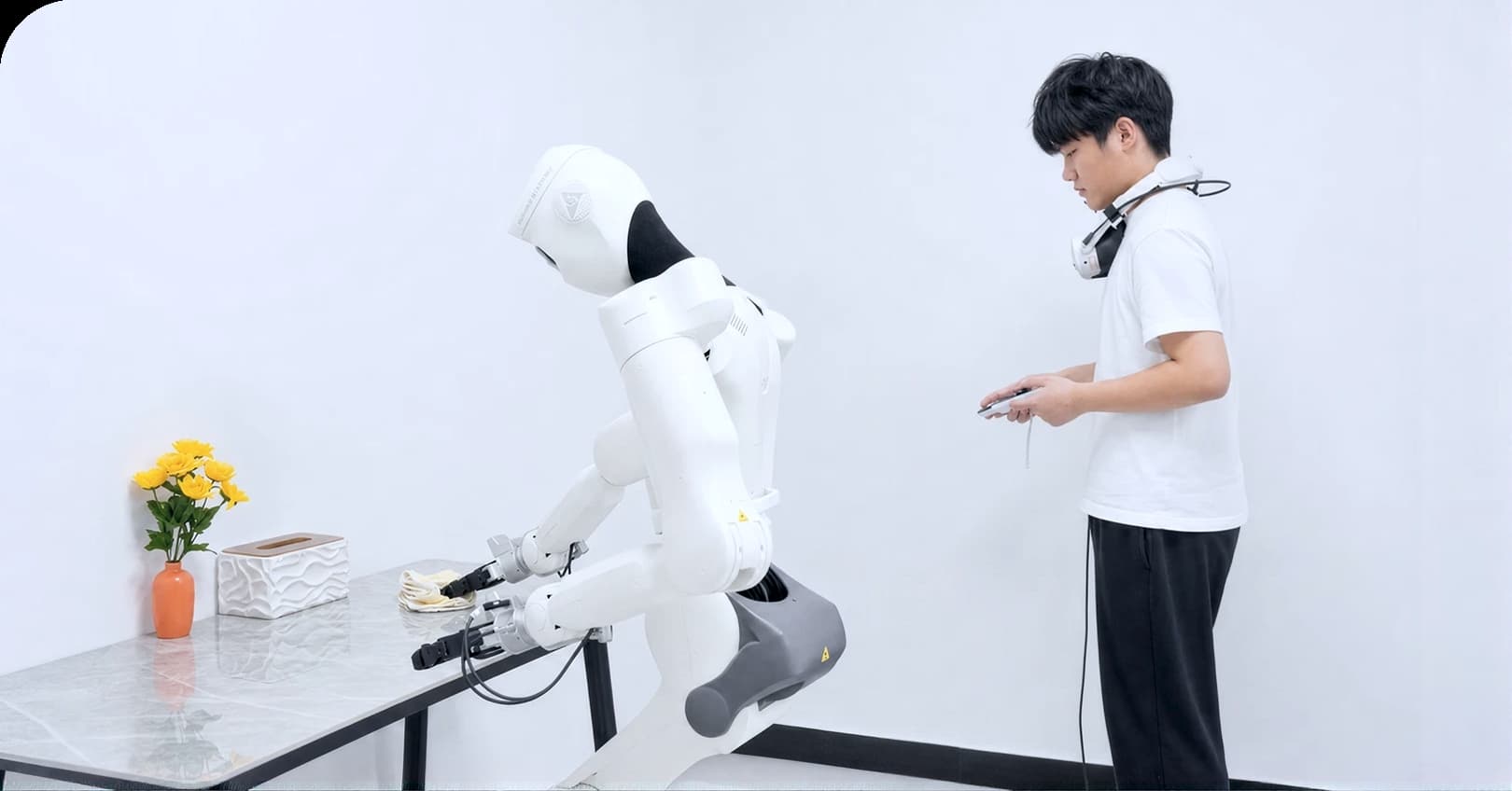
Physical AI robotics is entering a stage where model capability alone is no longer the primary constraint.
As robotic systems move from controlled demonstrations toward long-horizon tasks in dynamic environments, the engineering problem increasingly shifts from how to build a better policy to how to continuously produce the right data for improving that policy.
A robot foundation model may have strong visual reasoning capabilities, but this does not guarantee reliable physical execution. The model still needs to learn the relationship between perception, spatial state, action, contact, failure, recovery, and task outcome.
That creates a fundamentally different data problem.
For Physical AI robotics, training data is not simply a collection of images, videos, or trajectories. It is a structured record of physical interaction over time.
At BodenAI, we approach this problem from the data infrastructure layer: building the systems required to capture physical interactions with high fidelity, structure multimodal signals, generate training-ready data, control dataset quality, and continuously feed real-world experience back into model development.
Physical AI Robotics Is a Temporal Data Problem
The most important characteristic of robotics data is temporal dependency.
A robot does not make decisions from isolated frames. Its behavior emerges from a sequence:
Observation → State Estimation → Action → Physical Response → New Observation
Every action changes the subsequent state of the environment.
For example, a manipulation trajectory may contain:
- RGB or RGB-D frames
- Robot joint positions
- Joint velocities
- End-effector pose
- Gripper state
- Force and torque signals
- Object pose
- Robot action commands
- Task instructions
- Collision or contact events
- Success or failure states
The training value comes from the temporal relationship between these signals.
If the visual observation is misaligned with the corresponding robot action, the dataset may teach an incorrect relationship between perception and control.
This is why Physical AI robotics data infrastructure cannot be designed as a conventional storage-and-annotation workflow. Temporal integrity has to be treated as a first-class data property.
From Sensor Streams to Actionable Robot Data
Raw sensor data is only the starting point.
A useful robotics dataset needs to transform heterogeneous sensor streams into structured training units.
At the acquisition layer, this requires consistent handling of:
Timestamp → Sensor State → Robot State → Action → Environment Response
The challenge becomes significantly harder when different sensors operate at different frequencies.
A camera may generate frames at one rate, joint states at another, force sensors at another, while robot control commands may operate at a much higher frequency.
The data pipeline therefore needs mechanisms for:
- Timestamp synchronization
- Sensor calibration
- Coordinate transformation
- Sensor-to-robot alignment
- Joint-space mapping
- Trajectory reconstruction
- Missing-data detection
- Sequence integrity validation
These operations determine whether a trajectory is actually usable for model training.
At BodenAI, we treat data acquisition as an engineering problem rather than simply a recording process. Our BRIC data acquisition architecture is designed to standardize heterogeneous robot and sensor inputs so that physical interaction data can enter downstream data workflows without repeatedly rebuilding integration logic. Our BRIC Robo workflow includes robot registration, streaming integration, joint-space mapping, and sensor alignment.
Multimodal Alignment Is Critical for Robot Learning
Physical AI robotics increasingly depends on multimodal models.
A robot may simultaneously interpret:
- Visual observations
- Depth information
- LiDAR or spatial measurements
- Audio
- Tactile signals
- Proprioceptive states
- Natural-language instructions
- Robot actions
The objective is not simply to make these modalities available.
They must be semantically and temporally aligned.
Consider a grasping trajectory.
The visual stream identifies an object.
The robot moves its end effector.
The gripper closes.
Force feedback changes.
The object moves.
The robot confirms whether the grasp succeeded.
A training sample that breaks these relationships into independent records loses a significant portion of the physical interaction context.
For VLA and other embodied models, the useful representation is closer to:
Instruction + Scene State + Robot State + Action + Outcome
rather than:
Image + Label
This distinction becomes increasingly important as robotics models move from perception-centric training toward action-conditioned learning.
Robot Trajectory Data Needs More Structure
Trajectory data is often treated as a sequence of robot states.
For Physical AI robotics, that representation is insufficient.
A trajectory should provide enough context to answer:
What was the robot trying to accomplish?
What did it observe before acting?
What action did it execute?
What changed in the environment?
Did the action succeed?
If it failed, what happened next?
This makes task segmentation and event-level structure particularly important.
A long trajectory can be decomposed into meaningful interaction segments:
approach → grasp → lift → transport → place → release
Each segment can then be connected to its corresponding observation, robot state, action, and outcome.
This structure is valuable for supervised learning, imitation learning, reinforcement learning, trajectory retrieval, failure analysis, and policy evaluation.
The data pipeline therefore needs to preserve both low-level motion fidelity and high-level task semantics.
Failure Data Is a First-Class Training Signal
For real-world robotics, successful demonstrations alone are not sufficient.
A model trained primarily on successful trajectories may learn an idealized action distribution while remaining weak in situations where the environment deviates from expectations.
Physical environments naturally produce failure modes:
- Incorrect object localization
- Partial occlusion
- Failed grasping
- Object slippage
- Unexpected obstacles
- Misaligned placement
- Sensor degradation
- Human intervention
- Unstable contact
- Unexpected object motion
These failures should not automatically be removed from the dataset.
A failed trajectory can become highly valuable training data when the dataset preserves the state before failure, the failed action, the resulting state, and the recovery behavior.
For reinforcement learning and policy iteration, this becomes even more important.
The objective is not merely to learn:
Which action succeeds?
It is also to learn:
Under which state does an action fail, and how should the policy recover?
This requires a data infrastructure capable of preserving unsuccessful interactions instead of optimizing datasets exclusively for clean demonstrations.
Data Quality in Physical AI Is Different from Annotation Accuracy
For conventional perception datasets, annotation accuracy is often the dominant quality metric.
Physical AI robotics requires a broader definition of data quality.
A trajectory can have perfectly accurate object labels and still be unusable if:
- Sensor timestamps are misaligned
- Coordinate systems are inconsistent
- Robot actions are incomplete
- Frames are missing
- Trajectory segments are incorrectly ordered
- Task boundaries are wrong
- The outcome label does not match the actual physical state
Therefore, Physical AI data QA needs to operate across multiple dimensions.
Temporal Consistency
Do sensor observations and robot actions correspond to the same physical moment?
Spatial Consistency
Are sensor coordinates, robot coordinates, and object coordinates correctly transformed?
Semantic Consistency
Does the annotation accurately represent the physical state and task stage?
Trajectory Integrity
Is the action sequence complete and physically coherent?
Outcome Consistency
Does the success or failure label correspond to the actual result?
Distribution Quality
Does the dataset contain sufficient diversity across environments, objects, tasks, embodiments, and edge cases?
This is why robotics data quality should be treated as a system-level property, not simply an annotation score.
Physical AI Robotics Requires a Continuous Data Loop
The traditional dataset workflow is essentially linear:
Collect → Annotate → Train
This model is increasingly inadequate for Physical AI.
A deployed robot continuously encounters situations that were not represented adequately in the original training distribution.
A more effective architecture is:
Collect → Structure → Curate → Train → Deploy → Observe → Collect Again
The deployment environment becomes another source of training data.
This creates a continuous data flywheel.
When a model encounters an unfamiliar object configuration, an unusual contact state, or a failed trajectory, that interaction can be captured and routed back into the data pipeline.
The dataset therefore evolves according to actual model behavior.
This is particularly important for long-horizon manipulation, mobile manipulation, humanoid robotics, and other tasks where small errors can compound across multiple actions.
Scaling Robot Data Requires Infrastructure, Not More Manual Operations
At the beginning of a robotics project, engineers can manually inspect trajectories, write conversion scripts, and move datasets between tools.
That approach becomes increasingly fragile as the project scales.
The number of combinations grows rapidly:
Robot × Sensor × Task × Environment × Operator × Data Type × Model Version
Without standardized infrastructure, every new robot or sensor configuration can introduce another custom integration.
This creates several problems:
- Repeated data conversion
- Inconsistent schemas
- Difficult dataset versioning
- Poor traceability
- Manual QA bottlenecks
- Difficult cross-project reuse
- Limited visibility into data lineage
A scalable Physical AI robotics pipeline should instead establish common infrastructure primitives for acquisition, processing, annotation, quality control, and dataset management.
This allows new robots and new task categories to enter an established data system rather than creating another isolated workflow.
A Unified Data Architecture for Physical AI Robotics
We designed the BodenAI platform around this requirement.
The objective is to connect the complete physical AI data lifecycle rather than treating collection, annotation, and management as separate systems.
At the acquisition layer, BRIC provides the infrastructure for collecting high-fidelity physical-world data.
At the annotation layer, BASE supports multimodal data production across visual, LiDAR, audio, text, trajectory, and other data types.
At the management layer, BLINK provides centralized workflow and data management capabilities.
Together, these layers create a unified path from raw physical interaction data to structured training datasets and subsequent iteration.
For robotics teams working with heterogeneous embodiments and multimodal sensor configurations, this architecture is particularly important because data acquisition and downstream annotation should not become disconnected engineering pipelines.
Explore the BodenAI platform →
The Data Layer Between Robots and Foundation Models
As Physical AI robotics develops, the architecture increasingly looks like:
Physical World → Sensors → Data Infrastructure → Training Data → Foundation Model → Policy → Robot → Physical World
The data infrastructure sits directly in the middle of this loop.
It determines how physical experience is represented before reaching the model.
This layer therefore influences:
- What experiences the model can learn from
- Which edge cases are represented
- How accurately perception and action are aligned
- How quickly failures can become new training data
- How reproducible model experiments are
- How efficiently datasets can be regenerated
The quality of the model is constrained not only by its architecture but also by the quality and structure of the interaction data available to it.
For this reason, we increasingly view data infrastructure as part of the robotics intelligence stack itself.
From Data Collection to Robot Intelligence
The next phase of Physical AI robotics will require a shift in how teams think about data.
The key question is no longer:
How much robot data can we collect?
The more important questions are:
Can we preserve the physical context of every interaction?
Can we align perception, state, action, and outcome?
Can we identify which experiences are actually useful for training?
Can failures and recoveries be converted into structured learning signals?
Can the entire data pipeline scale as the number of robots and tasks increases?
These questions define the real infrastructure challenge behind Physical AI robotics.
A scalable robot intelligence system needs a scalable data system underneath it.
At BodenAI, we focus on building that underlying layer—from physical-world data acquisition and multimodal structuring to annotation, quality control, dataset management, and continuous iteration.
The objective is straightforward:
Capture the physical world with fidelity. Structure interaction data with precision. Turn real-world experience into continuously improving robot intelligence.
If you are building a Physical AI or robotics system and need to design a scalable data pipeline for robot interaction data, multimodal datasets, VLA training, or real-world policy iteration, talk to our technical team to discuss your data infrastructure requirements: