
Industry Insights
November 11, 2026
What Is Physical AI? A Technical Perspective on Data, Intelligence, and Real-World Interaction
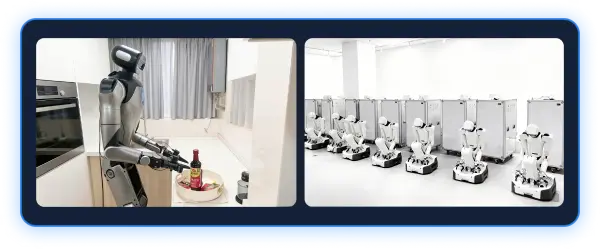
Physical AI is moving artificial intelligence from purely digital environments into systems that must perceive, reason about, and interact with the physical world.
The defining challenge is not simply enabling an AI model to control a robot. It is building a learning system that can continuously connect multimodal perception, spatial-temporal understanding, decision-making, physical action, and environmental feedback.
From a data infrastructure perspective, this changes almost everything.
Physical AI models do not learn only from static images, text, or isolated labels. They need structured representations of what happened in an environment, where it happened, when it happened, what action was taken, and what physical state resulted from that action.
This makes data infrastructure a fundamental component of Physical AI development.
What Is Physical AI?
Physical AI is an AI paradigm in which models learn to perceive, reason about, and act within physical environments.
A useful abstraction is:
Perception → State Representation → Reasoning → Action → Feedback
The system receives multimodal observations from the physical environment, builds an internal representation of the current state, predicts or evaluates possible actions, executes an action through a physical agent, and then observes the resulting state.
The critical difference is that the model operates within a dynamic physical system.
A change in the environment can alter the validity of the next action. An object can move, a human can intervene, a robot can encounter unexpected resistance, or the relationship between two objects can change after manipulation.
Therefore, Physical AI requires models to learn not only correlations between inputs and outputs, but also relationships between physical states, actions, and outcomes.
This is why the data problem for Physical AI is fundamentally different from conventional AI training.
Physical AI Is a Closed-Loop Learning Problem
For Physical AI, a dataset should not be viewed simply as a collection of independent samples.
A more useful representation is a sequence of physical states and transitions:
Sₜ → Aₜ → Sₜ₊₁
Where:
- Sₜ represents the physical state at time t
- Aₜ represents the action taken at time t
- Sₜ₊₁ represents the resulting state
For multimodal systems, each state can contain multiple synchronized streams:
Sₜ = {Vision, Depth, Audio, Robot State, Force/Tactile, Spatial Context, Task State}
This structure allows a model to learn relationships such as:
- what the robot observed before an action;
- which action was executed;
- how the robot's state changed;
- how objects moved;
- whether the task progressed successfully;
- what environmental feedback followed the action.
The value of Physical AI data therefore depends heavily on temporal continuity and cross-modal alignment.
A single image can describe a scene.
A synchronized trajectory can describe how the scene evolved and how an agent interacted with it.
That distinction is central to Physical AI training.
Why Temporal Structure Matters
Physical interaction is inherently sequential.
Consider a manipulation task. The relevant information is not limited to the final frame showing an object in a new position.
A model needs to understand the trajectory that produced that result:
Initial Scene → Approach → Contact → Grasp → Manipulation → Placement → Final State
If intermediate states are missing or poorly synchronized, the model loses information about causality.
This creates several requirements for Physical AI datasets.
Temporal synchronization
Camera streams, robot states, motion trajectories, and other sensor modalities need consistent timestamps.
Even relatively small synchronization errors can introduce incorrect relationships between perception and action.
Continuous trajectories
The transition between states can be as important as the states themselves.
For manipulation, navigation, and dynamic interaction, trajectory data provides information about how an action was executed rather than simply whether an action occurred.
Action-state alignment
The dataset needs to preserve the relationship between the observed environment and the corresponding physical action.
This allows models to learn:
Given this physical state, what action was taken, and what state followed?
This action-conditioned structure is one of the key foundations for training increasingly capable Physical AI systems.
Multimodal Data Is the Native Data Structure of Physical AI
Physical environments cannot be sufficiently represented by a single modality.
A robot may simultaneously receive information from:
- RGB cameras
- Depth cameras
- LiDAR
- Audio
- Force sensors
- Tactile sensors
- Joint encoders
- End-effector states
- IMU systems
- Robot kinematics
- Environmental sensors
Each modality describes a different aspect of the same physical event.
The challenge is therefore not simply collecting more modalities.
The challenge is fusing them into a coherent representation of the physical world.
For example, vision may indicate that a gripper is approaching an object, while robot-state data describes the joint configuration and tactile data confirms contact.
Only when these streams are temporally and semantically aligned can a model learn the complete interaction.
This makes multimodal synchronization, data normalization, metadata consistency, and quality control essential parts of a Physical AI data infrastructure.
From Data Samples to Physical Experience
One of the most important shifts in Physical AI is moving from sample-centric datasets to experience-centric datasets.
A traditional computer vision dataset may contain:
Image → Label
A Physical AI dataset can require a much richer structure:
Task Instruction → Scene → Observation → State → Action → Trajectory → Interaction → Outcome
This structure captures physical experience rather than isolated perception.
For example, consider a robot performing object organization.
The useful information may include:
- the initial arrangement of objects;
- the robot's viewpoint;
- the target object;
- the object's position and orientation;
- the robot's joint configuration;
- the end-effector trajectory;
- the interaction sequence;
- the resulting object arrangement.
The training value comes from the relationship among these elements.
At BodenAI, our Physical AI dataset development is built around this principle. Our production-grade dataset catalog currently provides 310,000+ samples and 10,000+ hours of real-environment data, covering multiple robot embodiments, scenes, and task types. The dataset structure includes scenarios such as object organization, food preparation, conveyor sorting, merchandise display, tool organization, and other physical interaction tasks.
Physical AI Data Must Represent Embodiment
Physical intelligence is also embodiment-dependent.
The same task can generate different trajectories depending on:
- robot morphology;
- degrees of freedom;
- actuator configuration;
- end-effector design;
- sensor placement;
- workspace;
- control frequency;
- motion constraints.
This means that robot data cannot always be treated as embodiment-agnostic.
A useful Physical AI dataset should retain sufficient information about the embodiment and execution context so that models can distinguish between:
what the task requires
and
how a particular physical system executes the task.
This distinction becomes increasingly important as foundation models are expected to generalize across different robotic systems.
A data infrastructure designed for Physical AI therefore needs to maintain relationships between task semantics, environment state, robot state, action trajectory, and embodiment characteristics.
Data Quality in Physical AI Is More Than Annotation Accuracy
For conventional supervised learning, annotation accuracy is often treated as a primary measure of dataset quality.
For Physical AI, this is necessary but insufficient.
A dataset can contain accurate labels and still be unsuitable for training if the underlying physical relationships are inconsistent.
We evaluate Physical AI data across several dimensions.
Sensor integrity
Sensor streams must be complete, readable, and correctly synchronized.
Temporal consistency
Events must maintain their correct chronological relationships.
Spatial consistency
Coordinate systems, object locations, robot states, and trajectories need to remain geometrically coherent.
Action validity
Recorded actions need to correspond to actual physical behavior rather than disconnected or corrupted control signals.
Semantic consistency
Task descriptions, scene information, actions, and outcomes must describe the same physical event.
Behavioral diversity
Data needs sufficient variation in environments, object configurations, trajectories, and interaction patterns to support generalization.
This leads to an important principle:
Physical AI dataset quality is multidimensional.
It is not enough to ask whether an annotation is correct.
We also need to ask whether the complete data sequence accurately represents the physical event.
Why Real-World Data Is Critical
Simulation provides an efficient environment for generating physical interaction data, but real-world data captures variables that are difficult to model exhaustively.
These include:
- sensor noise;
- object deformation;
- friction;
- imperfect contact;
- occlusion;
- environmental variation;
- human intervention;
- hardware-specific behavior;
- unexpected object configurations.
For Physical AI, these factors are not peripheral noise.
They are part of the learning environment.
Real-world data therefore provides the empirical distribution required to evaluate whether a model can generalize beyond controlled conditions.
A practical development loop increasingly looks like:
Simulation → Real-World Collection → Data Processing → Training → Evaluation → Failure Analysis → New Data Collection
The value of the data infrastructure is its ability to support this loop continuously.
Physical AI Data Infrastructure Is the Missing Layer Between Robots and Models
As Physical AI systems scale, data collection alone is not enough.
A production-grade workflow needs to manage the complete lifecycle:
Capture → Ingest → Synchronize → Process → Curate → Annotate → Validate → Manage → Train → Evaluate
Each stage affects the next.
Poor synchronization can compromise annotation.
Inconsistent metadata can affect dataset retrieval.
Incomplete trajectories can weaken model training.
Insufficient scenario diversity can reduce generalization.
Weak quality control can allow problematic samples to enter production datasets.
This is why Physical AI data infrastructure should be treated as part of the model development stack rather than as an external data-processing function.
At BodenAI, we approach this problem through an integrated data infrastructure covering physical data acquisition, data curation, annotation, and management. The platform architecture is designed to connect these stages into a unified workflow rather than treating each operation as an isolated process.
Explore the BodenAI Physical AI data platform
Physical AI and the Emergence of Action-Centric Data
The next stage of Physical AI development will increasingly shift attention from perception-centric datasets toward action-centric and experience-centric data.
A model needs to understand not only:
“What is in the scene?”
but also:
“What can I do?”
“What happened when I acted?”
“How should I modify the next action?”
This creates new requirements for data collection and dataset design.
Training data needs to capture increasingly rich relationships among:
Observation ↔ State ↔ Action ↔ Outcome
This structure is particularly relevant to policy learning, imitation learning, reinforcement learning, and vision-language-action systems.
For real-world reinforcement learning, the data requirement becomes even more demanding because the system must represent not only demonstrations but also intervention, exploration, reward, failure, recovery, and policy iteration.
Our work on real-world robot reinforcement learning follows this direction: the released RW-RL dataset contains more than 1,000 hours of real-robot interaction data, spanning multiple robot families, scenario domains, task templates, and data types, with the infrastructure designed around real-world policy iteration rather than simple demonstration collection.
What Does Physical AI Ultimately Need From Data?
From our engineering perspective, the long-term requirement can be summarized in five dimensions.
Scale
Physical AI models require large volumes of interaction data to capture the diversity of real environments.
Diversity
Data must cover different embodiments, environments, objects, tasks, viewpoints, and physical conditions.
Fidelity
Sensor signals, trajectories, states, and interactions need to accurately represent physical reality.
Structure
Raw data needs to be organized into meaningful relationships between perception, state, action, and outcome.
Iterability
The data pipeline must support continuous collection and refinement as models encounter new failure cases.
The fifth dimension is particularly important.
Physical AI development is unlikely to follow a simple:
Collect Data → Train Model → Deploy
sequence.
A more realistic loop is:
Collect → Train → Deploy → Observe Failures → Identify Data Gaps → Collect Again → Retrain
The ability to close this loop efficiently will increasingly determine how quickly Physical AI systems improve.
The Future of Physical AI Is a Data Infrastructure Problem
Physical AI is ultimately about giving machines the ability to learn from interaction with the physical world.
The model is important, but the model cannot learn physical intelligence without sufficiently rich physical experience.
That experience needs to be:
multimodal;
- temporally continuous;
- spatially coherent;
- action-aware;
- embodiment-aware;
- diverse;
- traceable;
- scalable.
This changes the role of data infrastructure.
It is no longer simply a system for storing datasets or managing annotations. It becomes the layer that connects physical environments, robotic systems, data production, model training, evaluation, and continuous iteration.
From this perspective, the fundamental question behind “What is Physical AI?” is not only how AI interacts with the physical world.
It is also how we transform physical interaction into structured experience that machines can learn from at scale.
That is the data foundation required for the next generation of Physical AI.
Build your Physical AI data pipeline with BodenAI