
Industry Insights
November 11, 2026
Egocentric Data Meaning: How It Powers Robot Learning
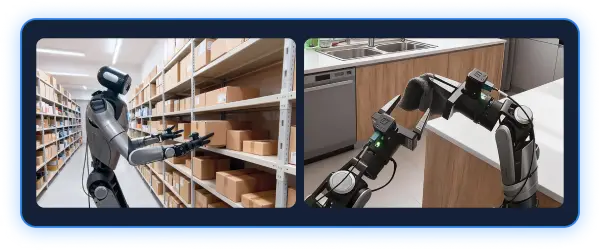
In current robot learning pipelines, egocentric data is increasingly treated as a source of structured physical-world supervision: it captures how an embodied agent observes objects, interacts with them, changes its viewpoint, and progresses through a task over time.
This makes egocentric human data particularly relevant to the scaling problem facing embodied foundation models. Robot demonstrations provide direct action supervision, but collecting them requires physical hardware, teleoperation infrastructure, and controlled execution. Human egocentric data offers a complementary source of large-scale real-world interaction experience that can be collected across substantially broader environments and task distributions. Recent research has demonstrated approaches for using this data in embodied pretraining and for converting human observations into robot-oriented action supervision.
The important question is therefore not simply “What does egocentric data mean?”, but “What information does egocentric data contain that an embodied model can actually learn from?”
What Does Egocentric Data Mean in Embodied AI?
In an embodied AI context, egocentric data is best defined as actor-centered, temporally continuous multimodal data that records physical interaction from the acting agent's viewpoint.
The distinction is important.
A conventional video dataset primarily describes visual content. An egocentric dataset can encode relationships between:
- the actor's viewpoint and scene geometry;
- hand position and manipulated objects;
- object state before and after an interaction;
- action sequences and their temporal dependencies;
- camera motion and physical movement;
- task progress and subtask transitions;
- human behavior under different environmental conditions.
Consequently, the useful unit of egocentric data is often not an individual frame, but an interaction episode.
For embodied foundation models, this temporal structure provides a basis for learning how visual observations evolve as an agent performs physical actions. Research on affordance learning, for example, has shown that egocentric videos can provide rich information about human-object interactions and object parts associated with particular actions.
Why Egocentric Data Matters for Embodied Foundation Models
The scaling bottleneck in embodied AI is not simply model capacity. It is the availability of sufficiently diverse real-world interaction data.
Large language and vision models benefit from enormous quantities of digital data. Physical intelligence has a different constraint: useful training data must reflect the dynamics of the physical world.
Robot trajectories are highly valuable because they contain direct action information. However, generating them at scale is expensive. Every new task, environment, object configuration, and robot embodiment can require additional physical data collection.
Egocentric human data provides another scaling axis.
Humans already interact with thousands of objects and environments without requiring dedicated robot hardware for every demonstration. A sufficiently structured egocentric pipeline can therefore capture large amounts of real-world interaction experience and use it as pretraining or auxiliary supervision.
A 2026 CVPR Workshop study on Always-on Egocentric data collection specifically frames human agents as scalable sources of real-world embodied interaction data, combining distributed capture with automated filtering and labeling to transform raw video into training data.
This changes the role of egocentric data from a video modality into a potential data-scaling layer for embodied AI.
The Core Information Encoded in Egocentric Data
The strongest value of egocentric data comes from the interaction signals embedded across time.
Hand-Object Interaction
For manipulation models, the relationship between the hand and an object is often more informative than object recognition alone.
An egocentric sequence can expose:
- approach direction;
- contact location;
- grasp configuration;
- object displacement;
- tool-object interaction;
- release conditions;
- changes in object state.
This makes the data useful for learning affordances and manipulation-relevant representations.
The model is not simply learning that a cup exists. It can learn that a cup has manipulable regions, that the hand approaches a particular region, and that a sequence of visual state changes follows the interaction.
Temporal Action Structure
Physical actions are inherently sequential.
Opening a drawer, for example, involves more than recognizing a drawer. The model needs to associate visual state, hand movement, contact, force-related consequences, and the resulting change in scene configuration.
Egocentric data naturally preserves this temporal relationship.
This is one reason why episode-level segmentation and temporal annotation can be more valuable than simply increasing the number of recorded frames.
Viewpoint-Action Correlation
Camera motion is itself informative.
As an embodied agent moves, its viewpoint changes according to body motion and task requirements. The resulting visual sequence therefore contains information about how perception changes as physical interaction takes place.
For robot learning, this creates a useful connection between visual state transitions and embodied movement, even when the original recording does not contain robot joint trajectories.
Real-World Variation
Egocentric data can capture variations that are difficult to reproduce systematically through scripted robot demonstrations:
- different human strategies;
- object appearance and geometry;
- workspace configurations;
- lighting conditions;
- clutter;
- interaction speeds;
- unexpected states;
- task deviations and recovery behavior.
Such variation is particularly relevant to generalization. A model trained only on highly standardized demonstrations can perform well within a narrow distribution while remaining fragile under environmental changes.
Egocentric Data Does Not Equal Robot Action Data
One of the most important technical distinctions is that human egocentric data and robot trajectory data are not interchangeable.
An egocentric recording may contain a human hand moving toward an object, but it does not inherently provide:
- robot joint states;
- robot end-effector coordinates;
- gripper commands;
- force/torque measurements;
- robot-specific kinematics;
- controller-level actions.
This creates an embodiment gap.
The human and robot may observe similar physical events, but their morphology, kinematics, action spaces, camera configurations, and control dynamics can differ substantially.
Consequently, a practical embodied AI pipeline may use egocentric data for broad representation or task learning and combine it with robot demonstrations for action grounding and embodiment-specific adaptation.
From Raw Egocentric Video to Training Supervision
For an embodied AI data infrastructure, the difficult part begins after capture.
Raw video must typically pass through multiple processing stages before it becomes useful training data.
Capture and Synchronization
Multimodal streams need a consistent temporal reference. Depending on the intended application, this can include RGB video, depth, IMU, hand pose, body pose, gaze, or other sensor streams.
Temporal synchronization becomes particularly important when downstream models need to associate a visual state with an action or physical event.
Episode Segmentation
Continuous recordings contain large amounts of irrelevant activity.
A production pipeline therefore needs to identify meaningful interaction windows and segment them into task-level or subtask-level episodes.
Quality Filtering
Not every recorded sequence is useful.
Filtering can remove samples affected by:
- excessive motion blur;
- severe occlusion;
- incomplete task execution;
- poor viewpoint;
- missing sensor streams;
- synchronization errors;
- ambiguous action boundaries;
- insufficient interaction visibility.
Recent egocentric collection research highlights automated filtering and preprocessing as key components in scaling these datasets rather than relying on raw recording volume alone.
Semantic and Action Annotation
Depending on the downstream objective, annotation can operate at multiple levels:
Video level: task and environment classification.
Temporal level: action and subtask boundaries.
Spatial level: hands, objects, contact regions, and affordances.
Trajectory level: motion or action representations derived from visual observations.
This layered annotation strategy allows the same raw capture to support different training objectives.
Data Quality Should Be Measured by Training Utility
For embodied AI, dataset quality cannot be reduced to resolution, duration, or annotation count.
A more useful evaluation framework considers whether the data contains the signals required by the target model.
Coverage
Does the dataset cover the task distribution, object diversity, environments, and execution strategies required for deployment?
Interaction Density
How much of the recorded sequence contains meaningful physical interaction?
Ten hours of continuous recording may contain considerably less useful supervision than a smaller dataset with high interaction density.
Temporal Integrity
Are actions correctly aligned with the visual states before, during, and after interaction?
Spatial Visibility
Are the hands, objects, contact regions, and relevant scene elements observable at the moments when they matter?
Cross-Embodiment Relevance
Can information extracted from human demonstrations be mapped to the robot's representation or used for pretraining?
Distribution Diversity
Does the dataset contain meaningful variation rather than repeated demonstrations under nearly identical conditions?
These criteria are particularly important when scaling data collection. A poorly specified pipeline can generate enormous quantities of footage while leaving the model's actual failure modes unresolved.
Egocentric Data and the Embodiment Gap
The most technically interesting use of egocentric data is therefore not direct imitation.
It is representation transfer across embodiments.
Human and robot agents differ physically, but many aspects of their interaction with the world are shared:
- object identity;
- object affordances;
- spatial relationships;
- task decomposition;
- action consequences;
- temporal dependencies;
- scene transitions.
Egocentric data can provide these higher-level physical priors, while robot-specific datasets can supply the final action grounding.
This suggests a layered training architecture:
Egocentric human data → physical and task representations → action-aware alignment → robot data → embodiment-specific policy learning
Designing an Egocentric Data Pipeline for Embodied AI
A scalable egocentric data program should therefore begin with the model's information requirements, not with a recording specification.
A typical pipeline can be structured around:
- Task and capability definition
- Data schema design
- Capture specification
- Multimodal synchronization
- Episode segmentation
- Automated quality filtering
- Privacy and provenance processing
- Semantic and action annotation
- Dataset validation
- Versioned delivery for training and evaluation
The pipeline should also remain connected to model evaluation.
If a policy repeatedly fails on object occlusion, the next collection cycle should increase relevant occlusion scenarios. If performance degrades when object geometry changes, the dataset should expand geometric diversity. If human data produces strong visual representations but weak action transfer, more robot-side action supervision may be required.
This creates a closed-loop data engine rather than a one-time data collection project.
For organizations building this type of infrastructure, the broader challenge is connecting collection, annotation, quality control, dataset management, and model development into one scalable system. Learn more about building an embodied AI data ecosystem and how different data sources can work together.
Where Egocentric Data Fits in a Larger Embodied AI Dataset
Egocentric data is most powerful when treated as one layer within a multimodal embodied AI dataset.
Depending on the model and application, a training ecosystem may combine:
- human egocentric demonstrations;
- robot trajectories;
- teleoperation data;
- RGB-D sequences;
- 3D spatial data;
- hand and body motion;
- language instructions;
- simulation trajectories;
- failure and recovery episodes;
- task-specific evaluation data.
Each source provides a different type of supervision.
Egocentric human data can contribute scale and diversity. Robot trajectories provide embodiment-specific action information. Simulation can expand controlled edge cases. Evaluation data reveals where the model remains weak.
The objective is therefore not to determine whether egocentric data is “better” than robot data. The more useful question is which part of the embodied learning problem each data source can solve most efficiently.
Organizations building or expanding embodied AI training pipelines can also explore available datasets and data resources through the BodenAI dataset collection.
Conclusion
The technical meaning of egocentric data in embodied AI is broader than first-person visual recording.
It is a mechanism for capturing temporally structured physical interaction from an actor-centered viewpoint, providing supervision about hand-object relationships, affordances, task progression, scene changes, and real-world variation.
Its strategic value comes from its potential to scale embodied experience beyond the expensive collection of robot trajectories. But raw human video is not equivalent to robot action data. The central engineering challenge is converting human-centered observations into reliable supervision that can complement robot-specific action data while accounting for the embodiment gap.
For embodied AI teams, the most effective egocentric data strategy is therefore not simply to collect more footage. It is to build a pipeline that connects data coverage, multimodal synchronization, temporal segmentation, quality filtering, annotation, action representation, and downstream model evaluation.