
Industry Insights
November 19, 2026
How Tactile Data Improves Offline Training for Robots
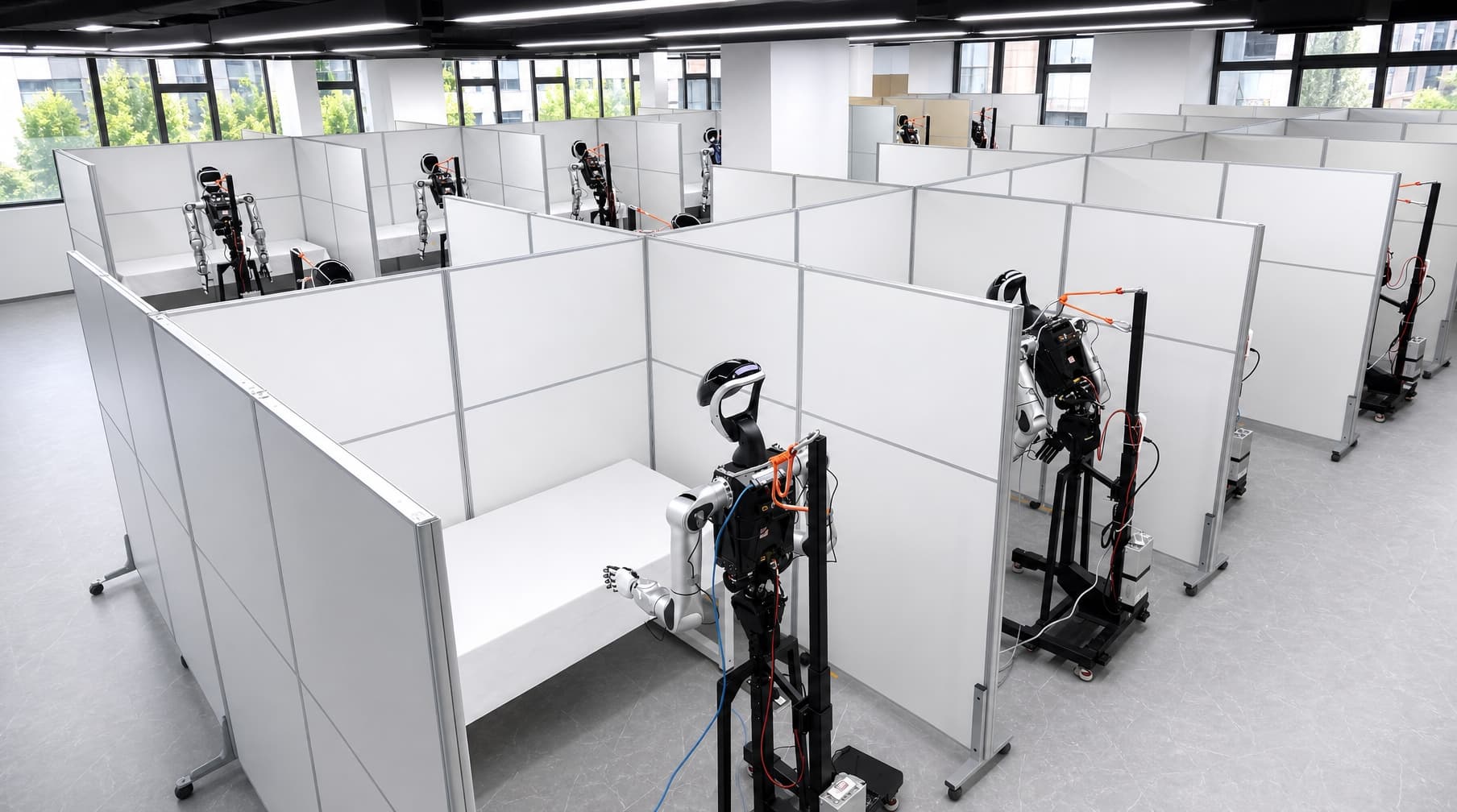
A robot can recognize an object, estimate its position, and plan how to reach it. But knowing what an object looks like is not the same as knowing how to handle it. When a robotic hand picks up a glass, for example, it needs to apply enough force to hold it securely without damaging it. If the glass starts to slip, the robot must recognize the change and adjust its grip before the object falls.
This is where tactile perception becomes important in embodied AI.
As robotics moves beyond controlled environments and into factories, laboratories, and everyday settings, robots need to learn from more than visual observations. They also need data that captures physical contact, force, movement, and the results of their actions. For developers working on manipulation systems and robotic foundation models, this makes tactile information an increasingly valuable part of an embodied AI robotics offline training dataset.
BodenAI helps robotics companies and research teams build the data infrastructure needed for Physical AI development. From real-world data acquisition to annotation and dataset management, our solutions support the preparation of complex robotics data for model training. If your team is developing tactile-aware robots or advanced manipulation capabilities, explore BodenAI's Physical AI data solutions.
Why Robots Need More Than Visual Data
Vision is essential for understanding the environment, but it has limitations when it comes to physical interaction.
A camera can show a robot where an object is and help it estimate its shape, size, and orientation. It cannot always tell the robot whether its fingers are making stable contact, whether the object is slipping, or whether the applied pressure is too high.
These details matter in tasks such as picking up fragile objects, handling tools, opening containers, and assembling components. In each case, successful manipulation depends on how the robot responds after physical contact begins.
Tactile sensors provide information that visual systems may miss. Depending on the sensor and application, they can capture contact location, pressure distribution, vibration, and changes in surface interaction. Combined with force measurements, this information gives a robot a better understanding of what is happening during manipulation.
For embodied AI models, the value of tactile data goes beyond detecting touch. It helps connect physical conditions with the actions a robot takes in response. A robot can learn not only that it has touched an object, but also how different contact conditions relate to grasp stability and task performance.
What Makes a Good Tactile Robotics Training Dataset?
Collecting tactile readings is only the beginning. For offline robot training, those readings need to be connected to the rest of the interaction.
Imagine a robotic hand attempting to pick up an unfamiliar object. The dataset should ideally capture what the robot sees before grasping, where its fingers make contact, how much force is applied, how its joints move, and whether the object remains stable.
When these signals are recorded together, researchers can reconstruct the interaction and study how the robot's actions affected the outcome.
A useful tactile-aware dataset may combine camera images, depth information, tactile sensor readings, force and torque measurements, joint states, end-effector poses, and action trajectories. Task annotations can provide additional context, such as whether an object was successfully grasped, whether contact was lost, or whether the robot needed to adjust its movement.
Synchronization is particularly important. If a tactile sensor detects a sudden change in pressure, researchers need to know what the robot was seeing and doing at that exact moment. Poor timestamp alignment can make it difficult to understand the relationship between sensory input and physical action.
The same applies to coordinate systems, missing sensor readings, and inconsistent annotation standards. These issues may seem like data engineering details, but they directly affect how useful a dataset is for training and evaluating robotics models.
For teams building large-scale robotics datasets, a reliable Physical AI data infrastructure helps bring these different data streams into a consistent workflow.
How Tactile Data Supports Offline Robot Training
Offline training gives researchers the opportunity to learn from previously collected robot interaction data. Instead of depending entirely on repeated physical experiments, developers can use existing trajectories to investigate how different policies might perform.
This is particularly useful for tactile-aware manipulation, where physical trials can be expensive and difficult to reproduce.
Consider a robot that repeatedly struggles to grasp objects with smooth surfaces. Its visual system may identify the objects correctly, but the robot may still fail because it does not apply enough grip force or respond quickly enough when slipping occurs.
If the training dataset includes tactile readings, force measurements, robot states, and action sequences, researchers can examine what happened during each attempt. They can compare successful and unsuccessful grasps, identify patterns associated with unstable contact, and investigate alternative manipulation strategies.
Failed interactions are especially valuable here. A dataset containing only successful demonstrations may not show the model what happens when contact is lost or an object moves unexpectedly. Recording these situations provides additional examples of the physical conditions a robot may encounter.
Offline datasets can also support policy evaluation. Researchers can compare how different models respond to similar interaction scenarios and examine whether their actions are associated with more stable contact or fewer unnecessary adjustments.
Of course, performance in an offline evaluation does not automatically guarantee success in the physical world. Models still need appropriate validation on real robots. However, well-organized interaction data provides a much stronger starting point for that process.
For teams exploring this approach, offline reinforcement learning for robotics is a closely related area worth considering.
From Physical Interactions to Scalable Training Data
As embodied AI systems become more sophisticated, the challenge is shifting from collecting individual demonstrations to building repeatable data production workflows.
A research team may begin with a single robotic hand and a limited set of grasping tasks. But as development progresses, the project may involve different robot embodiments, multiple sensor configurations, more object types, and increasingly complex environments.
Without a consistent data pipeline, managing these recordings becomes difficult. Different teams may use different annotation formats, sensor streams may not align, and valuable interaction data can become difficult to reuse across experiments.
BodenAI addresses this challenge through its Physical AI data infrastructure. Its BRIC data acquisition utilities, BASE annotation tools, and BLINK data management capabilities support different stages of the robotics data workflow.
The objective is to help teams move from raw recordings to structured, usable datasets without treating collection, annotation, and management as disconnected tasks.
BodenAI's broader robotics data portfolio includes more than 310,000 samples and over 10,000 hours of real-environment data. For projects involving tactile manipulation, the appropriate data collection and annotation requirements can be defined around the target robot, sensor setup, and training objectives.
This is relevant not only to commercial robotics developers but also to universities and research institutions working on robotic hands, manipulation policies, multimodal learning, and physical interaction.
CES 2027 and the Growing Focus on Physical AI
The development of more capable robots is also attracting increasing attention across the technology industry.
One important event to watch is CES (Consumer Electronics Show), one of the world's major technology exhibitions. CES brings together companies, startups, researchers, and industry professionals to explore developments across artificial intelligence, robotics, consumer technology, and industrial innovation.
CES 2027 is scheduled to take place from January 6 to 9, 2027, in Las Vegas, Nevada. Robotics and AI are among the technology areas featured at the event, making it an important opportunity to follow developments in intelligent machines and physical AI applications.
As humanoid robots, autonomous systems, and intelligent robotic manipulation attract greater industry interest, the conversation is moving beyond hardware capabilities alone. How robots learn from real-world environments is becoming just as important.
A more advanced robotic hand, for example, still needs sufficient interaction data to learn how to handle objects with different shapes, weights, and surface properties. Similarly, a humanoid robot needs more than visual recognition to perform reliable physical tasks.
This is why multimodal training data, including tactile and force-related information, deserves greater attention. It provides a way to represent the physical interactions that robots must eventually handle outside the laboratory.
For robotics manufacturers and research teams, the growing Physical AI ecosystem also creates a need for data infrastructure that can support larger, more diverse, and more reusable training datasets.
Preparing Robotics Data for the Next Stage of Embodied AI
Building capable embodied AI systems requires more than teaching robots to recognize their surroundings. They must also learn how to interact with the physical world and respond when those interactions do not go as expected.
Tactile data helps fill an important gap in robot learning by capturing what happens during contact. When aligned with visual observations, force measurements, robot states, and action trajectories, it provides a richer foundation for offline training and manipulation research.
For robotics companies, universities, and AI research teams, the next step is to build datasets that reflect real physical interactions and can be consistently used throughout the model development process.
BodenAI supports this work with data acquisition, annotation, and management infrastructure designed for Physical AI development.
Build better robotics datasets. Turn real-world interactions into training-ready data with BodenAI.
Contact BodenAI to discuss your Physical AI data requirements.