
Industry Insights
November 24, 2026
Massive Data for Embodied AI: From Data Scale to Robot Intelligence

Introduction: The Data Challenge Behind Embodied AI
Artificial intelligence has made significant progress through large-scale training. Language models learn from enormous collections of text, while vision models benefit from extensive image and video datasets. Embodied AI, however, faces a different challenge: teaching machines to understand and interact with the physical world.
A robot must do more than recognize an object or interpret an instruction. It needs to understand spatial relationships, coordinate movements, respond to physical contact, and adapt when an action produces an unexpected result. These capabilities require experience that connects perception with physical interaction.
This makes data availability one of the central challenges in developing general-purpose robots. Unlike internet-scale digital content, real-world robot interaction data is expensive and operationally difficult to collect, synchronize, annotate, and validate.
At BodenAI, we believe the next stage of embodied AI development depends on building scalable data infrastructure that turns physical-world experience into usable training resources. Through our Physical AI data infrastructure, we support data collection, curation, annotation, and management for robotics development.
Why Massive Data Matters for Robot Foundation Models
The development of robot foundation models is creating demand for training datasets that extend beyond individual tasks and controlled laboratory environments.
A robot trained to pick up a particular object may perform reliably under familiar conditions. However, changing the object's shape, surface, weight, or position can introduce new challenges. The model must recognize what has changed and adjust its behavior accordingly.
This is where large-scale data becomes important.
A broader collection of interaction experiences can expose models to different object configurations, movement patterns, environmental conditions, and task outcomes. Rather than learning a single sequence of actions, models have more opportunities to identify relationships between observations, actions, and physical consequences.
Recent robotics research also points toward the importance of building large-scale robot learning datasets that can support pretraining, evaluation, and further model development.
However, more data does not automatically produce better intelligence. Repeated demonstrations under nearly identical conditions may add volume without expanding the model's practical experience.
The more meaningful objective is to increase the amount of useful information available across different tasks, environments, and physical interactions.
Beyond Data Volume: Diversity and Cross-Embodiment Learning
One of the most important questions in massive-scale embodied AI is whether knowledge learned by one robot can be transferred to another.
Different robot embodiments have different physical characteristics. A humanoid robot, a dual-arm manipulation system, and a mobile robot may use different joint configurations, degrees of freedom, end-effectors, sensors, and control interfaces.
Even when two robots perform the same task, their action representations and physical constraints may be very different.
This creates a challenge for cross-embodiment learning.
To make data from different robotic systems more useful, datasets need structured representations of task instructions, observations, spatial coordinates, action sequences, robot states, and execution outcomes.
Where possible, shared representations can help models learn common patterns across different embodiments. At the same time, embodiment-specific information must be preserved so that the model can account for differences in hardware and control capabilities.
Data diversity also extends beyond robot hardware:
- Task diversity: Manipulation, navigation, object handling, assembly, and other physical activities.
- Environmental diversity: Homes, warehouses, laboratories, retail spaces, and industrial environments.
- Object diversity: Different shapes, materials, dimensions, textures, and physical properties.
- Behavioral diversity: Different action sequences, movement strategies, and recovery behaviors.
- Sensor diversity: Visual, depth, force, tactile, and other physical measurements.
For robotics researchers, this broader data coverage creates opportunities to investigate how models acquire transferable skills rather than simply memorizing task-specific demonstrations.
Multimodal Data: Connecting What Robots See With What They Do
Physical interaction cannot be fully understood through visual information alone.
Consider a robot picking up a flexible object. Camera images may show its position and shape, but they cannot always reveal whether the robot is applying excessive force, losing its grip, or experiencing unexpected resistance.
This is why multimodal data is becoming increasingly important for embodied AI.
A comprehensive dataset may combine:
- RGB and depth images for visual perception.
- Language instructions for task interpretation.
- Joint positions and velocities for movement representation.
- End-effector poses and trajectories for action learning.
- Force and torque measurements for physical interaction.
- Tactile signals for detecting contact, slip, and surface characteristics.
IEEE Spectrum's coverage of tactile robotics research highlights an important limitation of vision-centered learning: delicate manipulation often requires information about contact, friction, and force that visual observations alone cannot provide.
For example, a robot handling a small object may need to continuously adjust its grip based on tactile feedback. This requires the model to connect visual observations, physical contact, and movement decisions.
However, collecting multiple data modalities is only part of the challenge. They must also be synchronized and organized into a consistent representation.
Accurate timestamps, coordinate systems, sensor calibration, and action-state alignment are essential for ensuring that training data reflects what actually happened during a robot interaction.
Our egocentric data research for Physical AI explores another important source of physical-world information: first-person data that captures how humans perceive and interact with their surroundings.
Scaling Data Collection Through Real-World Experience and Simulation
The physical nature of robotics makes data collection fundamentally different from gathering digital training material.
Real-world collection often requires operating robots, preparing environments, configuring sensors, recording demonstrations, and maintaining consistent data quality. Teleoperation provides a practical way to generate demonstrations for tasks that are difficult to automate, while human egocentric recordings can offer additional information about everyday object interactions.
Simulation provides another route to expanding data coverage.
Researchers can generate different object configurations, environmental conditions, and task scenarios without repeatedly arranging physical experiments. Simulation is particularly useful for exploring rare situations and testing robot behavior under controlled conditions.
However, simulated data and physical-world data are not interchangeable.
Differences in contact dynamics, friction, object deformation, sensor characteristics, and environmental uncertainty can create gaps between simulated performance and real-world execution.
A more effective development strategy combines both sources:
Real-world data provides evidence of actual physical interactions and execution outcomes.
Simulation data expands scenario coverage and supports repeatable experimentation.
Physical validation tests whether the behaviors learned during training remain effective under real operating conditions.
The objective is to establish a continuous relationship between simulation, training, and real-world feedback rather than treating data collection as a one-time process.
From Massive Datasets to a Continuous Learning Loop
The value of massive embodied AI data becomes clearer when it is connected to model evaluation and continuous improvement.
Suppose a robot successfully completes a picking task in most conditions but repeatedly fails when handling slippery objects. Simply adding more general picking demonstrations may not address the underlying problem.
Instead, developers need to identify the failure patterns, examine the available sensor and action data, and collect additional demonstrations that address the specific capability gap.
This creates a continuous data feedback loop:
Real-World Interaction → Data Collection → Curation and Annotation → Model Training → Physical Evaluation → Failure Analysis → Targeted Data Collection
Each stage contributes to the next.
Evaluation results help identify weaknesses. Those weaknesses guide new data collection. Better-curated datasets then support further training and validation.
For research institutions, this process provides a structured way to study learning efficiency, generalization, and the relationship between dataset composition and model performance.
For robot manufacturers, it offers a practical foundation for improving task reliability as their systems encounter new objects, environments, and operating conditions.
Building Scalable Data Infrastructure for Physical AI
As embodied AI projects expand, managing data through disconnected collection and annotation workflows becomes increasingly difficult.
A scalable data infrastructure needs to support the complete data lifecycle:
- Data collection: Capturing real-world robot interactions and multimodal sensor streams.
- Data curation: Identifying incomplete, redundant, corrupted, or low-quality samples.
- Data annotation: Structuring tasks, actions, objects, trajectories, and interaction events.
- Data management: Maintaining dataset versions, metadata, consistency, and traceability.
- Data validation: Checking synchronization, coverage, and suitability for specific training and evaluation requirements.
At BodenAI, we bring these capabilities together through a unified Physical AI data infrastructure.
Our production-grade robotics datasets include more than 310,000 samples and 10,000 hours of real-environment data, covering multiple robot platforms, environments, and tasks. Our infrastructure combines data acquisition utilities, annotation tools, and data management capabilities to support robotics teams throughout the development process.
For organizations developing humanoid robots, manipulation systems, and other Physical AI applications, this provides a foundation for moving beyond isolated data collection projects toward repeatable, scalable data operations.
Explore our Physical AI data infrastructure to learn more about how structured data operations support robot learning and development.
Meet BodenAI at CES 2027
As embodied AI moves from research environments toward broader commercial applications, collaboration between robotics developers, AI researchers, and data infrastructure providers is becoming increasingly important.
BodenAI will be attending CES 2027, taking place January 6–9, 2027, in Las Vegas.
As a major global technology event, CES brings together innovators, technology companies, researchers, and industry professionals to explore emerging technologies and new opportunities for collaboration.
We look forward to connecting with robotics manufacturers, Physical AI developers, and academic research teams to discuss the growing importance of real-world data, multimodal datasets, and scalable data infrastructure.
If you are exploring new approaches to robot training, data collection, or embodied AI development, we welcome the opportunity to exchange ideas.
Conclusion
The progress of embodied AI will depend not only on more powerful models but also on the quality and breadth of physical-world experience available to train them.
Massive datasets can expand learning opportunities, but their real value comes from combining scale with diversity, multimodal alignment, cross-embodiment compatibility, and continuous validation.
For robotics manufacturers and research institutions, building this data foundation is becoming an essential part of developing more adaptable and capable intelligent systems.
At BodenAI, we are focused on making physical-world data more accessible, structured, and scalable for the next generation of Physical AI.
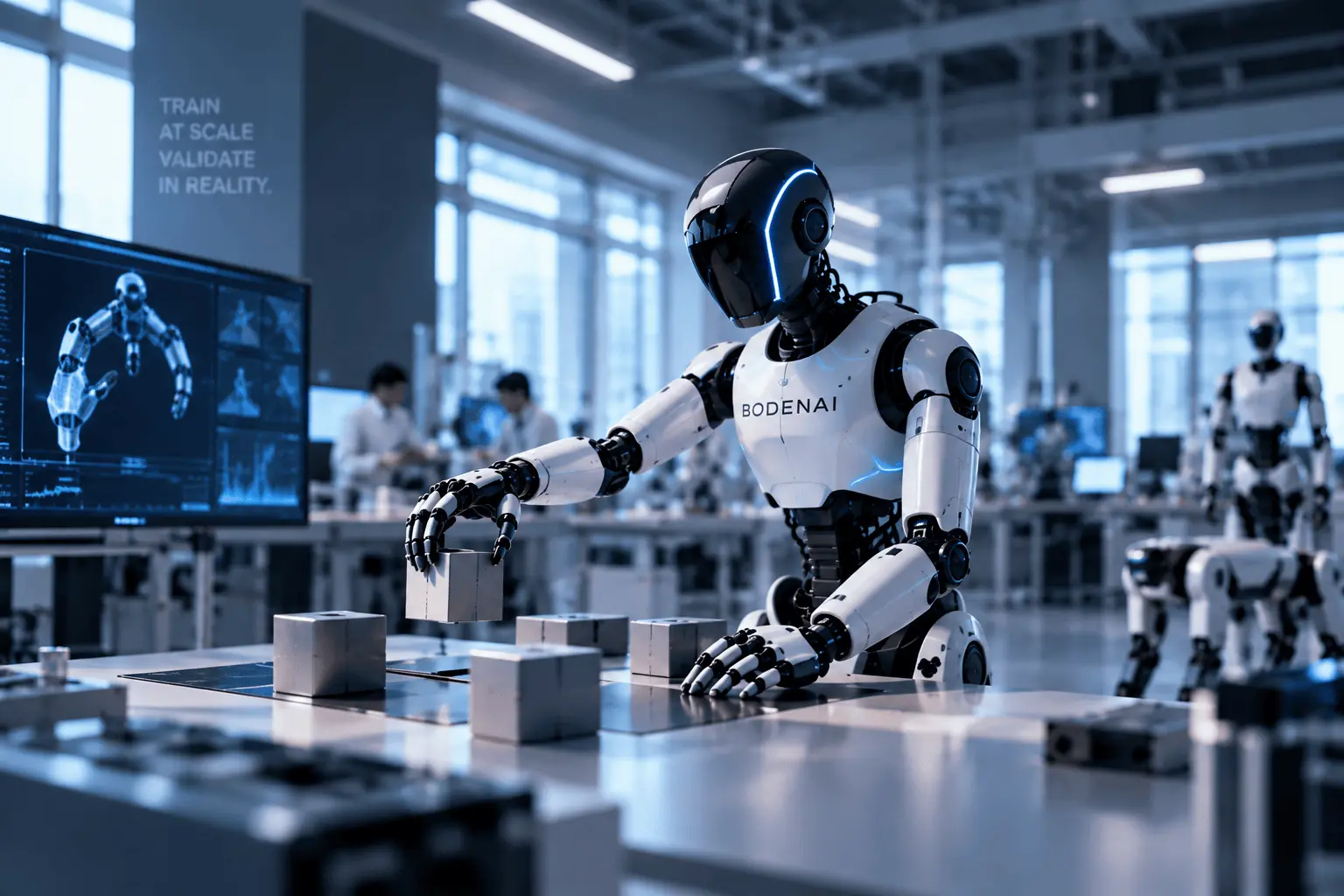
Train at Scale. Validate in Reality.
Explore our Physical AI data solutions or contact our team to discuss your project.