
Industry Insights
November 27, 2026
Physical AI Data Collection: What It Takes to Train Robots for the Real World
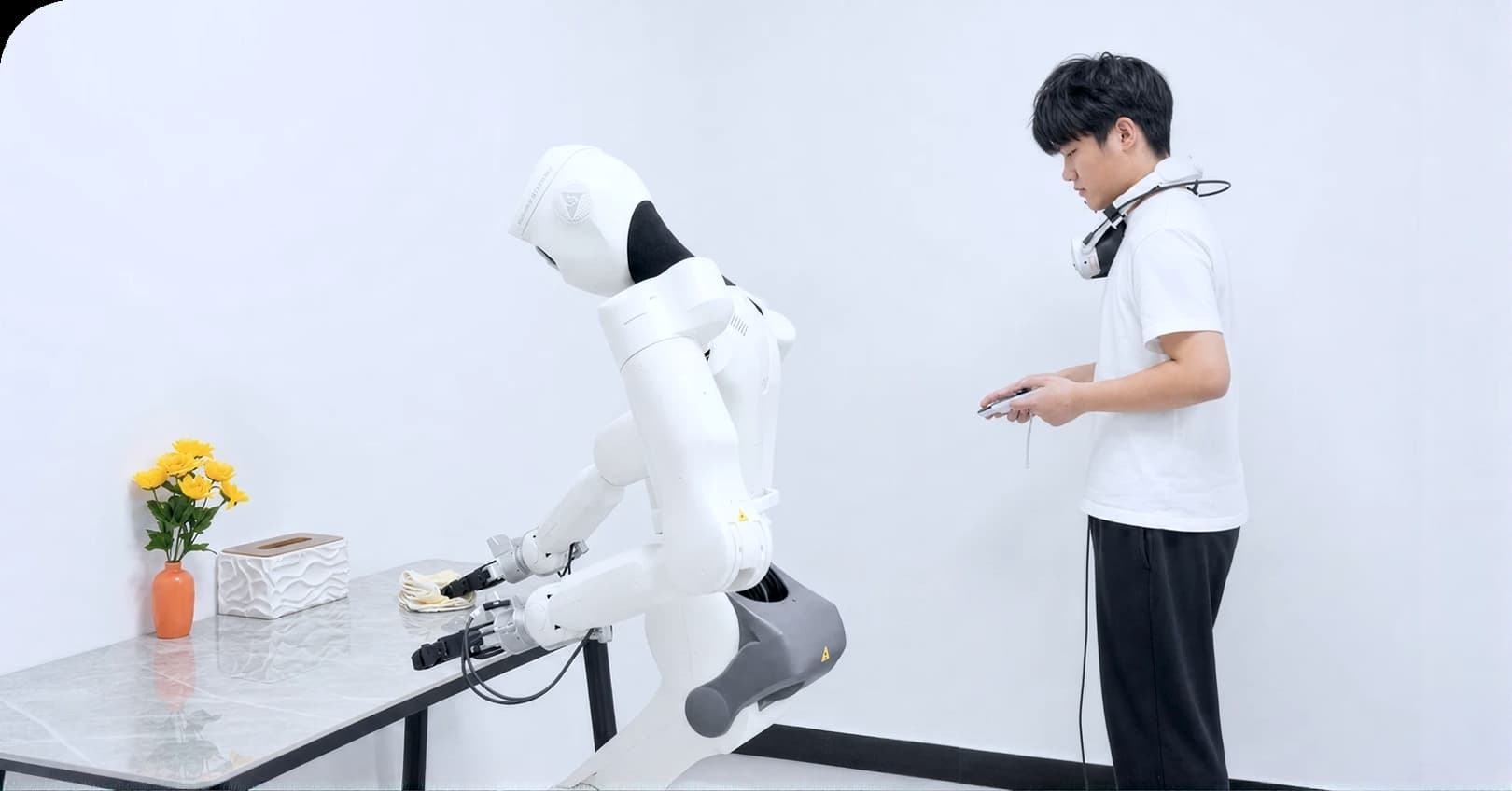
As robots become more capable of performing tasks outside controlled laboratory environments, the demand for reliable real-world training data is growing rapidly. A robot that can recognize an object or follow a predefined instruction still needs to understand how to interact with its surroundings, respond to unexpected changes, and adjust its actions based on physical feedback.
This is where Physical AI data collection becomes essential.
Unlike traditional AI datasets, which often consist of images, text, or video clips, Physical AI training data needs to capture the relationship between perception, movement, and physical interaction. Every grasp, movement, collision, and task outcome can provide useful information for developing more capable robotic systems.
For robotics manufacturers, AI developers, and research institutions, the challenge is no longer simply collecting more data. It is building a reliable process for capturing the right experiences and turning them into training-ready datasets.
At BodenAI, we work on this challenge through an integrated data infrastructure that connects physical-world data collection, curation, annotation, and management. Our solutions help robotics teams work with diverse robot embodiments and multimodal data while making the transition from raw recordings to structured training datasets more manageable. If you are developing robotic foundation models or scaling an embodied AI research project, explore our Physical AI data solutions to see how our infrastructure supports the entire data lifecycle.
Why Physical AI Needs a Different Approach to Data Collection
A conventional computer vision dataset might contain thousands of images showing different objects from different angles. For a robotic system, however, recognizing an object is only one part of the problem.
The robot also needs to understand where the object is located, how it can approach it, how much force to apply, and what happens after contact. These details cannot always be learned from isolated images.
Take a robotic arm picking up a cup as an example. The camera records the cup's position, while the robot's joint sensors capture the movement of the arm. Force or tactile sensors may register the moment the gripper makes contact. The robot's action sequence then provides information about how the grasp was executed.
Together, these signals describe an interaction rather than simply a scene.
This is why Physical AI data collection often involves multiple sources of information, including RGB video, depth data, point clouds, LiDAR, joint states, motion trajectories, force signals, and tactile feedback. The specific combination depends on the robot, the task, and the model being developed.
The important part is making sure these data streams remain connected. If sensor recordings are poorly synchronized or robot states are missing, even a large collection of recordings may be difficult to use effectively.
Collecting Data That Reflects Real-World Conditions
One of the biggest challenges in robotics development is that real-world environments are rarely as predictable as laboratory setups.
An object may be placed in a different position, lighting conditions may change, or an obstacle may appear where the robot does not expect it. A model trained on a narrow range of demonstrations may perform well during testing but struggle when these conditions change.
For this reason, a good data collection strategy should focus on meaningful variation.
In industrial environments, this could mean collecting demonstrations of assembly, sorting, material handling, and component placement across different workstation configurations. For household robots, the focus may be on everyday activities such as picking up utensils, organizing objects, or handling items with different shapes and materials.
The same principle applies to academic research. A university developing a general-purpose manipulation model may need data from multiple tasks, object categories, robot configurations, and environments to investigate how well a model transfers what it has learned.
At BodenAI, our Physical AI dataset portfolio covers a range of real-world environments and robotic applications, including household, industrial, pharmacy, office, and retail scenarios. This variety helps research and development teams work with different task conditions rather than relying entirely on repetitive demonstrations.
Why Synchronization Matters More Than Data Volume
Collecting multimodal data introduces another challenge: making sure everything recorded actually describes the same moment in time.
Imagine a robot reaching for an object. Its camera records the movement at one frequency, joint positions are updated at another, and tactile sensors may generate signals at a different rate. If these streams are not properly aligned, it becomes difficult to determine exactly what the robot saw when it performed a particular action.
This can create problems during training, especially for models that need to learn precise relationships between observations and actions.
A reliable collection workflow therefore needs to account for timestamps, sensor calibration, coordinate transformations, and robot-state alignment. These details may seem like technical implementation issues, but they directly affect whether collected data can be used to reconstruct and learn from physical interactions.
The challenge becomes even more significant when a project involves multiple robot platforms. Different embodiments may have different joint configurations, sensor placements, and communication protocols. Without a consistent acquisition process, integrating data from these systems can require considerable engineering effort.
Our work at BodenAI focuses on making this process more structured. Through BRIC for data acquisition, BASE for multimodal annotation, and BLINK for data management, we connect different stages of data production instead of treating collection and processing as separate activities.
Teleoperation and the Value of Human Demonstrations
For many robotics applications, teleoperation offers a practical way to collect demonstrations of complex physical tasks.
Rather than programming every movement in advance, a human operator controls the robot remotely while the system records its observations, movements, and interactions. These demonstrations can then be used to train robotic policies through imitation learning and other learning approaches.
However, the value of a demonstration depends on more than whether the task was completed successfully.
A useful recording should preserve the full sequence of actions, including the initial environment state, the robot's movement, changes during interaction, and the final outcome. Failed attempts and recovery behaviors may also provide valuable training information.
For example, a robot learning to grasp objects may benefit from seeing not only successful grasps but also situations where an object slips, moves unexpectedly, or requires a different approach.
This is particularly important when developing models intended to handle unfamiliar situations. A dataset containing only clean, successful demonstrations may not adequately represent the complexity of real-world operation.
From Raw Recordings to Useful Training Datasets
Data collection is only the beginning. Once recordings have been captured, they need to be organized, checked, and prepared for their intended training tasks.
This process often involves reviewing incomplete recordings, checking synchronization, organizing trajectories, adding annotations, and validating whether the data meets the requirements of a particular model.
The level of annotation also depends on the task. A vision model may need object-level labels, while a robotic manipulation policy may require action sequences, robot states, contact information, and temporal relationships.
A well-designed workflow should preserve the original data while making processed versions easy to trace and reuse. This becomes increasingly important as datasets grow and multiple research or engineering teams work with the same data.
At BodenAI, we bring these capabilities together through a connected data infrastructure. BRIC supports data acquisition, BASE provides tools for multimodal annotation, and BLINK helps manage data throughout the production process. This allows teams to focus less on coordinating disconnected tools and more on developing the datasets their models actually need.
For a closer look at how these capabilities fit together, read our article on Physical AI Data Infrastructure: Building the Data Engine for Embodied Intelligence.
Making Data Collection an Ongoing Part of Robot Development
A robotics dataset should not be treated as a finished asset that never changes. As a model is trained and tested, its limitations often reveal where additional data is needed.
A robot may perform well when picking up familiar objects but struggle with unfamiliar shapes. Another may complete a task in a structured environment but fail when the surrounding layout changes. These situations provide useful clues about which experiences are missing from the training data.
Instead of collecting more demonstrations without a clear direction, development teams can use evaluation results to guide their next collection efforts. They might focus on new object configurations, longer task sequences, different interaction conditions, or recovery behaviors.
Over time, this creates a continuous cycle: real-world interactions generate data, data supports model training, and model evaluation reveals new collection requirements.
As discussed in our article, The Future of Physical AI Robotics Starts With Better Data, this connection between data quality and model development is becoming increasingly important as robotics moves toward more complex real-world applications.
Building a Stronger Data Foundation for Physical AI
The progress of Physical AI will depend not only on advances in robot hardware and model architectures, but also on how effectively robots learn from physical experience.
Collecting useful data requires careful planning around task diversity, sensor synchronization, robot embodiments, and data quality. Just as importantly, the collection process needs to remain connected to annotation, dataset management, and model evaluation.
For robotics manufacturers, AI developers, and research institutions, investing in a structured data workflow can make it easier to scale experiments, improve dataset coverage, and support ongoing model development.
At BodenAI, we are building the data infrastructure to make this process more connected and scalable, helping teams turn real-world physical interactions into valuable training resources.
Train at Scale. Validate in Reality.
Explore our Physical AI data capabilities or talk to our team about your data collection and robotics training requirements.