
Industry Insights
November 27, 2026
Real-World vs. Simulated AI Training Environments
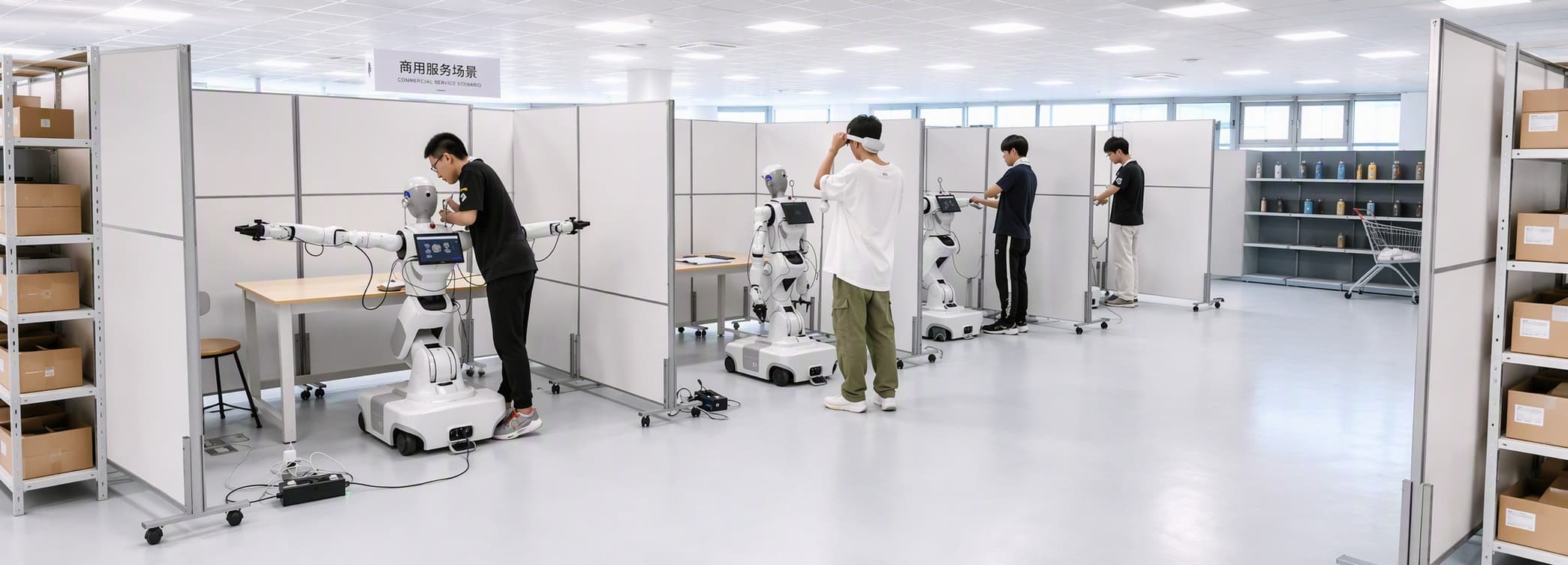
A robot can learn to pick up a cup in a laboratory, but can it do the same when the cup is placed near the edge of a crowded table, partially hidden behind another object, or made from a material it has never encountered before?
This is where the choice of training environment starts to matter.
For Physical AI, learning to perform a task under controlled conditions is only part of the challenge. Robots also need to recognize changes in their surroundings, respond to unexpected situations, and carry out actions in environments that are rarely as predictable as a training setup.
As embodied AI moves closer to real-world deployment, robotics developers and research teams are paying more attention to how training environments are designed, what experiences they provide, and how well those experiences reflect actual operating conditions.
At BodenAI, we help Physical AI teams build this foundation through real-world robotics data, structured datasets, and scalable data infrastructure. Whether you are developing a humanoid robot, a manipulation system, or an embodied foundation model, explore BodenAI's Physical AI data solutions to see how high-quality data can support the entire model development process.
What Makes a Good AI Training Environment?
An AI training environment is more than the physical space or virtual scene in which a robot performs a task. It includes the objects, surroundings, sensor inputs, interaction conditions, and feedback that shape how the model learns.
For example, a robot trained to organize items in a warehouse needs experience with different shelf arrangements, object sizes, packaging materials, and picking conditions. A humanoid robot learning household tasks faces a different set of challenges, from handling kitchen utensils to opening doors and moving around furniture.
These environments influence what a model learns to recognize and how it connects perception with action.
A useful training environment should therefore reflect the tasks a robot is expected to perform while exposing it to enough variation to prevent it from becoming dependent on a single set of conditions.
The goal is not to make every training scenario complicated. It is to give the model meaningful experience that prepares it for the situations it may encounter outside the training environment.
Real-World and Simulated Training Environments
Most robotics development relies on two complementary approaches: physical environments and virtual simulations.
Real-world environments give robots direct experience with physical interactions. They reveal details that are difficult to reproduce perfectly in a virtual setting, including friction, contact forces, material properties, sensor noise, and the unpredictable movement of objects.
For instance, a robotic arm learning to grasp objects needs more than visual information about their shape. It also needs to learn how objects respond when touched, lifted, pushed, or handled from different angles.
However, collecting physical interaction data takes time and resources. Each experiment requires access to hardware, suitable facilities, and a reliable data collection process. Reproducing unusual or difficult scenarios can be particularly challenging.
Simulation offers a more controlled alternative. Developers can change object positions, adjust scene layouts, test different robot configurations, and repeat experiments without rebuilding a physical setup each time.
This makes simulated environments useful for expanding scenario coverage and testing specific behaviors. The limitation is that virtual conditions do not always match physical reality. A robot that performs well in simulation may still struggle with real-world contact dynamics, sensor differences, or unexpected environmental changes.
For this reason, the strongest training workflows do not treat simulation and real-world data as competing approaches. They use each where it adds the most value.
Why Environment Diversity Matters for Robot Learning
One common problem in robotics development is that a model becomes familiar with its training setup but fails to adapt when something changes.
A robot may successfully grasp objects when they are placed in predictable positions, yet struggle when the same objects are rotated, partially occluded, or surrounded by clutter.
This is often a problem of limited training experience.
To improve generalization, training environments need to cover more than one version of a task. Developers should consider variations in object properties, spatial layouts, lighting, camera viewpoints, robot configurations, and interaction sequences.
Task diversity matters too. A robot that learns to move an object from one location to another may still struggle when the task requires several connected actions, such as locating an object, grasping it, repositioning it, and placing it accurately.
These differences are important because Physical AI models must learn relationships between what they perceive, what they do, and what happens afterward.
More training samples do not automatically solve this problem. What matters is whether the data represents the range of situations the model needs to handle.
The Role of Real-World Data in Building Better Training Environments
Even carefully designed simulations cannot capture every detail of physical interaction. This is why real-world robotics data remains essential.
A useful training dataset may contain synchronized video, robot joint states, movement trajectories, task instructions, object positions, and other sensor measurements. Together, these signals help models understand not only what an environment looks like, but also how interactions unfold over time.
For robotics teams, the challenge is making this data consistent and useful across different tasks and robot embodiments.
BodenAI approaches this through a connected data infrastructure that covers data collection, curation, annotation, and management. Its robotics data portfolio includes real-world activities across household, retail, pharmacy, and industrial environments, giving development teams access to a broader range of physical interactions.
You can explore BodenAI's Physical AI data infrastructure to learn more about how multimodal data is organized and prepared for robotics development.
The quality of this process matters. Poorly synchronized sensor streams or incomplete interaction records can make it difficult for a model to learn the relationship between an action and its physical outcome.
Connecting Training Environments with Real-World Performance
Training should not be treated as a process that ends once a model reaches a target performance level in a controlled setting.
A more practical approach is to use real-world testing to identify where the model still struggles, then bring those findings back into the next training cycle.
For example, a manipulation model may perform consistently in simulation but repeatedly fail when handling objects with unusual shapes. Developers can use these observations to identify missing scenarios, collect additional demonstrations, and adjust the training data distribution.
The process becomes a continuous cycle:
Environment Design → Data Collection → Model Training → Real-World Evaluation → Data Improvement
This feedback loop helps teams move beyond simply increasing dataset volume. It gives them a way to identify which additional experiences are most likely to improve model performance.
For a deeper look at how dataset coverage influences robotics development, read Physical AI Training Data: 7 Things Commercial-Grade Robotics Datasets Need in 2026.
Building Training Environments for the Next Generation of Physical AI
As robots take on more complex tasks in factories, warehouses, homes, and other everyday settings, their training environments will need to reflect the variety of the physical world.
The challenge is not simply creating more virtual scenes or collecting more demonstrations. It is connecting realistic environments with diverse, well-structured data and a reliable process for evaluating what models have actually learned.
For robotics manufacturers, AI developers, and research institutions, this means treating environment design and data infrastructure as closely connected parts of model development.
At BodenAI, we focus on helping Physical AI teams turn real-world interactions into structured, scalable training resources. From robotics datasets and multimodal data processing to data management and model development support, our goal is to make high-quality physical-world experience more accessible.
Because ultimately, a robot's ability to work in the real world depends on more than what it has been taught. It also depends on the environments it has experienced along the way.
Train at Scale. Validate in Reality.
Explore BodenAI and build a stronger data foundation for your Physical AI development.